By Louis ‘Barok‘ C. Biraogo
The echoes of police boots on the ground, the crackling of gates torn from their hinges, and the sharp clamor of unbridled force reverberate through the hallowed grounds of the Kingdom of Jesus Christ compound in Davao City. What was supposed to be a decisive strike against a fugitive, Apollo Quiboloy, instead unveiled a grotesque spectacle of excessive force, leaving a community in shock and a nation questioning its sense of justice.
Former President Rodrigo Duterte’s condemnation of this operation as “excessive and unnecessary” strikes at the heart of a deeply troubling narrative. This was not merely a tactical blunder; it was a stark display of what can only be described as governmental overreach. Duterte’s remarks, delivered with his characteristic brusqueness, urged the nation to reflect on whether the Marcos administration would continue this unsettling trend of heavy-handed tactics.
This incident, occurring at the KOJC Dome and on school premises, has not only raised eyebrows but has also caused a significant uproar. The notion that law enforcement, clad in battle gear and armed to the teeth, could breach a place of worship with ladders and heavy machinery, betrays a fundamental misjudgment of both the law and decency. As police forces, including the Special Action Force (SAF) and Criminal Investigation and Detection Group (CIDG), stormed through compounds in Davao City and beyond, they left behind more than just damage; they left behind questions that need urgent answers.
A Theater of Excess
The operation, far from the sterile execution of justice, transformed into a circus of chaos. The police, following what they claimed were standard operational procedures, proceeded with an arrest warrant but without a valid search warrant. This move, as pointed out by Quiboloy’s lawyer Israelito Torreon and former presidential spokesperson Harry Roque, was not only legally dubious but fundamentally flawed. An arrest warrant alone does not grant carte blanche to dismantle property and ransack premises without due cause.
Witnesses recount the surreal scene of authorities scaling walls with ladders, clashing with followers, and searching through the Jose Maria Colleges, the dormitories, and even Quiboloy’s hangar with a disregard for legal protocol. The police’s claim of following the rules rings hollow against the backdrop of injuries sustained by church workers and the palpable tension that pervaded the air.
The Supreme Court’s upholding of the charges against Quiboloy is an essential step towards justice. However, the manner in which the police carried out the operation brings into sharp focus the broader issue of police conduct and its repercussions on public trust. The overkill approach not only defies common sense but also undermines the very foundations of due process and human rights.
Duterte’s Plea and the Call for Change
Duterte’s critique of the current administration’s handling of Quiboloy’s case is both poignant and necessary. His challenge to the Marcos government to avoid the “lack of self-restraint” and to uphold constitutional rights resonates deeply in a society where the line between justice and tyranny is increasingly blurred. The call for moderation, for a balance that respects the rights of individuals even when they stand accused, is not just a plea for fairness—it is a demand for the preservation of our humanity.
But what is the way forward? How do we ensure that such excesses do not become the norm? First, there must be a thorough review of police procedures to ensure they are not only lawful but also humane. The implementation of stringent checks and balances, oversight mechanisms, and training in human rights must be prioritized.
Secondly, there must be a concerted effort to rebuild trust between the people and the police force. This requires transparency, accountability, and a genuine commitment to serving and protecting all citizens, regardless of their status or affiliations. The current incident, while shocking, presents an opportunity for reform—a chance to redefine what it means to uphold the law in a democratic society.
A Call for Justice, Peace, and Harmony
As the dust settles over the KOJC compound, and as the cries for justice grow louder, let us not lose sight of the broader picture. This is not just about a failed raid or a disgraced leader. It is about the soul of a nation, about whether we will allow fear and force to dictate our future or whether we will choose the path of justice, peace, and harmony.
The Supreme Court’s decisive action against Quiboloy and its stance against the excesses of the past must be a clarion call for all public servants: your actions will be scrutinized, and justice will prevail. Let this be a moment where we, as a nation, recommit ourselves to the ideals of justice and humanity. For in the end, it is not the force of arms, but the strength of our collective conscience that will determine the true measure of our society.

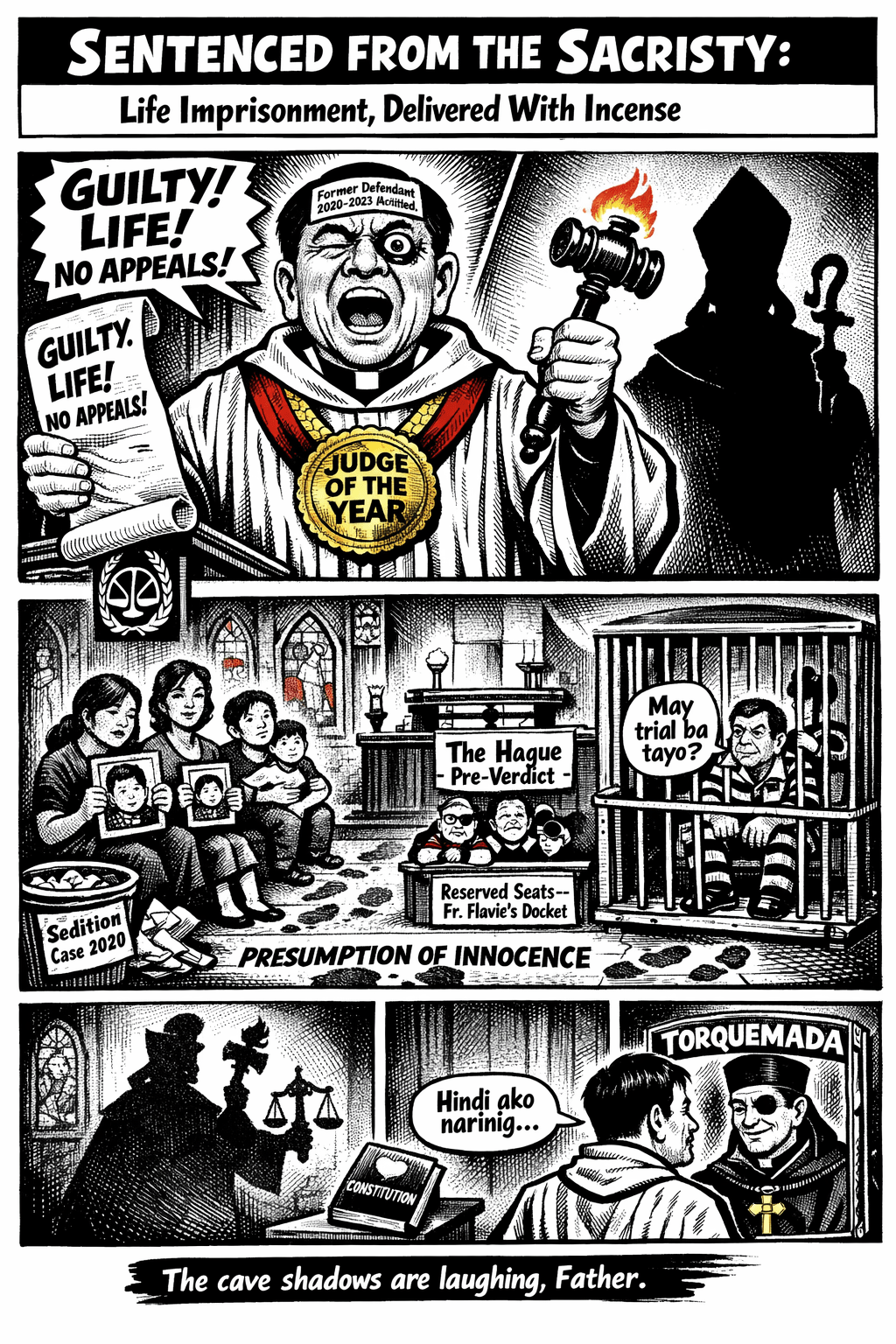
- Priest Sentences Duterte to Life – No Trial Needed
- Flood Control or Flood of Corruption? Marcos’ Infrastructure Probe Hits a Curious Pause

- Tau Gamma Phi: Where Brotherhood Means Beating You to Death and Blaming the Rogue Chapter
- Procurement Mafia’s Latest Hit Job: Why Herbosa Can’t Catch a Break
- Abra-Cadabra! 4.3 Million Poor Filipinos Just Vanished – Thanks, DHSUD Math





 KWEBA ni BAROK
Leave a comment