
By Louis ‘Barok‘ C. Biraogo
The South China Sea (SCS) dispute has reached a critical juncture, with Beijing and Manila appearing poised on the precipice of conflict. The stakes in this geopolitical chess game are higher than ever, particularly as both nations ramp up their military posturing. The recent decision by the Philippine government to increase the U.S. military presence in its archipelago has provoked a stern response from China, exacerbating an already volatile situation.
China’s interest in the South China Sea is well-documented. The region is not only a critical maritime route but also a treasure trove of natural resources, including vast reserves of oil and gas. As Mingjiang Li, a prominent scholar specializing in Chinese foreign policy, international relations, and security studies, highlights in her article, “Reconciling Assertiveness and Cooperation? China’s Changing Approach to the South China Sea Dispute,” Beijing’s strategy has been one of cautious assertiveness. While China’s civilian foreign policy community predominantly advocates for maintaining the status quo or enhancing cooperation, there is an undeniable drive to secure and protect energy resources crucial for China’s strategic interests in East Asia.
The imposition of a fishing ban by Beijing, justified under the guise of promoting sustainable fishing and conserving marine ecology, is seen by many, particularly in Manila, as an infringement on the Philippines’ sovereign rights. This ban, which extends to areas within the West Philippine Sea, directly affects Filipino fishermen and escalates tensions further. The Philippine response, characterized by an increased U.S. military presence and stern warnings from President Bongbong R. Marcos, signifies a significant shift in the region’s dynamics.
At the heart of this conflict lies a fundamental question: Can we afford to go to war?
The strategy adopted by the Philippines, though provocative, can be viewed through multiple lenses. From a legal standpoint, the Philippines has the 2016 ruling by the Permanent Court of Arbitration in The Hague on its side, which invalidated China’s expansive claims in the South China Sea. Upholding this ruling is crucial for the international rule of law, as it reinforces the primacy of legal resolutions over might-makes-right approaches.
Morally and ethically, the Philippines’ strategy to resist Chinese encroachments aligns with the principles of sovereignty and self-determination. It is a stand against bullying by a more powerful neighbor and a fight for the rights of ordinary Filipinos whose livelihoods depend on access to these contested waters.
Practically, however, the situation demands a nuanced approach. While bolstering defense capabilities is a necessary deterrent, the Philippines must avoid actions that could spiral into full-scale conflict. The costs of war—human, economic, and environmental—are too great to bear.
Diplomacy, therefore, remains the best course of action. The Philippines should continue to engage in multilateral forums, seeking the support of ASEAN and other international partners to pressure China into adhering to international law. Confidence-building measures, such as joint development agreements and maritime cooperation initiatives, could also pave the way for de-escalation.
For the Filipino people, the best outcome is one that secures peace and stability, allowing for economic development and the protection of their rights and resources. This means a steadfast commitment to diplomacy and the rule of law, backed by a credible defense posture.
In conclusion, while the Philippines’ strategy of increased military presence and international legal advocacy is understandable and justified, the path forward must prioritize peace. The world cannot afford another war, especially in a region as economically and strategically vital as the South China Sea. Let us hope that cooler heads prevail, and that diplomacy, not conflict, shapes the future of this disputed region.

- Russian Oil or Bust: Manila Begs Putin While Our Fuel Light Blinks Red

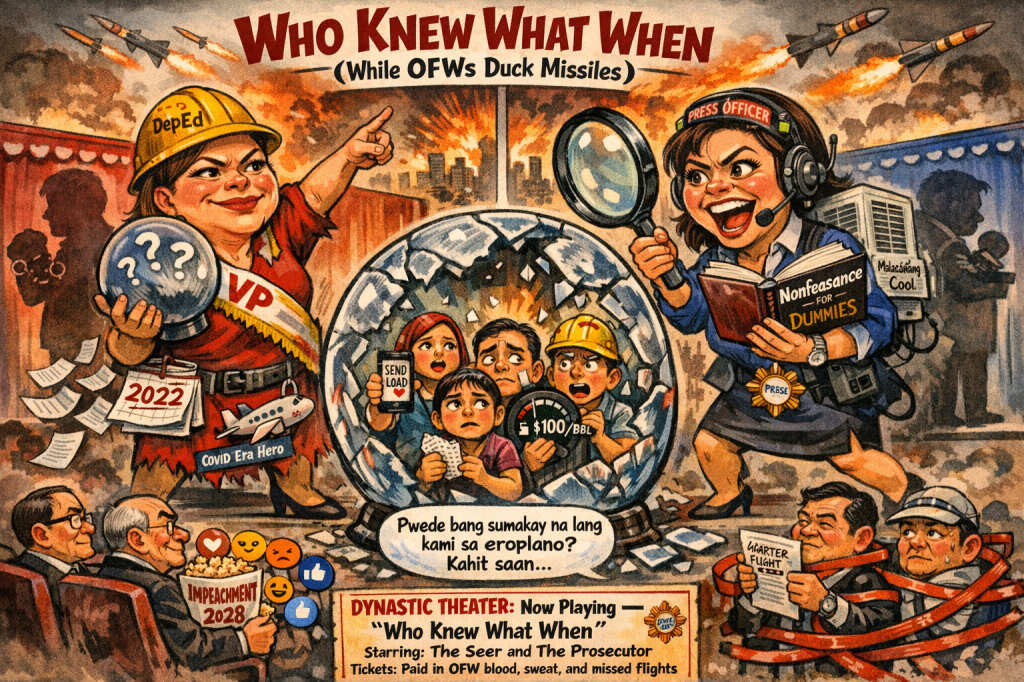
- “I Warned You in 2022!” — Sara’s Crystal Ball Meets Claire’s Nonfeasance Roast
- 200 Mega Boxes of Lies: Remulla Unleashes AI to Sort the Swamp (Before It Swallows Us All)
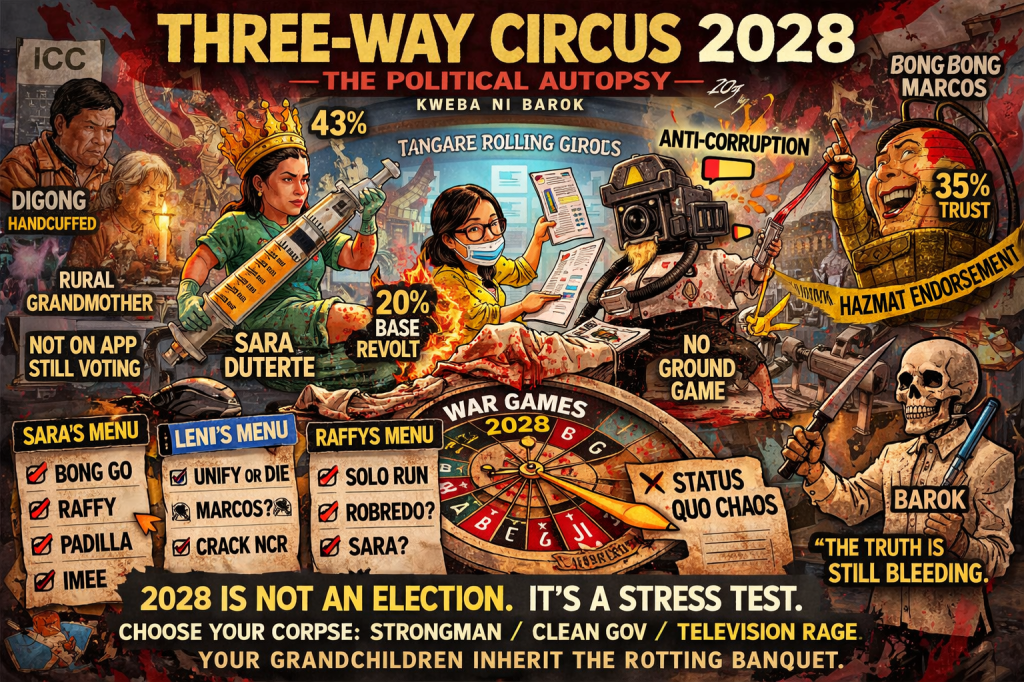
- Three-Way Circus 2028: Sara, Leni & Tulfo Walk Into a Poll…
- Marcoleta’s Zero Donations Lie: How a Televised Confession Became “Legal Complications”






 KWEBA ni BAROK
Leave a comment