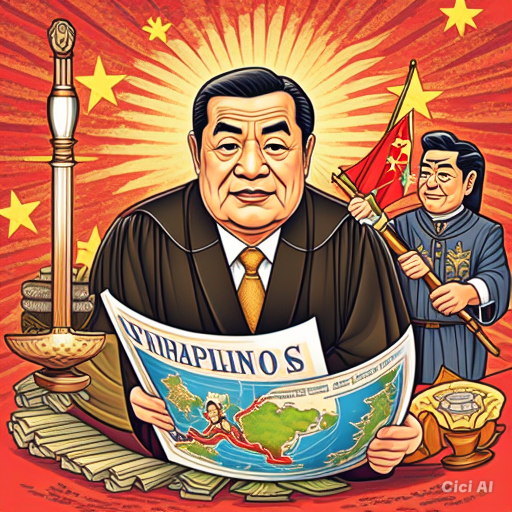
By Louis ‘Barok‘ C. Biraogo
In a notable turn of events, retired Supreme Court Senior Associate Justice Antonio Carpio has urged the Philippines to file another arbitration case against China, following Beijing’s objection to Manila’s claim for an extended continental shelf in the West Philippine Sea. Carpio’s assertions are rooted in the Philippines’ past victory in the 2016 Arbitral Award, which invalidated China’s extensive nine-dash-line claim in the South China Sea.
Historical Context of Carpio’s Assertions
To understand Carpio’s stance, it’s crucial to revisit the 2016 Arbitral Award. The Permanent Court of Arbitration (PCA) ruled in favor of the Philippines, stating that China’s claims to historic rights within the nine-dash line had no legal basis under the United Nations Convention on the Law of the Sea (UNCLOS). This landmark decision marked a significant victory for the Philippines, strengthening its claims over parts of the South China Sea.
Carpio now proposes leveraging this precedent to challenge China’s recent objections. The UNCLOS framework, particularly Article 76, allows coastal states to claim an extended continental shelf up to 350 nautical miles from their baselines, provided they can substantiate it with scientific data.
Framing Carpio’s Claims in History
- Legal Precedent: The 2016 Arbitral Award already invalidated China’s nine-dash line. Any subsequent claims by China based on this discredited line can be contested as non-compliant with international law.
- UNCLOS Provisions: Under UNCLOS, particularly Article 76, the Philippines has the right to claim an extended continental shelf if it meets the criteria. China’s objections lack legal foundation as the areas in question are beyond 350 nautical miles from China’s baselines.
- Geographical Evidence: Carpio emphasizes that the areas claimed by China are geographically too distant to fall under its jurisdiction. This physical reality undermines China’s assertion of sovereign rights over these areas.
- International Tribunal Decisions: The PCA’s 2016 ruling is a robust legal document that can be cited to reinforce the Philippines’ claims. The tribunal’s findings are based on comprehensive interpretations of international law, which strengthens the Philippines’ legal position.
Counter-Arguments in Favor of China
- Historic Rights: China often invokes historical rights and evidence to justify its claims. Despite the 2016 ruling, China continues to assert that historical usage and discovery of the South China Sea support its territorial claims.
- Sovereignty and Jurisdiction: China argues that its sovereignty and jurisdiction in the South China Sea are non-negotiable. This stance is supported by various Chinese laws and declarations, though these have not been recognized internationally.
- Rejection of Arbitration Ruling: China rejected the 2016 arbitration ruling, arguing that the PCA lacked jurisdiction. Beijing maintains that bilateral negotiations, not international arbitration, are the appropriate avenue for resolving disputes.
Unbiased Assessment
Legal and Geopolitical Advantage: The Philippines holds a significant advantage from a legal perspective. The 2016 Arbitral Award is a powerful precedent, and UNCLOS provisions clearly support the Philippines’ right to claim an extended continental shelf. The geographical realities further bolster the Philippines’ position.
However, geopolitically, China’s influence and refusal to recognize international rulings complicate enforcement. China’s strategic presence and military capabilities in the region pose substantial challenges to the Philippines.
Barok’s Verdict
From a purely legal standpoint, the Philippines stands on firmer ground. The 2016 Arbitral Award, UNCLOS provisions, and geographical facts collectively favor the Philippines’ claims. Nevertheless, enforcing these rights in the face of China’s geopolitical power remains a daunting task.
Recommendations
For the Philippines:
- File a New Arbitration Case: Proceed with filing a new case under UNCLOS to reinforce its claims and seek a formal ruling on the extended continental shelf.
- Diplomatic Engagement: Continue diplomatic efforts to garner international support. Engaging allies and international bodies can apply pressure on China to adhere to international norms.
- Strengthen Defense: Enhance maritime defense capabilities to protect sovereign rights and deter aggression in contested areas.
For China:
- Engage in Bilateral Talks: Show willingness to negotiate bilaterally with the Philippines, potentially finding mutually acceptable solutions without escalating tensions.
- Adhere to International Law: Consider the long-term benefits of adhering to international legal standards, which could enhance China’s global standing and foster regional stability.
- Regional Cooperation: Promote cooperative regional frameworks that address common concerns like resource management and maritime security.
In conclusion, while the legal advantage lies with the Philippines, the geopolitical landscape necessitates a blend of legal action, diplomacy, and strategic defense to effectively assert and protect national interests in the West Philippine Sea.

- Andres Heralds DoJ’s Transformative Justice

- Sailing to New Horizons: PEZA Sets Ambitious PHP250-B Approval Target for 2024

- Panga’s Bold Vision: The Paradigm Shift of Iwahig Mega Economic Zone

- Panga’s Pragmatic Approach to Sino-Philippine Investments

- The Shadow Over Manila

- Shadow of the Red Notice: Remulla hunts down Teves

- Frozen Enigma: NBI Bacolod’s Tussle with Darkness

- Quiboloy’s Supreme Court Shenanigans: A Pathetic Attempt to Dodge Justice

- RP’s cunundrum: A pawn in the SCS geopolitical chessboard

- Macapagal Leads: Navigating Relocation Challenges








 KWEBA ni BAROK
Leave a comment