
By Louis ‘Barok‘ C. Biraogo
THE recent decision by the Court of Appeals (CA) to affirm the dismissal of Mexico town Mayor Teddy Tumang and three other former municipal officials underscores the persistent issue of corruption and abuse of procurement laws in the Philippines. This case highlights the systemic flaws in the procurement process, which public officials often exploit, leading to significant legal and ethical consequences.
At the Epicenter: A Closer Look at the Controversy
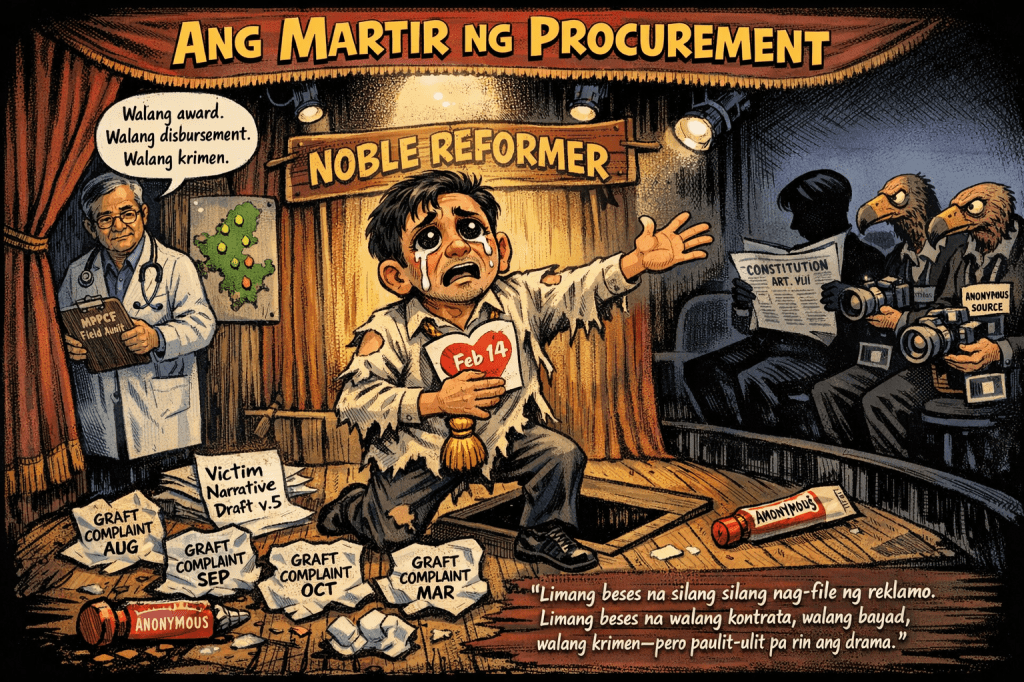
The controversy dates back to 2008 when Mayor Teddy Tumang, along with former municipal engineer and bids and awards committee (BAC) vice chairman Jesus Punzalan, former administrative officer Luz Bondoc, and former municipal accountant Perlita Lagman, were involved in the procurement of base course and other construction materials. These materials were acquired for road repairs from Buyu Trading and Construction through the shopping method, an alternative procurement mode.
Shopping Mode of Procurement: As per Republic Act No. 9184, known as the Government Procurement Reform Act, shopping is a method of procurement that can be used for readily available off-the-shelf goods or ordinary/regular office supplies and equipment not available in the Procurement Service involving an amount not exceeding P50,000. For ordinary office supplies, the threshold is P250,000.
The Field Investigation Bureau of the Office of the Deputy Ombudsman for Luzon (FIB-OMB) alleged that the procurement did not follow the competitive bidding process as required. The FIB-OMB found that the BAC’s resolution authorizing the procurement through shopping was issued after the procurement activities had already taken place, and the funds were disbursed without the necessary approval from the municipal accountant. Additionally, the supplier’s capacity was questionable, as established by the Commission on Audit (COA).
The Case Against: Legal Charges and Allegations
The legal issues revolve around the following points:
- Violation of Republic Act No. 9184: The procurement should have been conducted through competitive bidding instead of shopping. This violation points to non-compliance with the principles of transparency and competitiveness in government procurement.
- Grave Misconduct: The officials were found administratively liable for grave misconduct. Grave misconduct is defined under the Civil Service Commission (CSC) rules as a transgression of some established and definite rule of action, a forbidden act, a dereliction of duty, or an unlawful behavior that implies wrongful intent and not mere error of judgment.
- Violation of COA Rules: The transactions were executed without the required signatures and certifications from the municipal accountant, violating Presidential Decree Nos. 1445 and 344, and the Local Government Code of 1991.
Court of Appeals Decision
The CA, in a 32-page decision penned by Associate Justice Myra Garcia-Fernandez, upheld the Ombudsman’s rulings against the accused. The decision emphasized that:
- Non-Compliance with RA 9184: The shopping method was improperly applied as the conditions for its use were not met. The procurement was not for ordinary or regular office supplies and the amount exceeded the allowable threshold for shopping.
- Condonation Doctrine: The defense of condonation doctrine, which Tumang invoked, was rejected. The Supreme Court had abandoned this doctrine in the case of Carpio-Morales v. Court of Appeals and Binay Jr., stating that it was no longer applicable to cases filed after April 12, 2016. Since the complaints against Tumang were filed after this date, the condonation doctrine could not be used as a defense.
Beyond the Verdict: Collateral Legal Impacts
Aside from administrative penalties, the accused could face various criminal and civil liabilities under Philippine laws:
- Criminal Charges: The officials can be prosecuted under Republic Act No. 3019, or the Anti-Graft and Corrupt Practices Act, for acts such as entering into contracts disadvantageous to the government and causing undue injury to any party, including the government. Violation of this act can lead to imprisonment, perpetual disqualification from holding public office, and confiscation or forfeiture of properties derived from the unlawful act. In the case of Sistoza v. Desierto (G.R. No. 144294, July 9, 2003), the Supreme Court upheld the criminal liability of a public official for entering into contracts without the necessary public bidding, underscoring the importance of adhering to procurement laws.
- Civil Liability: The officials can also face civil cases for damages under the Civil Code of the Philippines. Article 27 of the Civil Code allows a person to recover damages from any public officer or employee who directly or indirectly causes them damage due to their unlawful actions.
- Forfeiture Proceedings: Under Republic Act No. 1379, properties unlawfully acquired by public officials can be forfeited in favor of the state. This act provides a mechanism for the government to recover properties deemed to have been unlawfully acquired by public officials.
Counterpoint Refuted: Addressing Opposing Views
The accused argued that the use of the shopping method was justified to promote efficiency and meet urgent needs. They also claimed that their actions were mere errors in judgment rather than grave misconduct. Tumang further argued for the application of the condonation doctrine.
The CA rejected these arguments, stating:
- The conditions for shopping were not met as there was no unforeseen contingency.
- The procurement involved construction materials, not regular office supplies.
- The condonation doctrine was not applicable as the Supreme Court had already abandoned it for cases filed after April 12, 2016.
Legal Recourse: Options Available to the Accused
The accused have the option to appeal the CA’s decision to the Supreme Court. They could file a petition for review on certiorari, challenging the CA’s decision on the grounds of errors of law or grave abuse of discretion.
Prospects for Victory: Assessing the Outcome
The likelihood of success for the accused in the Supreme Court appears slim given the clear violations of RA 9184 and the abandonment of the condonation doctrine. The CA’s decision is well-founded on existing laws and precedents, making it difficult for the accused to overturn the ruling.
Recommendations
- Strict Adherence to Procurement Laws: Government officials must adhere strictly to procurement laws to ensure transparency and competitiveness.
- Training and Awareness: Regular training and awareness programs should be conducted for public officials to understand procurement laws and ethical standards.
- Strengthening Oversight Mechanisms: Strengthen oversight mechanisms to detect and prevent procurement irregularities early on.
- Encourage Whistleblowing: Encourage whistleblowing by providing protection and incentives for those who expose corruption.
This case serves as a reminder of the importance of adhering to legal and ethical standards in public procurement and the severe consequences of failing to do so.

- “Forthwith” to Farce: How the Senate is Killing Impeachment—And Why Enrile’s Right (Even If You Can’t Trust Him)

- “HINDI AKO NAG-RESIGN!”

- “I’m calling you from my new Globe SIM. Send load!”

- “Mahiya Naman Kayo!” Marcos’ Anti-Corruption Vow Faces a Flood of Doubt

- “Meow, I’m calling you from my new Globe SIM!”

- “No Special Jail for Crooks!” Boying Remulla Slams VIP Perks for Flood Scammers

- “PLUNDER IS OVERRATED”? TRY AGAIN — IT’S A CALCULATED KILL SHOT

- “Several Lifetimes,” Said Fajardo — Translation: “I’m Not Spending Even One More Day on This Circus”

- “Shimenet”: The Term That Broke the Internet and the Budget

- “We Did Not Yield”: Marcos’s Stand and the Soul of Filipino Sovereignty




 KWEBA ni BAROK
Leave a comment