By Louis ‘Barok‘ C Biraogo — September 1, 2024
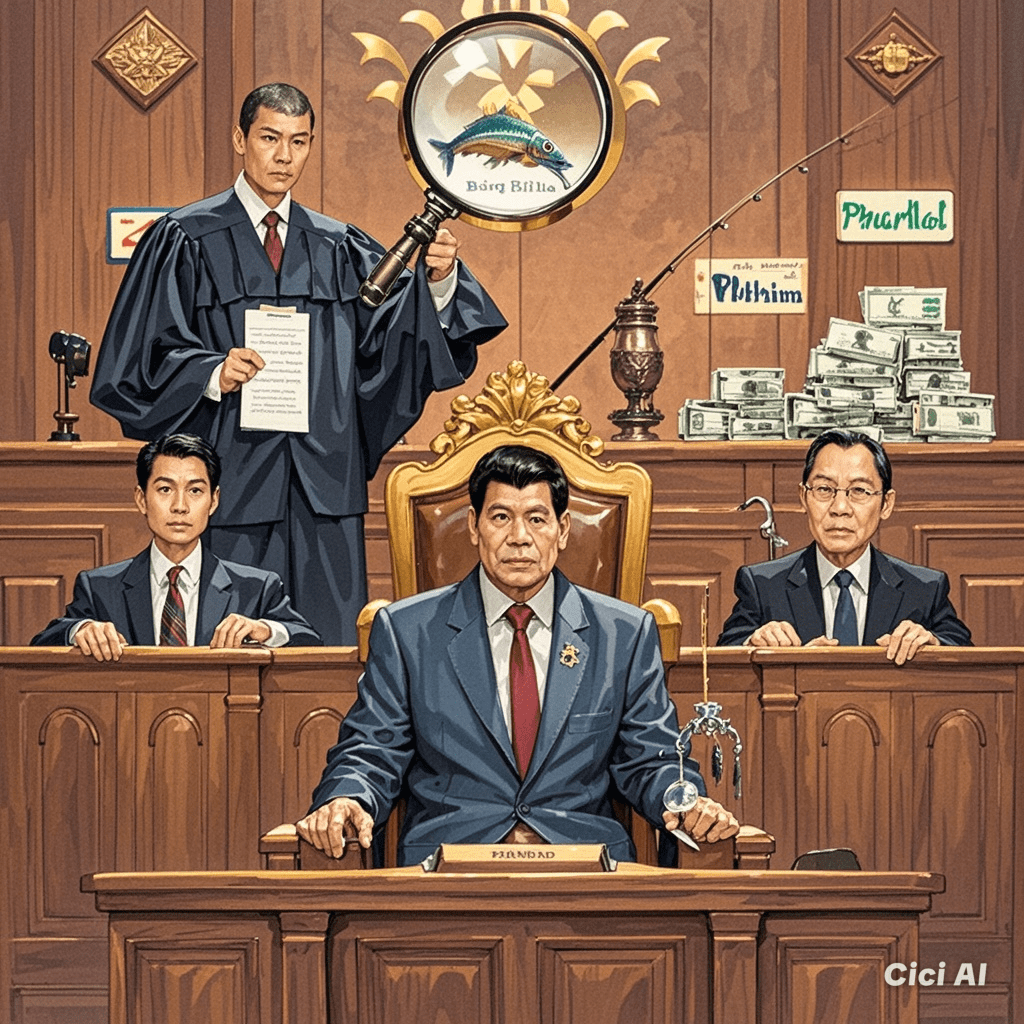
IMAGINE you’re trying to clean up a mess, but you only manage to catch the little bits of debris while the big, messy stuff remains untouched. That’s the situation in the Philippines, where the Pharmally case, a scandal involving the government’s pandemic response, has finally reached the Sandiganbayan. Former Health Secretary Francisco Duque III and former Budget Undersecretary Christopher Lloyd Lao face graft charges, but as former Senator Richard Gordon, the relentless crusader behind this investigation, warns, the “big fish” – the true orchestrators of this alleged corruption – remain at large. The fight for justice in the Philippines is a long and winding road, and it seems the real battle is just beginning.
Behind the Scandal: A Closer Look at the Pharmally Case
The Pharmally scandal began as the world reeled from the unprecedented impact of the COVID-19 pandemic. With hospitals overwhelmed and health workers crying out for protective equipment, the Philippine government found itself in a desperate race to secure medical supplies. Enter Pharmally, a fledgling company with a meager paid-up capital of P625,000, which somehow managed to secure P11 billion in government contracts to supply these critical resources.
The transactions, facilitated by the Department of Health (DOH) and the Procurement Service-Department of Budget and Management (PS-DBM), quickly raised eyebrows. How could a company with no track record and such limited financial capacity win the largest pandemic-related procurement deal? Senator Richard Gordon, then-chair of the Senate Blue Ribbon Committee, was determined to find out.
Gordon’s committee uncovered a tangled web of alleged irregularities, including the questionable transfer of P41.5 billion in public funds from the DOH to the PS-DBM, which then facilitated the procurement from Pharmally. As the hearings progressed, the finger of suspicion pointed higher and higher up the chain of command, eventually landing squarely on the shoulders of the then-President Rodrigo Duterte.
The Case Against Lao and Duque
The first to fall were the alleged foot soldiers of this grand scheme—former Health Secretary Francisco Duque III and former Budget Undersecretary Christopher Lloyd Lao. Both men now face graft charges in the Sandiganbayan, the Philippines’ anti-graft court.
According to the Office of the Ombudsman, Duque and Lao are culpable for failing to adhere to proper procurement protocols when engaging the PS-DBM, an act which the Ombudsman deemed as “grave misconduct” and “conduct prejudicial to the best interest of the service.” Their failure to comply with Republic Act No. 3019, the Anti-Graft and Corrupt Practices Act, specifically Section 3(e), which prohibits public officials from causing undue injury to any party, including the government, by giving any private party unwarranted benefits, advantage, or preference, forms the basis of the charges against them.
Moreover, the Supreme Court has long held that public officials who act with gross negligence or flagrant disregard for legal procedures can be held liable for graft, as established in the case of Sancho vs. Ombudsman (G.R. No. 155770, July 26, 2007). The indictment against Duque and Lao reflects this principle, as their actions during the procurement process allegedly allowed Pharmally to benefit improperly at the expense of the public.
Duque, for his part, has vigorously denied the accusations, arguing that his decisions were made in good faith and under the pressure of a national emergency. Yet, the specter of accountability looms large, as the Sandiganbayan now holds the power to determine whether Duque’s justification holds water or whether it will crumble under legal scrutiny.
The Elusive Big Fish
But Gordon’s sights are set beyond the likes of Duque and Lao. He has been unyielding in his belief that the true masterminds of this scandal remain at large—powerful figures who orchestrated the scheme from behind the scenes. Chief among them, according to Gordon, is none other than former President Rodrigo Duterte.
Duterte’s involvement, if proven, would not only be a damning indictment of his administration but also a seismic event in the landscape of Philippine politics. Gordon has asserted that Duterte, in his capacity as president, facilitated the transfer of billions of pesos to Pharmally through the PS-DBM, an act that could be construed as a gross misuse of presidential power under the 1987 Constitution. Article VII, Section 17 of the Constitution vests the President with the duty to ensure that all laws are faithfully executed, a duty that Gordon argues Duterte blatantly disregarded.
The potential legal implications for Duterte are profound. Under the 1987 Philippine Constitution, a sitting president enjoys immunity from suit, but this immunity does not extend beyond his term of office. Thus, Duterte could potentially face charges now that he is out of office. The Supreme Court has set a precedent in Estrada vs. Sandiganbayan (G.R. No. 148560, 2001), where former President Joseph Estrada was prosecuted and convicted for plunder after his presidency, affirming that no one is above the law.
The case against Duterte would likely revolve around whether there is sufficient evidence to establish his direct involvement in the Pharmally scheme. Republic Act No. 3019, The Anti-Graft and Corrupt Practices Act, as well as Republic Act No. 6713, the Code of Conduct and Ethical Standards for Public Officials and Employees, in conjunction with Republic Act No. 7080, the Plunder Law, would be critical in prosecuting such a case. The Plunder Law defines plunder as the accumulation of ill-gotten wealth amounting to at least P50 million through a combination or series of overt criminal acts. If evidence suggests that Duterte orchestrated or benefitted from the Pharmally contracts, he could face charges under this law.
The Legal Maze Ahead
As the Pharmally case progresses through the courts, several legal steps must be navigated to ensnare the “big fish” Gordon seeks. The first hurdle is the question of evidence—prosecutors must build an airtight case that clearly links the higher-ups to the irregularities uncovered by the Senate probe. Without concrete evidence, any attempt to prosecute figures like Duterte would be futile.
Moreover, the potential for political interference looms large. The judiciary in the Philippines has, at times, been accused of being susceptible to pressure from powerful figures. Ensuring a fair trial, free from external influence, is critical to the credibility of any legal proceedings against high-profile individuals.
The Case Examined: Weighing the Evidence
The case against Duque and Lao is likely to proceed with some measure of success, given the evidence of procedural lapses and the legal precedents that support the charges. However, the same cannot be said for the pursuit of the alleged masterminds. The lack of direct evidence linking Duterte or other high-ranking officials to the procurement irregularities may prove to be an insurmountable obstacle. The prosecution would need to rely heavily on testimonies from insiders—individuals like Duque, who, as Gordon suggests, could turn state witness. But even this strategy is fraught with uncertainty, as turning witnesses may not suffice to build a compelling case against such powerful figures.
The Supreme Court, in cases like Sereno vs. Republic (G.R. No. 237428, May 11, 2018), has underscored the need for clear and convincing evidence in cases of this nature. Without it, any charges against Duterte or other “big fish” may fail to hold in court.
Recommendations
To the Ombudsman: Pursue the investigation with rigor and impartiality. Expand the scope to include the big fish and ensure that the rule of law prevails.
To the Sandiganbayan: Administer justice without fear or favor, upholding the integrity of the judicial process.
To the Senate: Continue your oversight functions, ensuring that this case does not end with mere foot soldiers.
To the public: Stay vigilant. Demand transparency and accountability at every stage of this case.
Conclusion
The Pharmally case is a storm cloud hanging over the Philippines, a reminder that the fight against corruption is a constant battle. But just as a storm can clear the air, this case has the potential to be a turning point, a moment when we choose to confront our demons and emerge stronger. Richard Gordon’s relentless pursuit of justice is proof that hope can bloom even in the darkest times, a testament to the power of persistence and the belief that even in the darkest of times, the light of truth can prevail.
- ₱75 Million Heist: Cops Gone Full Bandit

- ₱6.7-Trillion Temptation: The Great Pork Zombie Revival and the “Collegial” Vote-Buying Circus

- ₱1.9 Billion for 382 Units and a Rooftop Pool: Poverty Solved, Next Problem Please

- ₱1.35 Trillion for Education: Bigger Budget, Same Old Thieves’ Banquet

- ₱1 Billion Congressional Seat? Sorry, Sold Out Na Raw — Si Bello Raw Ang Hindi Bumili

- “We Will Take Care of It”: Bersamin’s P52-Billion Love Letter to Corruption

- “Skewed Narrative”? More Like Skewered Taxpayers!

- “Scared to Sign Vouchers” Is Now Official GDP Policy – Welcome to the Philippines’ Permanent Paralysis Economy
- “Robbed by Restitution?” Curlee Discaya’s Tears Over Returning What He Never Earned

- “No Pressure” Luistro? The House Pork Bazaar Exposed

 KWEBA ni BAROK
Leave a comment