By Louis ‘Barok‘ C. Biraogo — September 10, 2024
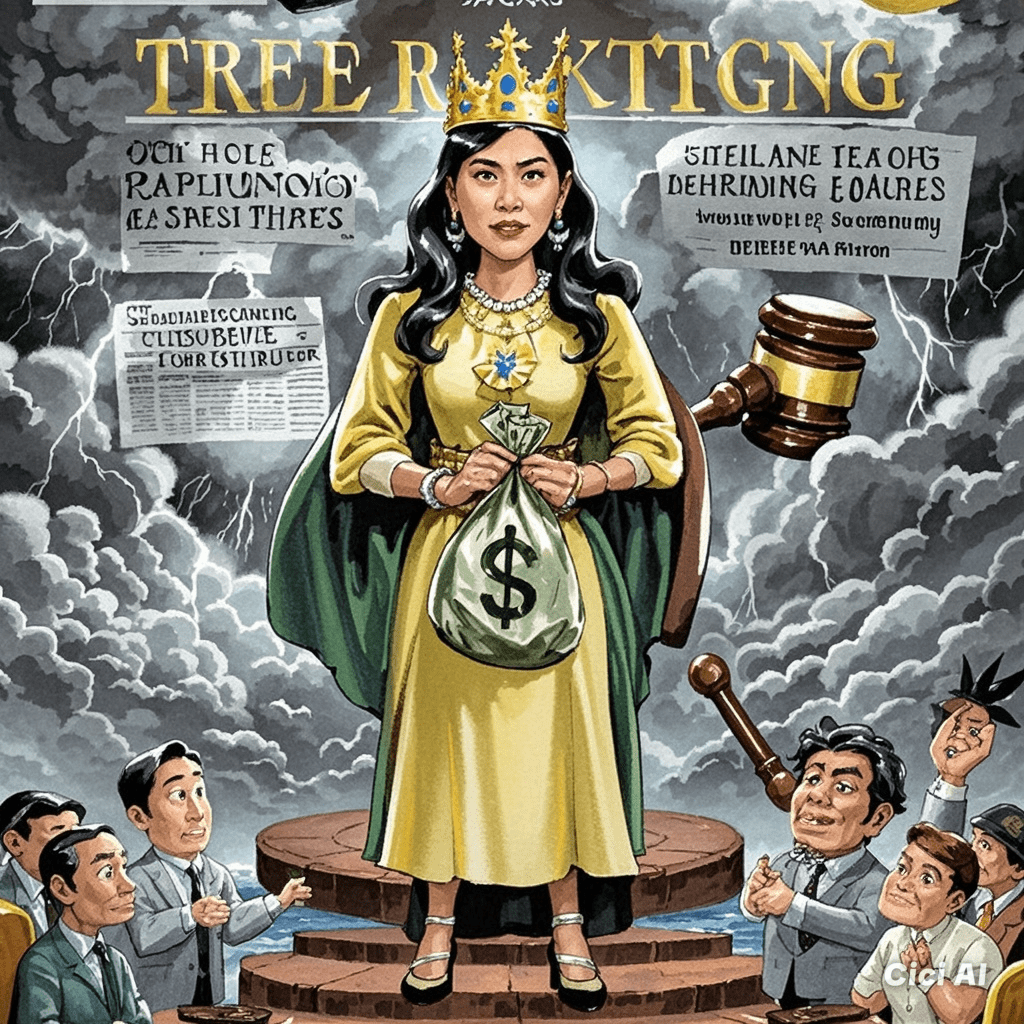
VICE President Sara Duterte, once heralded as a rising star in Philippine politics, now finds herself ensnared in a complex political storm. Her actions during the House of Representatives budget hearings have left both her supporters and critics grappling with the consequences of her decisions, as Duterte’s refusal to directly engage in budget deliberations has fueled public and political ire. The sudden adversarial nature of her relationship with the House, paired with the intense scrutiny from the Commission on Audit (COA) of both her office (OVP) and the Department of Education (DepEd), signals a potentially unintended unraveling of her political strategy.
As Duterte prepares for what many speculate will be a run for the presidency in 2028, the question looms: Will this controversy define her trajectory, or will she successfully navigate the treacherous waters of political accountability?
The Budget Hearings: A Moment of Defiance
Duterte’s refusal to defend the OVP’s PHP 2.037 billion proposed budget for 2025 during the August 27 House hearing was a move that raised more questions than it answered. Her explanation? A handful of lawmakers were using the hearing as a platform to launch political attacks against her. By framing the interrogation as a political spectacle, she chose to step back, leaving it to the House to approve the budget based on their own judgment.
In a preemptive video interview released on September 9, she doubled down on her position, stating, “It’s important for the public to know the budget proposal,” but stressing that her transparency had already been demonstrated by publishing the details online. To some, this appeared as a calculated move to avoid being cornered by hostile lawmakers.
However, the political fallout was immediate. House leaders, including House Deputy Majority Leader Jude Acidre and Assistant Majority Leader Amparo Maria Zamora, sharply criticized her for evading the standard question-and-answer process. They insisted that transparency and accountability required her presence in the hearings to defend the budget directly. Acidre’s pointed remark—“Why explain outside? Speak here in the budget process”—resonated with many who saw Duterte’s move as a breach of tradition and protocol.
Scrutiny from All Sides: COA’s Findings and Public Perception
The scrutiny surrounding Duterte’s leadership is not confined to the OVP budget alone. The COA has flagged both the OVP and DepEd for issues in how their funds were used. The DepEd’s handling of its School-Based Feeding Program (SBFP), which suffered from instances of wasted food and logistical failures under Duterte’s watch, further compounded her problems. The COA found P5.6 billion in wasted food meant for undernourished students—an error that, though systemic, was nevertheless pinned to Duterte’s tenure as secretary.
In light of these findings, public opinion has been sharply divided. Loyal supporters, including those from her Davao stronghold, insist that Duterte’s refusal to engage in the hearings is a calculated stance against political adversaries. Senator Imee Marcos, an ally, argued that the criticism against her is nothing more than an attempt to undermine her future political aspirations. In contrast, the public and lawmakers alike have voiced frustration over her perceived evasiveness, particularly when it comes to the use of confidential funds—funds that the COA flagged for lacking transparency and documentation.
Criticisms and Justifications: Navigating the Crossfire
Critics’ Stance: Lawmakers leading the charge against Duterte have framed her behavior as evasive and disrespectful to the democratic process. As Assistant Majority Leader Jil Bongalon of the Ako Bicol party-list pointed out, refusing to answer questions about confidential funds only deepened concerns about potential misuse of public money. Bongalon argued that public service, especially at Duterte’s level, requires a level of transparency that she has failed to provide. Her decision to forgo the traditional defense of her budget may also breach ethical standards set by Republic Act No. 6713, which mandates public officials to uphold transparency and accountability in the discharge of their duties.
House protocol, too, traditionally requires budget defense to be handled directly by agency heads—a responsibility Duterte abdicated. In historical precedents like the 2009 Licaros v. Sandiganbayan case, the Philippine Supreme Court ruled that failing to comply with the standards of transparency in government spending is tantamount to gross negligence. Many argue Duterte’s refusal to engage in the hearings directly may result in further erosion of public trust.
Duterte’s Defense: Duterte, however, remains steadfast. She contends that her refusal to engage is not an act of defiance but a strategic choice, emphasizing that the budget proposal had already been made available for public scrutiny. She insisted that some lawmakers were weaponizing the hearing as a political stage to settle old scores—a claim that may hold some weight, given the politically charged atmosphere surrounding her tenure.
Moreover, Duterte denies the accusations of acting like a “spoiled brat,” a term that has haunted her since the hearings. She cites her track record in Davao as evidence of her being a grounded leader, not someone prone to tantrums. This narrative—of an outsider being attacked by entrenched political forces—plays well to her base, who view her as a fighter willing to challenge the old guard. As she claimed in her public statement, “The people know I’m not a spoiled brat.”
Legal and Political Consequences: A Balanced Analysis
Legal Fallout: Duterte’s decision to forego defending her budget in person does not inherently violate any laws, but it does skirt established protocols that call for budget transparency. Her refusal to provide more detailed explanations regarding the OVP’s confidential funds, flagged by the COA, could, however, lead to legal ramifications under the Anti-Graft and Corrupt Practices Act (RA 3019) if evidence of misuse is found.
The Supreme Court’s ruling in Atty. Corona v. Senate (2013) emphasized that public officials are held to high standards of transparency, particularly when it comes to the use of public funds. Should the COA’s findings lead to more serious allegations, Duterte could face legal challenges that would derail her political ambitions.
Political Fallout: On the political front, Duterte’s strategy may backfire. The rift with the House—especially the leaders of the appropriations committee—could diminish her influence in securing budgetary support for future projects. This could be a significant obstacle if she plans to build a platform for a 2028 presidential run. Historically, we have seen similar controversies derail the careers of otherwise formidable politicians. The 2012 ousting of Chief Justice Renato Corona, for example, was fueled by a loss of confidence in his ability to be transparent, setting a historical precedent for accountability in the highest offices.
That said, Duterte’s core base remains loyal. In regions like Davao, where her political clout is almost untouchable, these controversies may not be enough to erode her support. However, for the broader national electorate, this episode could cement the perception that she is unwilling to engage in the necessary transparency expected of high-ranking officials.
A Political Game of Chess: Who Holds the Advantage?
In the short term, it appears that Duterte’s critics have the upper hand. They have public opinion on their side, bolstered by the COA’s findings and Duterte’s apparent unwillingness to engage in the process. The legal framework clearly favors transparency and accountability, and her refusal to participate in the budget hearing plays directly into the hands of those accusing her of misconduct.
However, Duterte’s political resilience should not be underestimated. Her narrative of being the victim of political attacks has worked before, and she may yet rally her supporters by framing this as another instance of political persecution. In a country where political loyalties shift quickly, Duterte’s fate remains uncertain.
Recommendations
For Sara Duterte: To mitigate the damage, Duterte must immediately adopt a more cooperative stance. Engaging in the hearings directly—if only to clear her name—would signal a willingness to be accountable. She should also provide more detailed explanations for the confidential funds flagged by the COA. As history has shown, stonewalling can lead to more severe political consequences, as it did with former President Joseph Estrada during his impeachment in 2001.
For the House Leaders: Lawmakers must continue to press for transparency but should avoid framing the controversy as purely political. The best course of action is to focus on the issue of budget accountability, rather than personal attacks, to maintain the integrity of their inquiries.
In the shadow of this unfolding political drama, the stakes for Duterte and her critics are sky-high. How she responds to this moment could very well determine her political future—and shape the road to 2028. So, what will it be, Philippines? Will you accept this controversy as a sign of a broken system, or will you demand greater accountability and transparency from your government officials? The choice is yours.

- “Forthwith” to Farce: How the Senate is Killing Impeachment—And Why Enrile’s Right (Even If You Can’t Trust Him)
- “HINDI AKO NAG-RESIGN!”

- “I’m calling you from my new Globe SIM. Send load!”

- “Mahiya Naman Kayo!” Marcos’ Anti-Corruption Vow Faces a Flood of Doubt

- “Meow, I’m calling you from my new Globe SIM!”

- “No Special Jail for Crooks!” Boying Remulla Slams VIP Perks for Flood Scammers

- “PLUNDER IS OVERRATED”? TRY AGAIN — IT’S A CALCULATED KILL SHOT

- “Several Lifetimes,” Said Fajardo — Translation: “I’m Not Spending Even One More Day on This Circus”

- “Shimenet”: The Term That Broke the Internet and the Budget
- “We Did Not Yield”: Marcos’s Stand and the Soul of Filipino Sovereignty


 KWEBA ni BAROK
Leave a comment