By Louis ‘Barok’ C Biraogo — October 2, 2024
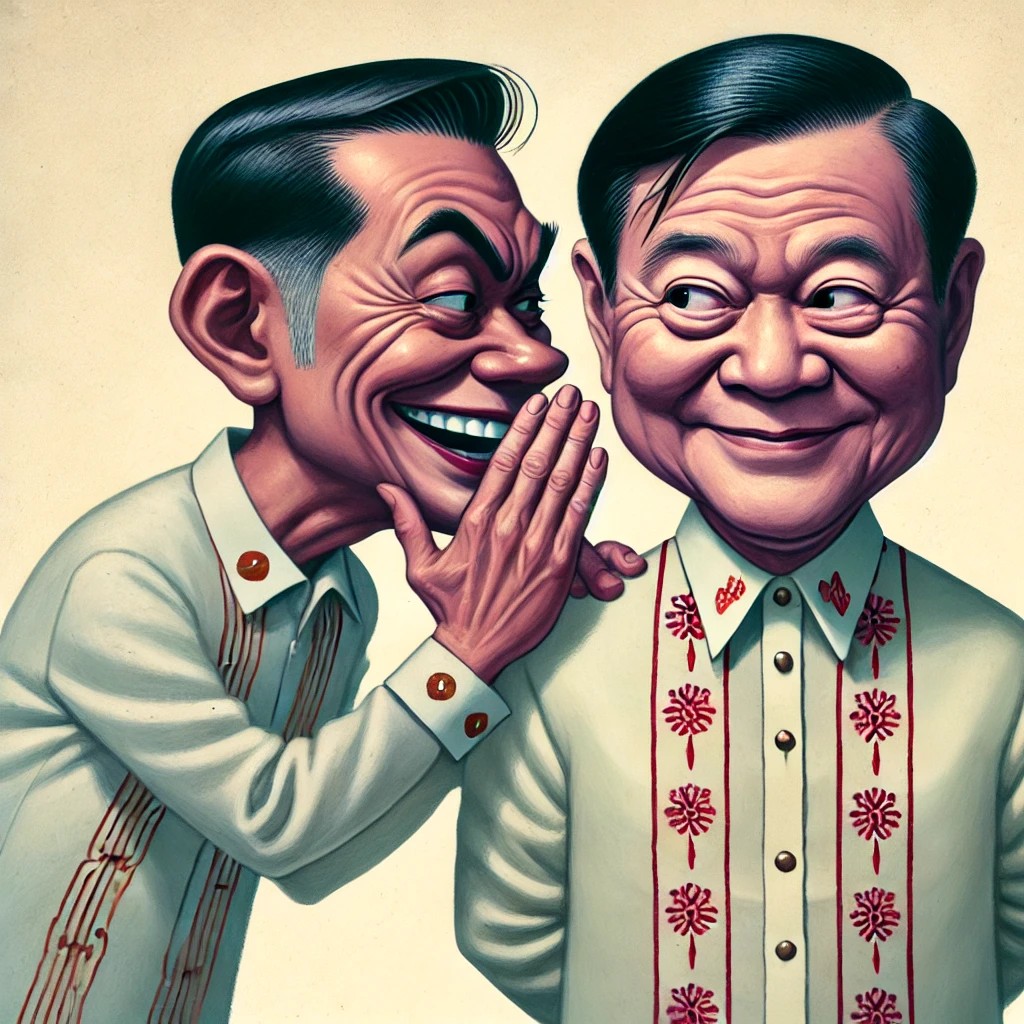
ONCE known as President Duterte’s right-hand man, Senator Bong Go now faces a growing cloud of suspicion. The brutal assassination of Wesley Barayuga, former PCSO board secretary, has pulled Go into a controversy that pits his past proximity to power against his denial of any involvement. As the accusations mount and new testimonies emerge, Go’s name is no longer synonymous with loyalty but with questions that demand answers. Could his closeness to Duterte have given him insight into events darker than we imagined?
The Go-Duterte Nexus
Bong Go’s special role during the Duterte administration is no secret. Officially, Go transitioned into the Senate, but unofficially, he remained Duterte’s right-hand man. He reportedly managed almost 90% of Duterte’s day-to-day duties, operating as a key filter for information that reached the president. More notably, Go acted as a liaison even within Duterte’s inner family circle, handling requests from close relatives—a privilege that led to envy and friction within Duterte’s orbit. His ability to operate in this gray zone of politics earned him both loyalty and suspicion.
In light of this, Go’s current claims of innocence—insisting that as a senator, he was focused on pandemic-related responsibilities—merit a closer look. His longstanding proximity to Duterte raises the question of whether he might have had access to sensitive information even after officially stepping away from his role as Special Assistant to the President (SAP). Was he really out of the loop, or merely distancing himself from a volatile situation?
Pinili’s Allegations and the “Privileged Conversation”
Former PCSO chairperson Anselmo Pinili introduced a twist by claiming that he had shared information about Barayuga’s murder with both Go and former undersecretary Jesus Quitain during a “privileged conversation.” This term implies a confidential exchange that could be shielded from public disclosure due to its sensitive nature. The fact that Pinili waited four years before revealing this conversation adds an air of intrigue. Was it fear, as speculated by Representative Romeo Acop, a former police general, that kept Pinili silent?
Pinili’s claim, if true, implies that Go may have had knowledge of potential motives and suspects in Barayuga’s killing—information that could shift the narrative around his involvement or awareness. If Pinili’s testimony stands, Go might face ethical and legal challenges. Under Philippine ethical standards, public officials are expected to report crimes or knowledge of crimes to authorities. Moreover, under the Revised Penal Code, any person who conceals or fails to disclose information about a crime could be seen as an accessory, potentially complicating Go’s position.
Go’s Defense: A Matter of Boundaries and Mandate
Go’s defense rests on several points. First, he insists that as a senator, he had neither the mandate nor the power to interfere in police investigations, delegating such matters to the appropriate authorities. This argument is supported by his claim that he referred reports to the relevant offices during his time in the Senate. From a legal perspective, his stance aligns with the principle of separation of powers, where legislative officials do not intervene in the executive function of law enforcement.
Furthermore, Go’s denial that he ever held relevant information about Barayuga’s killing could shield him from accusations of unethical conduct. Under the Philippine Ethical Standards Act (RA 6713), public officials must act with transparency and integrity. By emphasizing his referral of issues to proper channels, Go may position himself as a responsible official following the letter of the law.
Yet, legal precedents suggest that even indirect involvement in sensitive cases can draw scrutiny. The Philippine Supreme Court has historically weighed the responsibilities of public officials against their knowledge of crimes or unethical activities. If evidence were to surface proving Go’s knowledge of the murder plot, he could face investigations under ethical, criminal, and administrative frameworks.
Mendoza’s Accusations and the Tangle of Power
Adding complexity to the case are the accusations of Police Lt. Col. Santie Mendoza, who claimed that Barayuga’s assassination was tied to allegations of his involvement in the illegal drug trade—an operation reportedly sanctioned by former PCSO general manager Royina Garma and Napolcom Commissioner Edilberto Leonardo. Both Garma and Leonardo denied Mendoza’s claims, but the scenario paints a disturbing picture of how deeply personal and institutional rivalries might have driven the events leading to Barayuga’s death.
For Go, the reopening of this investigation carries potential dangers. If deeper connections to the power struggles within the PCSO or the police hierarchy emerge, Go’s role as a confidante and insider during Duterte’s presidency may come under renewed scrutiny.
The Legal and Ethical Tightrope
Go’s denials might be legally sound, but politically, they raise questions. The allegations present an ethical dilemma. If Go was aware of these details, why did he not take a more active role in seeking justice for Barayuga? On the other hand, if his denial holds, then Go may emerge as a victim of political mudslinging—a figure caught in the crossfire of factional disputes within government institutions.
At this juncture, the stakes are high. The truth about Go’s knowledge of Barayuga’s murder could determine whether he emerges unscathed or faces legal repercussions. Philippine laws concerning privileged conversations, such as the rules on confidentiality and the ethical obligations of public officials, will play a crucial role in how this case unfolds. Additionally, the re-investigation into Barayuga’s death should prioritize transparency, ensuring that justice is served irrespective of political loyalties.
Recommendations
For Go, the best course of action is to fully cooperate with ongoing investigations while continuing to distance himself from unsubstantiated allegations. Transparency and a willingness to engage with law enforcement will strengthen his defense and could help rebuild trust. On the other hand, Pinili should provide concrete evidence supporting his claims, as mere allegations without proof can further polarize an already tense political atmosphere.
The investigation into Barayuga’s murder must proceed with rigor, given the multitude of conflicting testimonies. Independent oversight and adherence to Philippine legal precedents will be crucial to uncovering the truth in this murky case, ensuring that justice is not swayed by power or proximity to authority.
Senator Go’s journey has always been one of navigating the thin line between power and peril. As the truth remains hidden in the murky recesses of political whispers, only time will tell if those once trusted ties will lift him to safety—or bind him to his demise. In the shadows, the final reckoning waits.
- “Forthwith” to Farce: How the Senate is Killing Impeachment—And Why Enrile’s Right (Even If You Can’t Trust Him)
- “HINDI AKO NAG-RESIGN!”

- “I’m calling you from my new Globe SIM. Send load!”

- “Mahiya Naman Kayo!” Marcos’ Anti-Corruption Vow Faces a Flood of Doubt

- “Meow, I’m calling you from my new Globe SIM!”

- “No Special Jail for Crooks!” Boying Remulla Slams VIP Perks for Flood Scammers

- “PLUNDER IS OVERRATED”? TRY AGAIN — IT’S A CALCULATED KILL SHOT

- “Several Lifetimes,” Said Fajardo — Translation: “I’m Not Spending Even One More Day on This Circus”

- “Shimenet”: The Term That Broke the Internet and the Budget

- “We Did Not Yield”: Marcos’s Stand and the Soul of Filipino Sovereignty





 KWEBA ni BAROK
Leave a comment