By Louis ‘Barok‘ C. Biraogo — October 3, 2024
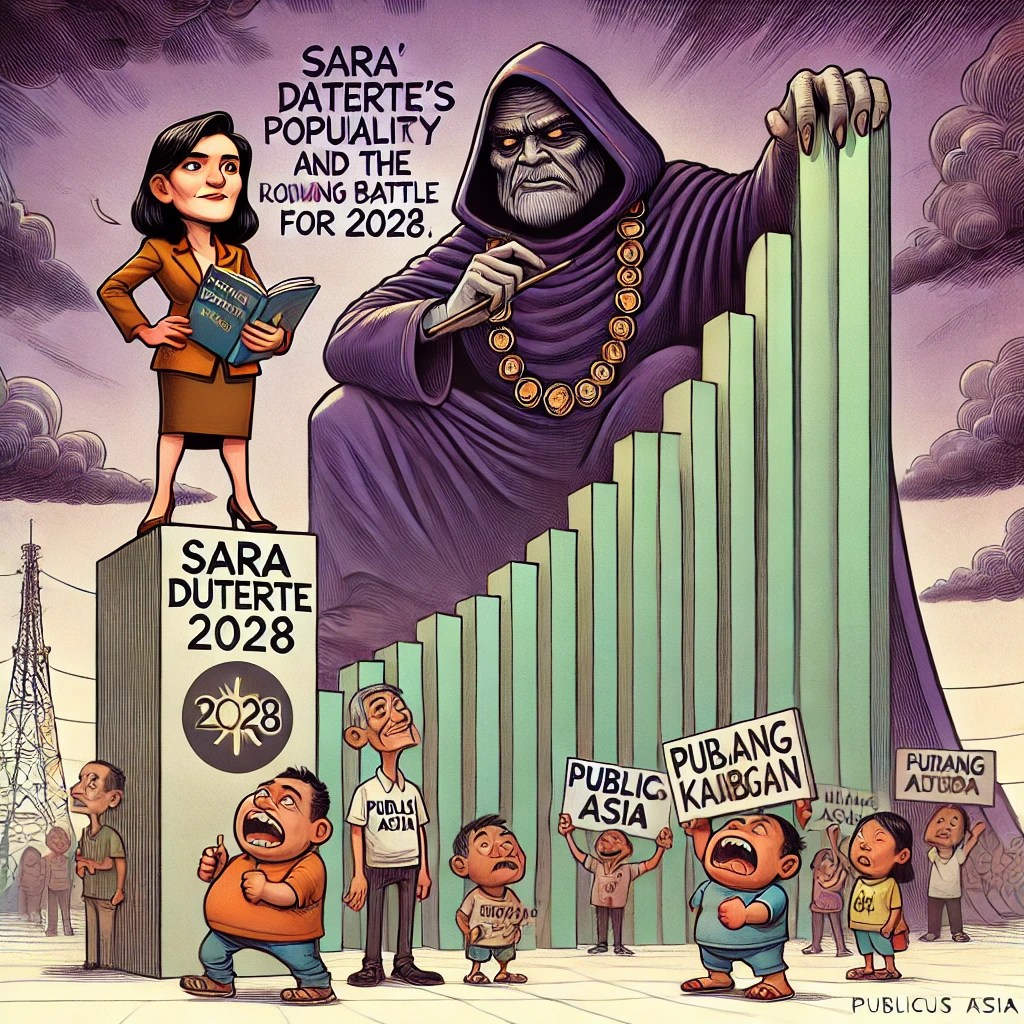
ONCE hailed as a future president, Sara Duterte now faces a political crisis few saw coming. A shocking third-quarter survey from Publicus Asia reveals that the Vice President’s approval and trust ratings have plummeted, shaking the bedrock of her 2028 aspirations. In a political landscape where polls can make or break careers, Duterte’s sudden fall from grace is both startling and suspenseful—an unexpected twist in what seemed like a sure path to power.
Publicus Asia: A Political Barometer
Publicus Asia, known for its political surveys, has become a cornerstone in Philippine politics. Founded in 2003, it has offered politicians a way to measure their success, gauge the public’s mood, and, crucially, test their viability for future campaigns. Public opinion surveys have an outsized role in shaping political strategies in the Philippines. They are often relied upon by candidates and political strategists to read the tea leaves of voter sentiment, serving as a compass that guides policy, public relations, and sometimes, the candidates’ political survival.
For Sara Duterte, these surveys—particularly those by Publicus—have been both a blessing and a curse. In the 2023 third quarter survey, Duterte enjoyed an approval rating of 62%, a number befitting her stature as the political heir to her father, former President Rodrigo Duterte. But that era of stability and confidence is now a distant memory.
A Fallen Star in 2024: The Decline of Sara Duterte
In 2024, Duterte’s approval rating nosedived to 40%, with disapproval hovering close behind at 37%. Similarly, her trust rating plummeted to 33%, with a significant portion of respondents—41%—expressing little to no trust in her leadership. Compared to her 2023 figures, which were comfortably above 50%, her steady decline is unmistakable.
Publicus’ surveys present more than just numbers—they reveal the cracks in Duterte’s political armor. This erosion of public confidence begs the question: What led to such a dramatic fall from grace? The factors are manifold, and each carries the weight of potential disaster for her 2028 presidential aspirations.
Five Factors That Shaped Her Decline
- Controversies Over Fund Misuse: A major controversy engulfed Duterte regarding the Office of the Vice President’s (OVP) allocation of funds. Public dissatisfaction was sparked by accusations that her office was overlapping with existing social assistance programs. The scrutiny intensified as Duterte became embroiled in a scandal over a proposed ₱10 million budget for her self-authored book, “Isang Kaibigan.” The optics of using taxpayer money for personal projects only deepened the public’s distrust.
- Investigations into Davao’s Dark Legacy: The House’s quad-committee investigation into the illegal operations of Philippine Offshore Gaming Operators (POGOs), extrajudicial killings tied to her father’s drug war, and a substantial drug haul during Rodrigo Duterte’s term in Davao placed Sara squarely in the shadows of her father’s controversial legacy. These unresolved national wounds have made it increasingly difficult for her to distance herself from her father’s polarizing history.
- Her Abrupt Resignation from the Department of Education: Duterte’s sudden departure from her role as Secretary of the Department of Education was another blow to her credibility. Many viewed her resignation as a retreat under pressure, especially as the department faced criticism over curriculum revisions and teacher shortages.
- Non-Appearance at Budget Hearings: Adding fuel to the fire, Duterte’s conspicuous absence during budget hearings sparked further allegations of her disengagement from vital government affairs. Her claim that the national budget was controlled by a small cadre of political figures, while inflammatory, did little to restore faith in her ability to govern effectively.
- Geopolitical and Economic Instability: Finally, the broader economic challenges facing the Philippines—rising inflation, corruption, and a fractious political environment—compounded her troubles. These national issues cast a harsh light on her leadership, with her performance being perceived as inadequate or evasive.
The Path to 2028: Can Duterte Recover?
Sara Duterte’s sharp decline in the Publicus surveys poses a direct threat to her once-likely run for the presidency in 2028. Despite these setbacks, all is not lost. Duterte retains significant political capital in Mindanao, where she continues to poll better than most of her rivals. However, for her to reclaim national prominence, she will need to execute a strategic recalibration that addresses both her image and her policies.
- Rebuilding Trust through Transparency: Duterte must address the scandals head-on. A commitment to transparency in how her office manages public funds could go a long way in quelling rumors of corruption. Engaging in regular, unscripted dialogues with the public could also help humanize her and demonstrate accountability.
- Distancing Herself from Controversial Alliances: Though Duterte’s political pedigree comes from her father’s legacy, her success in 2028 will likely depend on her ability to carve out her own identity. This may require her to decisively distance herself from the drug war, extrajudicial killings, and other controversies linked to her father.
- Building Alliances with Reformists: Duterte should consider building alliances with reform-minded politicians. By crafting a forward-looking platform focused on economic recovery, education reform, and anti-corruption measures, she can begin to pivot the conversation away from her controversies toward the future.
The Opponents: What Can They Do?
For those eyeing 2028, Duterte’s vulnerability is a strategic opportunity. Candidates like former Vice President Leni Robredo, House of Representatives Speaker Martin Romualdez, and Senator Raffy Tulfo, whose approval ratings remain relatively stable, should focus on exploiting Duterte’s weak points.
- Seizing the Narrative on Corruption: Duterte’s opponents would be wise to highlight the fund controversies and press for further investigations. By positioning themselves as anti-corruption champions, they can erode Duterte’s base of support in key regions.
- Capitalizing on Regional Weaknesses: Duterte’s decline in Luzon and the National Capital Region, historically strongholds for competitive elections, is a prime opening for her rivals. They should double down on their campaigns in these areas, emphasizing Duterte’s regional disconnect.
- Unifying the Opposition: Duterte’s fall offers a rare moment for opposition forces to unite behind a single, charismatic candidate. A fractured opposition will only benefit Duterte’s eventual campaign.
A Verdict for the Filipino People
The road to 2028 is paved with the familiar echoes of political dynasties and corruption, but this time, the script might change. For Sara Duterte, the warning signs are everywhere. If she falters, her rise to power may end before it truly begins. Meanwhile, the opposition stands poised to capitalize on every misstep. In the coming years, the Filipino people will witness a battle for the nation’s soul—one where every strategy, every mistake, will shape history.

- “Forthwith” to Farce: How the Senate is Killing Impeachment—And Why Enrile’s Right (Even If You Can’t Trust Him)
- “HINDI AKO NAG-RESIGN!”

- “I’m calling you from my new Globe SIM. Send load!”

- “Mahiya Naman Kayo!” Marcos’ Anti-Corruption Vow Faces a Flood of Doubt

- “Meow, I’m calling you from my new Globe SIM!”

- “PLUNDER IS OVERRATED”? TRY AGAIN — IT’S A CALCULATED KILL SHOT

- “Several Lifetimes,” Said Fajardo — Translation: “I’m Not Spending Even One More Day on This Circus”

- “Shimenet”: The Term That Broke the Internet and the Budget

- “We Did Not Yield”: Marcos’s Stand and the Soul of Filipino Sovereignty

- “We Gather Light to Scatter”: A Tribute to Edgardo Bautista Espiritu


 KWEBA ni BAROK
Leave a comment