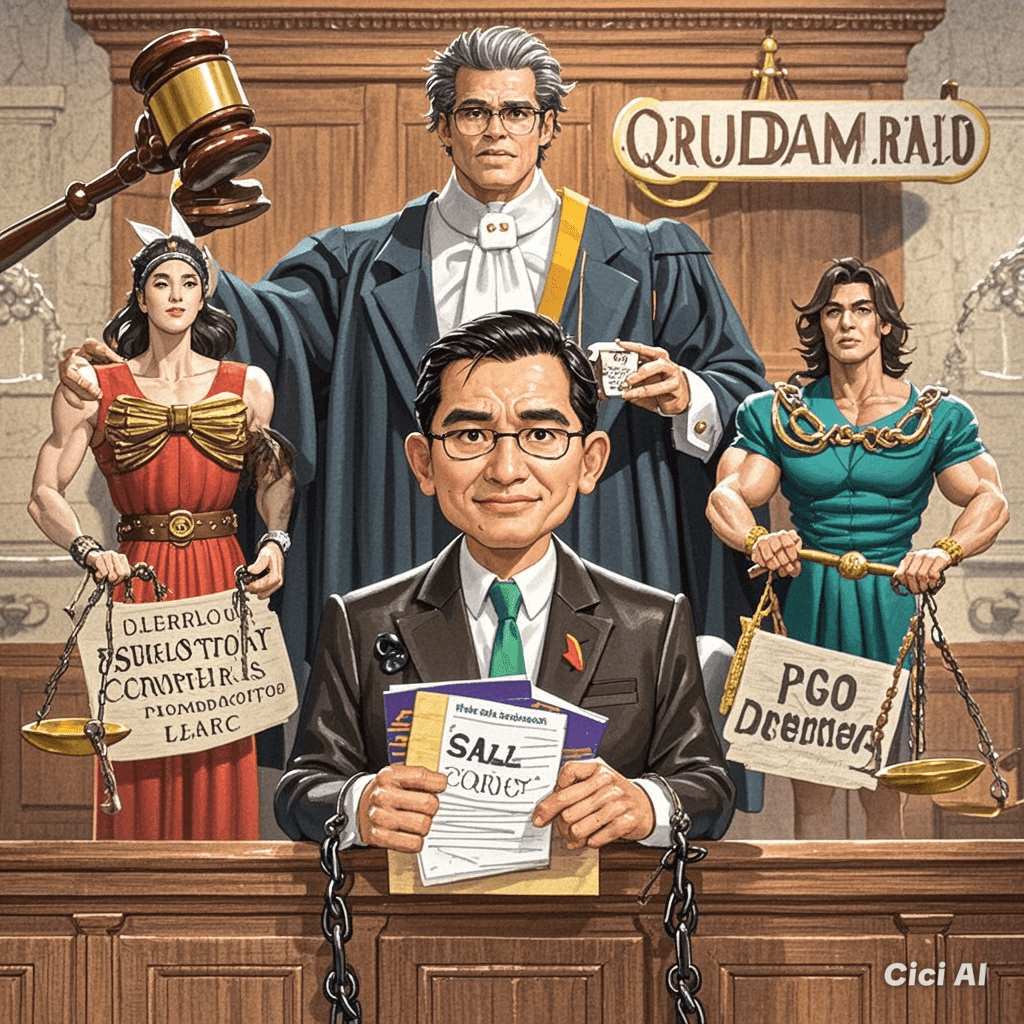
By Louis ‘Barok‘ C. Biraogo — October 4, 2024
WHAT happens when a former presidential spokesperson takes on the entire legislative system? Harry Roque is about to find out. His attempt to shield himself from a contempt order issued by the powerful Quad Committee hit a major roadblock when the Supreme Court denied his request for protection. But the court left some critical doors ajar, raising even more questions about the limits of Congress’ oversight and the clash between legislative power and individual rights. As Roque’s legal journey unfolds, the stakes for both him and Philippine democracy have never been higher.
Political and Legal Context
Roque’s entanglements with the law stem from allegations linking him to Lucky South 99, a Philippine Offshore Gaming Operator (POGO) hub raided for human trafficking. Documents bearing Roque’s signature were discovered during the raid, leading to an investigation by QuadComm. Roque admitted accompanying Katherine Cassandra Ong, a key figure tied to the company, but denied any legal representation for the gaming operator. His refusal to submit personal documents, including his Statement of Assets, Liabilities, and Net Worth (SALN), escalated the situation, leading QuadComm to issue a contempt order.
Supreme Court’s Decision and Analysis
The Supreme Court rejected Roque’s petition for a writ of amparo, finding that the remedy was inappropriate in this case. The writ of amparo, designed to protect individuals from extralegal killings and enforced disappearances, was deemed inapplicable to Roque’s situation. This decision aligns with prior rulings where the court clarified the limited scope of the writ of amparo, such as in Secretary of National Defense v. Manalo, where the court emphasized that the writ is intended for protecting life and liberty from state abuse .
In contrast, the court sustained Roque’s petition for a writ of prohibition, which could prevent QuadComm from requiring him to submit further documents or attend hearings. This aspect of the decision reflects a careful balance between respecting Congress’ oversight powers while ensuring that legislative inquiries remain within constitutional bounds. Roque’s arguments hinged on constitutional protections, particularly his right against self-incrimination under the 1987 Constitution, Article III, Section 17, and his claim that the QuadComm’s inquiry exceeded the limits of legislative authority.
Roque’s Arguments: Successes and Failures
Roque’s plea for a writ of amparo failed primarily because his situation did not involve a direct threat to his life or liberty, the core function of the writ. This was a predictable outcome, as the legal precedent in Razon v. Tagitis established that the writ’s application is narrowly defined to address human rights abuses .
However, Roque did find some success in his plea for a writ of prohibition. His argument that QuadComm’s actions were not truly “in aid of legislation” but rather a form of political persecution resonated with the court enough to prompt further scrutiny. Roque also argued that forcing him to submit more documents violated his right against self-incrimination, a claim with constitutional backing under the Bill of Rights. This claim has been affirmed in cases like People v. Ayson, where the Supreme Court ruled that individuals cannot be compelled to testify or submit evidence that could incriminate them .
QuadComm’s Likely Response and Legal Grounds
QuadComm, backed by Congress’ legislative authority, will likely argue that its investigations are firmly within the bounds of constitutional oversight. Under Article VI, Section 21 of the Philippine Constitution, Congress has the power to conduct inquiries in aid of legislation. The Supreme Court has previously upheld this broad authority in Senate v. Ermita, where it confirmed that legislative inquiries are crucial for transparency and governance .
QuadComm will also point out that Roque’s refusal to submit documents, including his SALN, undermines the committee’s mandate to ensure public accountability. Roque’s alleged involvement in questionable POGO activities strengthens QuadComm’s position that their investigation is a legitimate exercise of its oversight function. The contempt order against Roque, therefore, would be portrayed not as a punitive measure but as a necessary step to compel compliance with a lawful inquiry.
Legal Implications and Consequences
The Supreme Court’s decision, while providing temporary relief to Roque through the writ of prohibition, strengthens Congress’ authority to enforce compliance in legislative investigations. This decision affirms the separation of powers, allowing Congress to exercise its oversight role without undue interference from the judiciary, while ensuring that the rights of individuals under investigation are protected.
For Roque, the ruling means that his legal battles are far from over. Should QuadComm provide compelling arguments in its comment to the court, the investigation could proceed, possibly leading to his arrest. The implications extend beyond Roque’s personal legal troubles. This ruling could embolden Congress to issue contempt orders in other high-profile investigations, potentially raising concerns about overreach and abuse of legislative power.
Roque’s Legal Options
Roque’s remaining legal avenues include challenging the scope of the QuadComm investigation, arguing that it is politically motivated and not truly in aid of legislation. He could also continue to assert his right against self-incrimination and challenge the requirement to submit additional documents. Should QuadComm persist in seeking his arrest, Roque could file for a temporary restraining order (TRO) to prevent detention while his case is pending. Additionally, he may consider appealing to the public by framing this as an issue of executive-legislative overreach, leveraging his political experience to sway public opinion.
Recommendations
For Roque, the best course of action would be to comply with select document requests to avoid further contempt charges while simultaneously challenging the investigation’s scope through the courts. A public relations strategy that focuses on the potential overreach of Congress in politically sensitive investigations could also garner public sympathy.
For QuadComm, maintaining transparency and ensuring that its inquiries are tightly aligned with legislative objectives will be critical. Any perception that the investigation is politically motivated could undermine its legitimacy. Ensuring adherence to procedural fairness and offering clear justifications for its contempt orders will bolster its position in both the court of law and public opinion.
Conclusion
In the Roque case, the Supreme Court has drawn a fine line between legislative authority and personal liberty—a line that may define the contours of Philippine democracy for years to come. While Congress asserts its power and the judiciary shields constitutional rights, the true test of this decision lies ahead. How this battle unfolds will not only shape Roque’s future but could forever alter the balance of power between those who govern and those who are governed.

- “Forthwith” to Farce: How the Senate is Killing Impeachment—And Why Enrile’s Right (Even If You Can’t Trust Him)
- “HINDI AKO NAG-RESIGN!”

- “I’m calling you from my new Globe SIM. Send load!”

- “Mahiya Naman Kayo!” Marcos’ Anti-Corruption Vow Faces a Flood of Doubt

- “Meow, I’m calling you from my new Globe SIM!”

- “No Special Jail for Crooks!” Boying Remulla Slams VIP Perks for Flood Scammers

- “PLUNDER IS OVERRATED”? TRY AGAIN — IT’S A CALCULATED KILL SHOT

- “Several Lifetimes,” Said Fajardo — Translation: “I’m Not Spending Even One More Day on This Circus”

- “Shimenet”: The Term That Broke the Internet and the Budget

- “We Did Not Yield”: Marcos’s Stand and the Soul of Filipino Sovereignty


 KWEBA ni BAROK
Leave a comment