By Louis ‘Barok‘ C. Biraogo — October 18, 2024
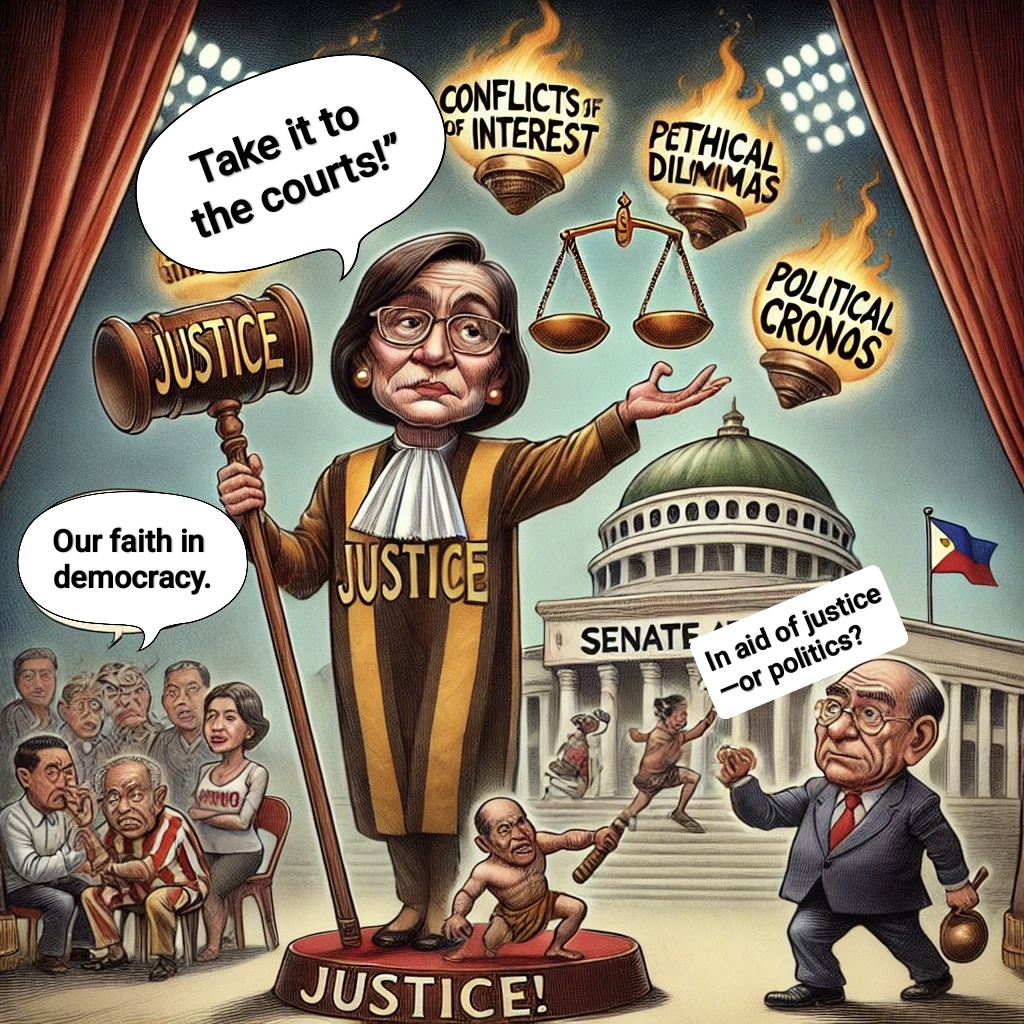
WHEN the architect of Duterte’s drug war, Senator Ronald ‘Bato’ dela Rosa, offers to lead a Senate inquiry into that very same war, the alarm bells start ringing. Is this a pursuit of truth or a move to shield political cronies? As questions of justice collide with accusations of conflicts of interest, Sen. Imee Marcos throws another curveball: shouldn’t the courts, not the Senate, decide this fate?
The Drug War Controversy
The Duterte administration’s war on drugs left thousands dead in anti-drug operations, raising accusations of extrajudicial killings and crimes against humanity. Now, the ongoing probe by the House of Representatives’ Quad Committee, which implicated Senators Dela Rosa and Bong Go, casts a shadow over the Senate’s role. Dela Rosa, Duterte’s first police chief and the architect of the drug war, leading the investigation appears like an arsonist probing a fire they started.
Critics assert a glaring conflict of interest, arguing that a man who operationalized Duterte’s aggressive anti-drug campaign has no place leading an inquiry into its abuses. Marcos, sharing this concern, warns that the Senate probe risks becoming a spectacle where vested interests clash rather than a genuine quest for justice.
Imee Marcos’s Position: “Bring It to Court”
Marcos’s recommendation to bring the issue to court rather than conducting a Senate investigation is a call to preserve institutional integrity. Her position relies on several arguments:
- Separation of Powers: The Philippine Constitution enshrines a division among the branches of government to avoid concentration of power. Marcos argues that courts, as neutral arbiters, are the proper venues for determining guilt or innocence, while legislative bodies should focus on crafting laws. Conducting a probe in the Senate could blur these boundaries and even conflict with the concurrent Quad Committee inquiry in the House.
- Perception of Bias and Partisanship: With Dela Rosa’s deep connection to the Duterte administration, his leadership of the Senate inquiry risks being perceived as a defensive strategy, undermining public trust in the investigation’s impartiality. Marcos’s suggestion to bring the issue to the courts aims to sidestep accusations of political self-preservation.
- Aid of Legislation: The Senate’s mandate to investigate is supposed to be in aid of legislation. Marcos points out that any inquiry should focus on identifying laws needing amendment or reform, rather than apportioning blame. She suggests that if evidence already presented by the House Quad Committee is sufficient, the Department of Justice (DOJ) should take over, avoiding redundancy and accelerating the pursuit of justice.
- Swift Justice: Marcos’s appeal highlights the danger of delay in justice—witnesses may fade, evidence may deteriorate. She contends that the DOJ, assisted by law enforcement agencies, is equipped to prosecute those responsible without a drawn-out legislative process.
Dela Rosa’s Defense: “Why Not?”
Senator Dela Rosa’s defenders argue that his leadership of a motu proprio investigation is not necessarily improper. Several counterpoints arise:
- Expertise and Experience: As the chief implementer of the drug war, Dela Rosa possesses firsthand knowledge of its operations and can provide insights that would otherwise be inaccessible. His involvement could be seen as bringing a necessary perspective, given his understanding of the policies and their execution.
- Political Strategy: By taking the lead, Dela Rosa can directly address allegations against himself and Bong Go. This strategy might neutralize the political attacks by seizing control of the narrative rather than allowing others to dictate the terms of scrutiny.
- Delicadeza and Ethical Standards: Although conflict of interest concerns loom large, the Senate ethics rules and Philippine Supreme Court precedents allow individuals involved in prior incidents to participate in investigations, provided they disclose the conflict. Dela Rosa’s role could therefore be justified on the grounds that he is not the only decision-maker and that he operates under the committee’s collective oversight.
- Judicial Standards and Past Precedents: Philippine Supreme Court rulings recognize that public officials accused of misconduct can still participate in proceedings unless there is conclusive evidence of partiality or bias. Dela Rosa’s defenders might cite this as a precedent for his involvement in the investigation.
Which Side Is Right?
The arguments against Dela Rosa leading the Senate probe are compelling, resting on principles of justice and ethical governance. His dual role as both investigator and potential subject compromises the Senate’s impartiality. It risks entrenching the belief that justice is selectively applied based on power and connections. Thus, Marcos’s recommendation to defer the matter to the courts is not only legally prudent but also politically sound.
However, Dela Rosa’s supporters are not without justification. They argue that excluding him from the inquiry could be construed as preemptively disqualifying a potentially insightful voice, setting a dangerous precedent where individuals with relevant knowledge are excluded from discussions purely on the basis of perceived conflicts.
Potential Legal and Political Repercussions
For Marcos and those who support court intervention:
- Legal Repercussions: If the matter is handed over to the courts, any finding of liability could lead to criminal charges against high-ranking officials, including Dela Rosa and Go. This could prompt sweeping changes to the legal framework governing police operations and drug enforcement.
- Political Fallout: Politically, a court battle could fracture the Duterte bloc and embolden opposition voices calling for accountability. It could also serve as a litmus test for the judiciary’s independence in politically sensitive cases.
For Dela Rosa:
- Reputational Risk: If he proceeds to lead the Senate investigation and it fails to satisfy the public’s demand for accountability, his credibility and that of the Senate may suffer irreversible damage.
- Legal Vulnerabilities: Should a separate court case proceed in parallel, findings from the Senate investigation could be used against him, possibly aggravating his legal situation.
Recommendations
For Senator Marcos and her supporters:
- Continue Advocating for Court Action: To preserve the integrity of the Senate, Marcos should sustain her call to let the judicial process take precedence. She can propose legislative reforms based on the findings of the House committee, thus aligning with her stance that inquiries should aid legislation.
For Senator Dela Rosa:
- Recuse or Co-chair: Dela Rosa should consider recusing himself from a direct leadership role or sharing it with a co-chair from the opposition, enhancing the inquiry’s legitimacy. He could still contribute to the investigation’s findings while removing doubts about partiality.
In this battle of power versus principle, the stakes have never been higher. Will justice pierce through the web of political allegiances, or will truth be swallowed by the very system meant to uphold it? With every twist, the nation holds its breath—its future shaped by the outcome of this struggle.

- ₱75 Million Heist: Cops Gone Full Bandit

- ₱6.7-Trillion Temptation: The Great Pork Zombie Revival and the “Collegial” Vote-Buying Circus

- ₱1.9 Billion for 382 Units and a Rooftop Pool: Poverty Solved, Next Problem Please

- ₱1.35 Trillion for Education: Bigger Budget, Same Old Thieves’ Banquet

- ₱1 Billion Congressional Seat? Sorry, Sold Out Na Raw — Si Bello Raw Ang Hindi Bumili

- “We Will Take Care of It”: Bersamin’s P52-Billion Love Letter to Corruption

- “Skewed Narrative”? More Like Skewered Taxpayers!

- “Scared to Sign Vouchers” Is Now Official GDP Policy – Welcome to the Philippines’ Permanent Paralysis Economy

- “Robbed by Restitution?” Curlee Discaya’s Tears Over Returning What He Never Earned

- “No Pressure” Luistro? The House Pork Bazaar Exposed
- “My Brother the President Is a Junkie”: A Marcos Family Reunion Special

- “Mapipilitan Akong Gawing Zero”: The Day Senator Rodante Marcoleta Confessed to Perjury on National Television and Thought We’d Clap for the Creativity




 KWEBA ni BAROK
Leave a comment