By Louis ‘Barok‘ C. Biraogo — October 26, 2924
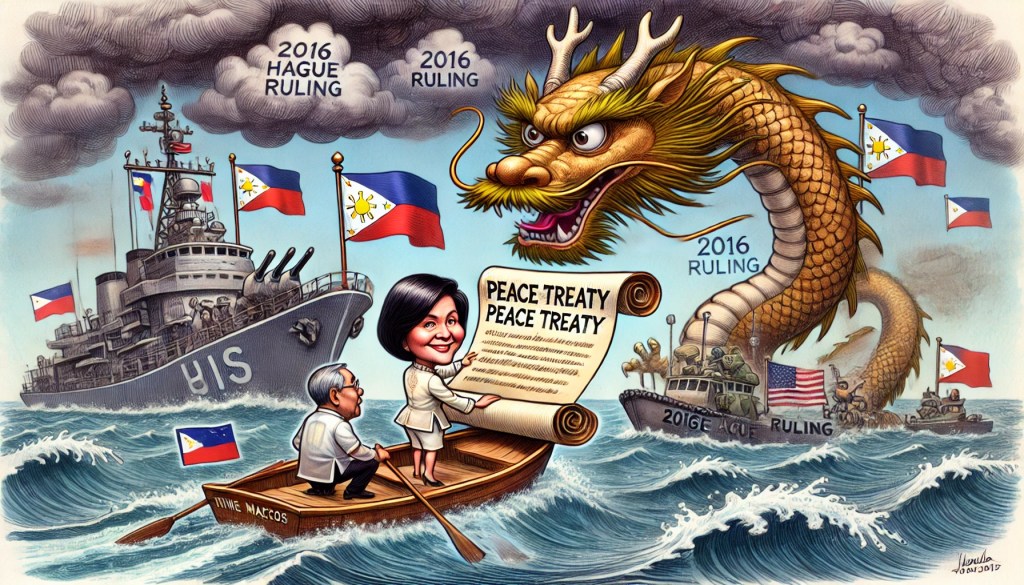
WITH tensions rippling through the South China Sea, Senator Imee Marcos has dared to float the idea of a peace accord with China—a bold attempt to echo China and India’s recent border détente. But as power plays churn beneath the surface, one wonders: Can diplomacy hold steady in waters where conflict looms as close as the horizon?
China’s rapid rise as a global power has deepened regional anxiety and sharpened its competition with the United States. For the Philippines, the stakes are staggering. Despite the 2016 ruling by The Hague in favor of the Philippines’ exclusive economic rights, China has shown no intention of abandoning its “nine-dash line” claim over nearly all of the South China Sea. Chinese vessels continue to patrol and assert their presence aggressively in Philippine waters, undermining both legal precedents and diplomatic norms.
Imee Marcos’s stance signals a divergence from her brother, President Ferdinand Marcos Jr., who has aligned more closely with U.S. interests. As a veteran lawmaker and the Senate’s voice on foreign relations, her call for dialogue reflects an independent—some would say, idealistic—approach. She argues that a peaceful settlement is achievable if Manila and Beijing can follow the path that China and India have walked. But the obstacles in the South China Sea are vastly different, rooted not just in territorial claims but in issues of historical resentment, national identity, and global ambition.
The Case for Diplomacy
Imee Marcos’s vision of diplomacy appeals to both humanitarian and strategic sensibilities. War is costly—not only in lives and economic resources but in environmental damage and diplomatic fallout. A diplomatic solution could preserve crucial regional partnerships, foster economic stability, and prevent ecological harm in one of the world’s most biodiverse seas. As Imee Marcos sees it, compromise could yield mutual gains for both nations, creating a shared framework for resource development and setting an example of regional peacebuilding.
There is no denying that diplomacy, when successful, brings invaluable benefits. It preserves relationships, fosters alliances, and creates a channel for countries to cooperate on shared challenges, from economic growth to disaster resilience. These outcomes would be pivotal for the Philippines, a nation heavily reliant on maritime resources and regional trade stability. Diplomacy also has the advantage of upholding international norms, such as the United Nations Convention on the Law of the Sea (UNCLOS), providing a rule-based order that all parties can recognize.
The Complexities: Countercurrents and Confounding Factors
However, the South China Sea is not the China-India border, and the challenges are daunting. Critics of Imee Marcos’s proposal point out that the Indian and Chinese standoff involved land boundaries, not overlapping maritime zones rich with resources. China, moreover, has shown little interest in recognizing the Permanent Court of Arbitration’s ruling that favors the Philippines’ claim. The Philippines’ alliance with the United States and other regional partners like Japan and Australia further complicates diplomatic efforts. Beijing is unlikely to back down easily, as the South China Sea is not merely a territorial interest but a strategic one, a fulcrum of power in its bid for regional hegemony.
Geopolitical dynamics amplify these tensions. The United States has committed to supporting the Philippines under its Mutual Defense Treaty, a stance that positions the region as a flashpoint in the U.S.-China rivalry. Any conciliatory move by the Philippines may be seen as a concession by the U.S., undermining the broader strategy of containing China’s influence. This dynamic places Marcos’s vision for diplomacy at odds with the geopolitical reality, where external alliances make peaceful compromise increasingly tenuous.
Additionally, nationalism on both sides of the dispute complicates efforts toward conciliation. In the Philippines, public sentiment runs high against China’s actions, with many citizens viewing the issue as a test of their national sovereignty. Concessions on either side could spark public backlash and political instability, pressuring leaders to adopt more assertive positions to appease domestic audiences. China, too, faces its own brand of national pride, one that frames the South China Sea as a historical claim, dating back centuries.
Missteps and Missing Nuance
Further clouding the issue is Imee Marcos’s apparent oversimplification of the China-India comparison. India and China’s “peace accord” has largely been about managing tensions, not resolving underlying disputes. The recent de-escalation in the Himalayas is fragile, a temporary calm enforced by disengagement protocols rather than a full-fledged peace. In the South China Sea, no such framework exists between Manila and Beijing, and China’s outright rejection of The Hague’s ruling all but eradicates the prospect of formal negotiation. The article’s focus on dialogue as a panacea overlooks these stark differences, risking an illusion of easy resolution.
Toward a Realistic Path Forward
To navigate these treacherous waters, the Philippines must adopt a multi-faceted strategy that integrates diplomacy, legal frameworks, and prudent military alliances. While dialogue remains an essential component of any solution, it must be grounded in a realistic understanding of power and backed by a coherent framework that includes external support where necessary.
For Senator Marcos, the call for peace is admirable, but she must weigh it against the substantial obstacles posed by China’s stance, historical mistrust, and regional complexities. It is possible for Manila to engage in diplomatic initiatives that lower tensions while simultaneously strengthening its alliances and capabilities. The goal should not only be peace but a sustainable peace that respects international law, honors Filipino sovereignty, and resists coercion.
In the Philippines’ bid for peace in the South China Sea, aspiration alone will not suffice. In a realm where power often trumps principle, only a strategy that balances ambition with awareness can chart a path toward peace. Imee Marcos’s proposal must evolve beyond optimism—toward a resilient course capable of navigating not just the currents of diplomacy, but the depths of regional ambition.

- ₱8B BBM Pork: CCTV for Every Captain’s Kumpare?

- ₱75 Million Heist: Cops Gone Full Bandit

- ₱6.7-Trillion Temptation: The Great Pork Zombie Revival and the “Collegial” Vote-Buying Circus

- ₱1.9 Billion for 382 Units and a Rooftop Pool: Poverty Solved, Next Problem Please

- ₱1.35 Trillion for Education: Bigger Budget, Same Old Thieves’ Banquet

- ₱1 Billion Congressional Seat? Sorry, Sold Out Na Raw — Si Bello Raw Ang Hindi Bumili

- “We Will Take Care of It”: Bersamin’s P52-Billion Love Letter to Corruption

- “Skewed Narrative”? More Like Skewered Taxpayers!

- “Scared to Sign Vouchers” Is Now Official GDP Policy – Welcome to the Philippines’ Permanent Paralysis Economy

- “Robbed by Restitution?” Curlee Discaya’s Tears Over Returning What He Never Earned

- “No Pressure” Luistro? The House Pork Bazaar Exposed

- “My Brother the President Is a Junkie”: A Marcos Family Reunion Special







 KWEBA ni BAROK
Leave a comment