By Louis ‘Barok‘ C. Biraogo — November 1, 2024
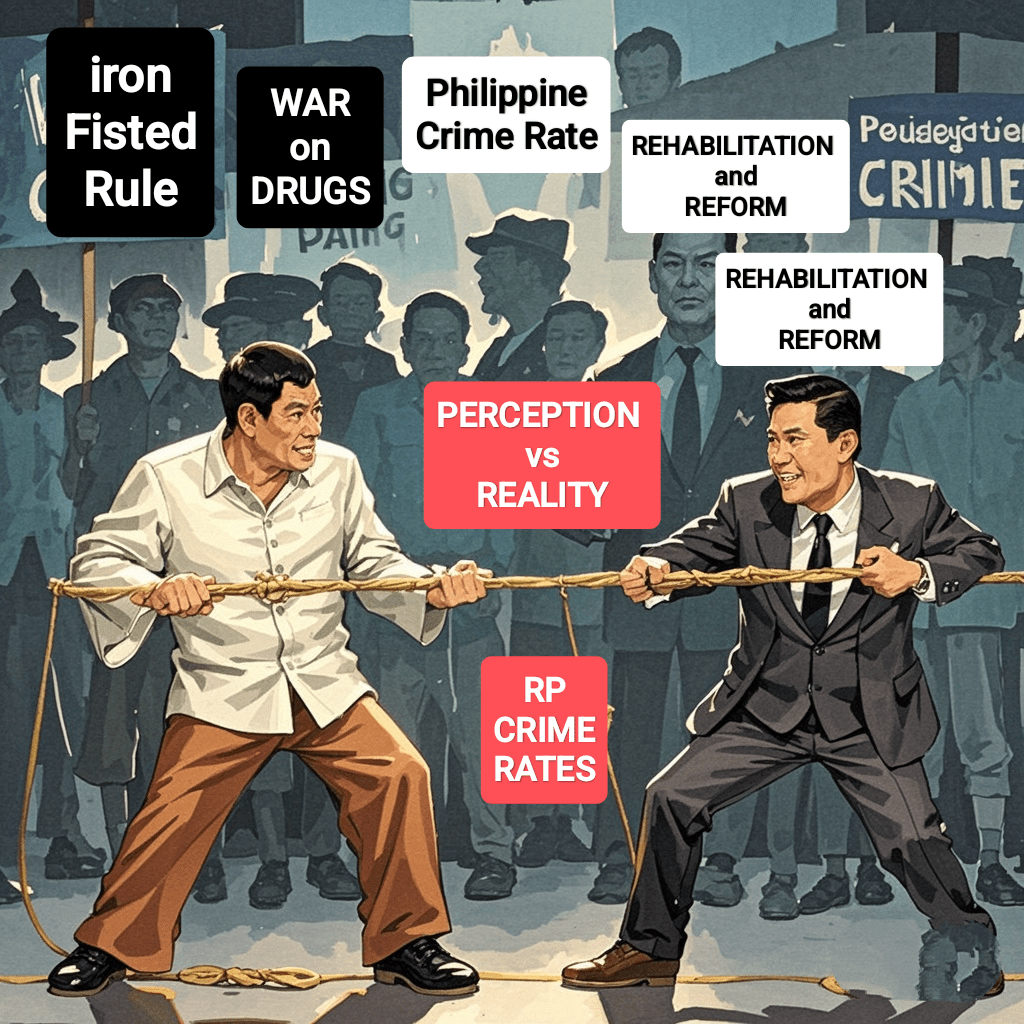
RODRIGO Duterte’s latest jab at President Ferdinand “Bongbong” Marcos Jr.—a claim that crime has surged since his own iron-fisted rule—has reignited memories of his bloody war on drugs. During Duterte’s presidency, the line between justice and retribution blurred, leaving thousands dead in a quest for swift control over crime. Now, as the Marcos administration contends with this provocative accusation, they’re faced with an unsettling divide between perception and reality: a struggle over who truly holds the legacy of crime control in the Philippines.
Duterte’s War on Crime: The Cost of Law and Order
Duterte’s tenure (2016-2022) was distinguished by his ruthless pursuit of law and order. Duterte’s war on drugs sent shockwaves through the nation, impacting every Filipino, with police empowered to aggressively target drug-related crimes. In a nation where drug abuse was portrayed as a grave social disease, Duterte’s method resonated with some Filipinos, who saw it as a means to cleanse their neighborhoods of dangerous elements. Yet, the price of this campaign was steep. Thousands of deaths—a number hard to tally accurately, given the alleged manipulation of data by the administration—became a chilling fixture of this war on drugs. Duterte’s tactics, while yielding an immediate decline in drug-related crimes, polarized the nation and the world with their brutality, leaving a legacy of fear as well as unanswered questions on the real cost of this approach.
Duterte’s concerns, however, are anchored in perception. He argues that the Marcos administration’s emphasis on rehabilitation and de-escalation over punitive enforcement has created an environment conducive to rising crime. Yet, as Remulla argues, this view is not only outdated but misaligned with reality. The data, if selectively examined, supports a decrease in crime since Marcos took office. According to the Department of Justice (DOJ), crime has decreased by 10.66% from the previous period under Duterte. This statistical picture reveals a nation where—if we trust the numbers—crime is less rampant than Duterte suggests. But the question remains: which numbers are definitive? And can these statistics adequately capture the qualitative differences between two administrations’ philosophies on law enforcement?
Marcos’s Approach: Measured Tactics and Remulla’s Role
Where Duterte employed fear, Marcos has aimed for reform. The Marcos administration’s focus on rehabilitation represents a stark departure from Duterte’s unyielding suppression of crime. While Duterte’s approach presumed all criminals beyond redemption, Marcos’ policies suggest an approach focused on rehabilitation and addressing the roots of crime. Remulla, as the Secretary of Justice, has championed these priorities, aiming to demonstrate that a crime-free society does not require a culture of violence. This approach, however, is not without risks. Some critics argue that an emphasis on rehabilitation over hardline enforcement may embolden criminals—a worry Duterte has seized upon in his accusations.
Yet Remulla, backed by DOJ records, maintains that crime rates are down under the current administration, citing improved policing methods and targeted social policies as key factors. His claims find backing in the reported drop in crime statistics. Still, doubts linger, and Duterte’s assertions can’t be fully dismissed without considering the potential biases and limitations in data collection. Factors like underreporting, social media’s amplification of crime incidents, and political narratives all affect perceptions.
The Missing Pieces: A Crisis of Data and Comparison
Comparing the crime records of Duterte and Marcos is complicated by inconsistent reporting standards, lack of independent verification, and significant differences in governance philosophy. The challenge lies in assessing an administration like Duterte’s, where the government’s own data may have been manipulated to mask extrajudicial killings as law enforcement victories. Marcos’ tenure, though still in progress, demands more transparency if any accurate historical comparison is to be made.
Long-term trends are essential here. In both administrations, statistics alone may fail to capture the psychological and societal impact of policy differences. Duterte’s “war on drugs” reverberated through Filipino society in a way that Marcos’ policies, while achieving statistical improvements, have not. Where Duterte’s legacy was built on an iron-fist approach that left a visible mark on Filipino life, Marcos’ is more subdued, focusing on restructuring the law enforcement framework itself. This transition, however, remains unproven in the long term, and the sustainability of Marcos’ approach is yet to be fully tested.
Recommendations: A Path Forward
For Duterte, Marcos, Remulla, and indeed all Filipinos, the path forward requires honest reckoning. Duterte’s warnings should not be disregarded outright; crime is a threat that must be continually monitored. However, metrics matter, and the perception of crime must be anchored in reality. It’s imperative for the Marcos administration to expand data transparency, allowing independent agencies to verify crime statistics. This step would bring credibility to Marcos’ administration while allowing his policies to stand on their own merit.
For Marcos, a commitment to rehabilitation should be balanced with accountability. The war on drugs may have left scars on the Filipino people, but crime prevention remains a priority. Rehabilitation is commendable, but it must not overshadow the need for effective policing.
Remulla, too, faces a crucial task. As Justice Secretary, his role should be one of balance—guiding a nation away from extrajudicial killings but keeping it anchored in effective law enforcement. As the chief custodian of law and order, he must work to foster trust in the justice system, ensuring that data used to support policy decisions is accurate, accessible, and impartial.
Finally, for every Filipino, there is an essential role as well: to demand transparency and to discern the reality of their communities from narratives shaped by fear. For too long, Filipinos have been told that violence is a necessary cost of peace. The present moment demands a critical evaluation of these beliefs. As Marcos, Remulla, and the DOJ continue their efforts, citizens must hold them accountable, ensuring that both policy and perception reflect a genuine commitment to public safety over sensationalism.
Duterte’s shadow still looms, but a chance for a different legacy is within reach—a vision where justice balances strength with compassion. Yet without true transparency and accountability, this vision might fade, leaving Filipinos still waiting for a peace that feels real and lasting.

- “Forthwith” to Farce: How the Senate is Killing Impeachment—And Why Enrile’s Right (Even If You Can’t Trust Him)
- “HINDI AKO NAG-RESIGN!”

- “I’m calling you from my new Globe SIM. Send load!”

- “Mahiya Naman Kayo!” Marcos’ Anti-Corruption Vow Faces a Flood of Doubt

- “Meow, I’m calling you from my new Globe SIM!”

- “No Special Jail for Crooks!” Boying Remulla Slams VIP Perks for Flood Scammers

- “PLUNDER IS OVERRATED”? TRY AGAIN — IT’S A CALCULATED KILL SHOT

- “Several Lifetimes,” Said Fajardo — Translation: “I’m Not Spending Even One More Day on This Circus”

- “Shimenet”: The Term That Broke the Internet and the Budget

- “We Did Not Yield”: Marcos’s Stand and the Soul of Filipino Sovereignty

- “We Gather Light to Scatter”: A Tribute to Edgardo Bautista Espiritu

- $150M for Kaufman to Spin a Sinking Narrative

 KWEBA ni BAROK
Leave a comment