By Louis ‘Barok‘ C. Biraogo — November 2, 2024
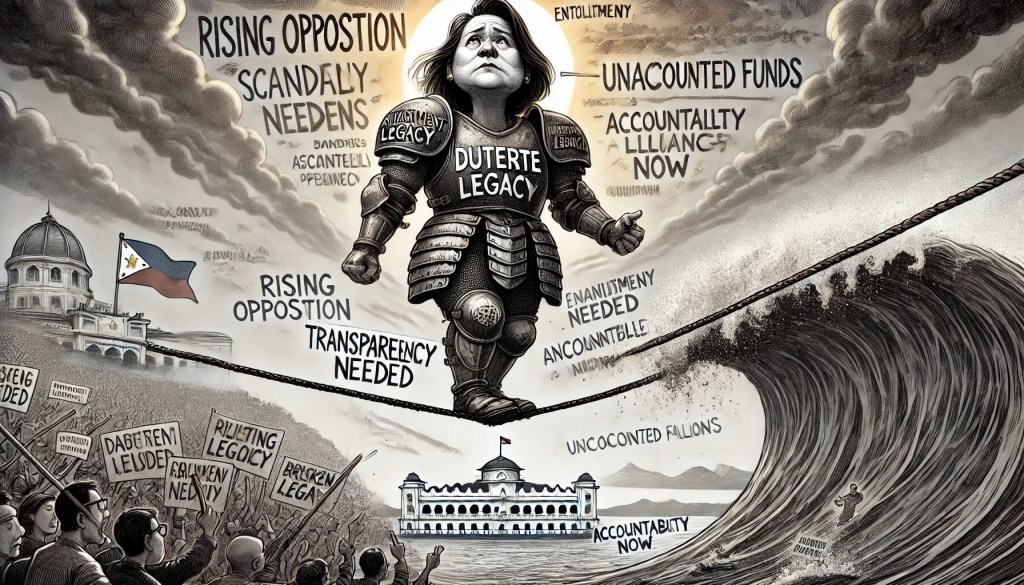
SARA Duterte’s political armor is cracking. Once the emblem of unwavering public loyalty, the Vice President now confronts a harsh reality: a fractured base, rising opposition, and a legacy overshadowed by her father’s looming influence. Her journey exposes the tightrope walk of Filipino politics, where alliances shift, and expectations run high.
Once a political powerhouse in Davao City, Sara Duterte rose as an heir to the Duterte brand, a name with a unique command over her father’s stronghold. The “Queen of Davao” rarely encountered serious opposition and was largely untested in the rugged, nationwide political fray. That isolation bred confidence—perhaps too much—given that her every victory there relied on the unimpeachable sway her father, Rodrigo Duterte, wielded. Now, a delicate dance of privilege and perceived entitlement has left her struggling to resonate beyond Davao’s borders. As one of the strongest potential candidates for the 2028 presidency, Duterte’s early setbacks call into question her ability to endure the scrutiny that comes with ambition on a national scale.
Her journey from Davao City to Manila should have been one of triumph. But recent polling numbers by OCTA and Pulse Asia tell a story of declining confidence, a sobering signal that the political insulation she once enjoyed has waned. OCTA Research’s Q3 survey highlights a six-point decline in trust, while Pulse Asia registered a nine-point fall in approval in just one quarter, with significant drops in Metro Manila, Balance Luzon, and the Visayas. Even within her stronghold in Mindanao, cracks are starting to show. Her plunge from an 87 percent approval rating in early 2023 to current numbers that barely clear the 60 percent threshold marks a stark shift in public sentiment.
What is behind this rapid change? Duterte’s rocky tenure as Secretary of Education certainly plays a part, particularly her controversial management of the Department’s budget. Her unapologetic push for confidential funds—a move she’s defended with an almost cavalier disregard for public critique—provoked strong opposition. During congressional hearings, her defiance toward budgetary scrutiny displayed an audacious side that some see as reckless, a bold but flawed tactic that estranged allies and emboldened critics. Analysts noted that her defensive posturing in Congress, complete with accusations and confrontational rhetoric, shocked and disappointed a public unaccustomed to seeing its leaders behave in such a way. This unorthodox response underscored Duterte’s sense of entitlement—a remnant of her years in Davao, where few questioned her authority.
Surveys reveal that public opinion is turning against Duterte, with anti-administration sentiment surfacing across social classes and regions. In her core demographic—Class E—approval remains high but is steadily declining. Classes ABC, the economic elites, have shown the most significant dip in support, a sign that the well-informed urban population, sensitive to issues of transparency, has become skeptical of her political intentions.
Now, as she eyes a potential presidential bid in 2028, Duterte must confront her political vulnerability. Her adversaries and former allies alike sense the opportune moment to widen the rift between her and President Ferdinand Marcos Jr., with whom her alliance has noticeably soured. With the 2025 midterm elections approaching, this schism may create a power vacuum in Davao City, further weakening her political base.
To halt this trajectory of decline, Duterte’s strategic playbook requires a measured approach:
- Transparency and Accountability: Duterte’s most significant misstep lies in her opaque handling of confidential funds. To regain public trust, she must adopt a more transparent stance, allowing for independent audits and accountability. A willingness to engage with critics in an open and cooperative manner would signify a shift from the entitled tone she exhibited in past hearings.
- Building New Alliances: As her relationship with the Marcos camp grows tense, Duterte would do well to solidify ties with other political figures who share her vision. This approach requires diplomacy, a skill that she has yet to master fully, but one that is crucial to balancing out her otherwise contentious image.
- Rebranding Her Public Image: Duterte must soften her rhetoric and prioritize a policy-driven approach. The “macho” posturing may resonate in localized settings but appears abrasive on a national scale. Refocusing on educational reform—emphasizing transparency, accessibility, and modernization—could help her gain favor, particularly in Class D, where education remains a critical concern.
- Strengthening Local Governance: To sustain her influence in Davao and beyond, Duterte could benefit from doubling down on reforms within her strongholds. Displaying a focus on tangible improvements at the local level can bolster her reputation as a grounded leader capable of enacting real change.
Given the weight of these challenges, can Duterte salvage her slipping fortunes? It’s difficult to say. The Philippine political arena has historically been forgiving, and the Duterte brand remains influential. But her inexperience and entitlement have created fractures that will be hard to mend. Her adversaries, sensing blood in the water, will seize every opportunity to exploit her weaknesses.
Her allies, on the other hand, may advise caution. They could encourage her to re-engage the public with humility, acknowledging mistakes, and committing to a transparent and service-oriented leadership style. Only by heeding these lessons might she alter her current course.
In the turbulent waters of Filipino politics, Sara Duterte’s fall is a poignant reminder that no name, however powerful, is immune to the judgment of the people. Her story, once one of ascension, now wavers between redemption and ruin—a fate that mirrors the delicate balance of legacy and accountability. As the nation watches, her next steps will shape not just her future but the very narrative of what it means to lead.



 KWEBA ni BAROK
Leave a comment