By Louis ‘Barok‘ C. Biraogo — November 5, 2024
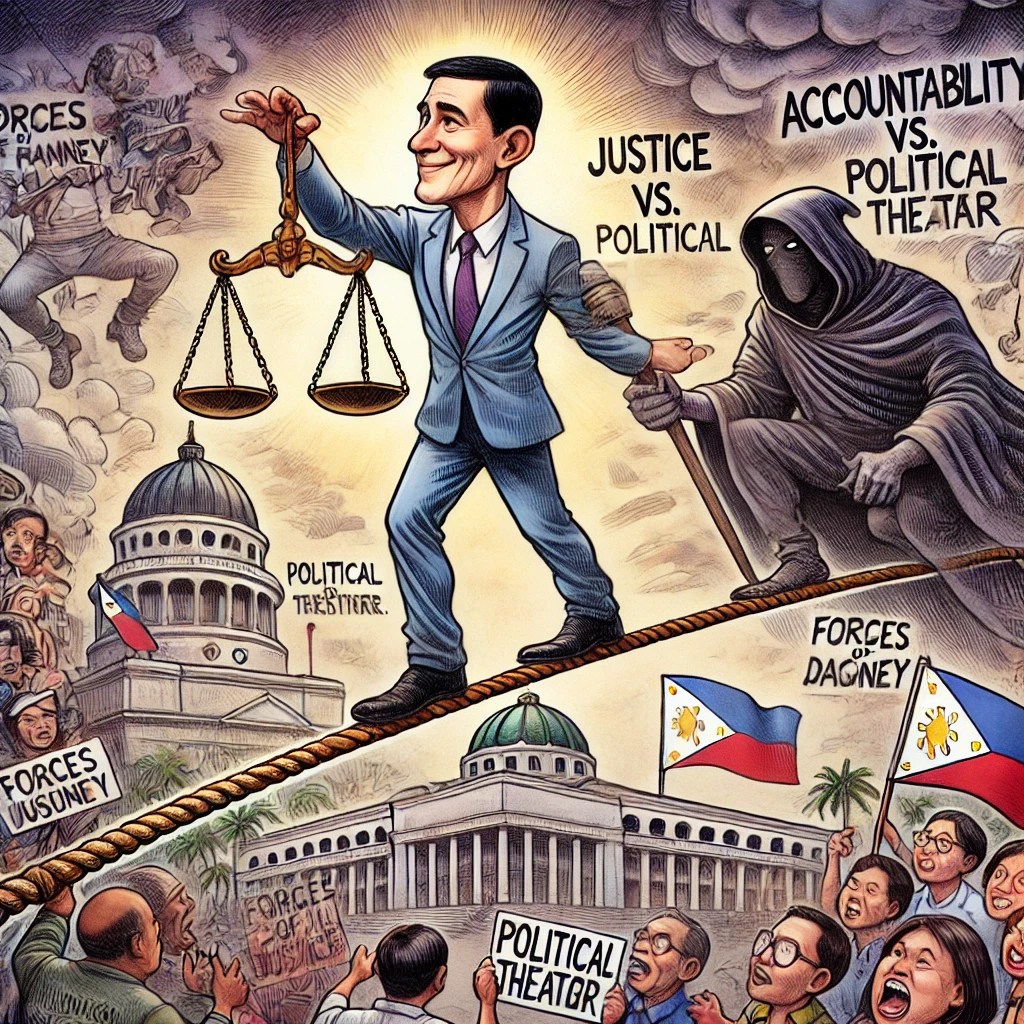
THE Philippine House of Representatives has rarely felt so charged with tension and purpose. Speaker Martin Romualdez’s voice cuts through the hall with a defiance that borders on the historic: “We will not yield to intimidation or pressure.” With these words, Romualdez casts their investigation into extrajudicial killings and Philippine Offshore Gaming Operators (POGOs) not just as a legal necessity but as a moral crusade, a battle to confront those who wield corruption and violence with impunity. This is no ordinary probe—Romualdez is calling it a defining test of justice for the nation.
These are powerful assertions, yet they unfold in a context laden with intense public scrutiny, political intrigue, and relentless media attention. The House’s quad committee probing the Duterte administration’s bloody drug war and the shadowy POGO industry finds itself both lionized and castigated. On one side, human rights advocates, former lawmakers, and segments of the public are calling for transparency and accountability. On the other, critics question the political motivations, raising suspicions that the probe may be little more than a calculated gambit to taint former President Duterte and his allies.
But Romualdez’s insistence that the House is “on the right side of history” is not merely political rhetoric. The Philippine Constitution mandates Congress to oversee and investigate actions that affect public interest, and Supreme Court rulings, such as Ocampo v. Enrile and Angara v. Electoral Commission, underscore the importance of legislative oversight in ensuring accountability. The Drug War and POGO probes, Romualdez argues, are anchored in this legal and patriotic responsibility. House Bills No. 10986 and 10987—the Anti-Extrajudicial Killing Act and Anti-Offshore Gaming Operations Act—are introduced as legislative shields to protect the nation from lawlessness, aiming to enshrine EJKs as heinous crimes and ban offshore gaming operations outright. These measures represent not only a response to past misdeeds but a preventative framework for the future.
The stakes, however, are high, and the opposition is fierce. Romualdez’s references to “forces of darkness” hint at the multifaceted resistance against the probe. Some critics and politicians with ties to the Duterte administration are rallying against what they see as an attempt to destabilize their legacy. Other opponents are financial beneficiaries of the unregulated POGO industry—an industry accused of not only circumventing taxes but also feeding organized crime and even human trafficking. These forces, Romualdez claims, are using misinformation, political pressure, and character attacks to undermine the integrity of the House probe.
Despite this opposition, the House’s commitment to pushing forward is, in many ways, a remarkable show of leadership. By consolidating the resources of multiple committees and bringing in diverse stakeholders, including law enforcement and human rights advocates, the House signals a dedication to a thorough investigation. This transparency strategy, Romualdez hopes, will quell public skepticism and inspire trust.
However, Romualdez’s assurance that the House stands as a bastion of justice and patriotism has not been universally embraced. Skeptics view the probe as a convenient weapon against Duterte’s legacy, particularly his brutal drug war, which claimed thousands of lives and prompted both domestic and international condemnation. For Duterte’s allies, the probe is less about justice and more about settling political scores. They argue that while EJKs and POGO-related crimes are serious, an inquiry led by a chamber composed of the opposition risks devolving into a partisan spectacle rather than a quest for truth.
To Romualdez and his supporters, however, these accusations miss the point. They argue that patriotism and public service demand holding those in power accountable, regardless of political ramifications. This resolve is underpinned by a belief in democratic principles and the notion that justice must prevail over political alliances. The Supreme Court has repeatedly upheld that Congress has not only the authority but the duty to scrutinize actions affecting national integrity and human rights—a mandate that transcends party lines.
Romualdez’s task is not without accomplishment. Already, the probe has uncovered legislative gaps, prompting calls for the enactment of comprehensive measures to address both EJKs and the POGO industry. The submission of documents for potential civil forfeiture proceedings against foreign nationals who illicitly obtained Filipino citizenship is another step towards accountability. These tangible outcomes provide credence to the House’s claim that the probe is productive and that its members are, indeed, acting in the interest of the Filipino people.
Yet the probe’s success will ultimately hinge on its ability to transcend partisanship and focus on systemic reform rather than retribution. For Romualdez, the goal is to show that the House can be an impartial body dedicated to good governance. But to truly be on the “right side of history,” the House must remain vigilant, ensuring that this investigation serves justice rather than political expedience.
Therein lies the tension—and the test. This investigation must walk a tightrope between addressing legitimate grievances and avoiding political theater. The task before Romualdez and his allies is daunting: to conduct a probe that is as transparent as it is rigorous, one that draws clear lines between accountability and partisan retribution. Only then can the House of Representatives claim with certainty that it has acted not only in the name of justice but on behalf of the Filipino people and the rule of law.
Whether this investigation will carve out justice or merely add to a history of forgotten promises is yet to be seen. But in a nation often paralyzed by silence, Romualdez’s bold stand could be the spark that reignites the Philippines’ long-dormant hope for accountability.

- “Forthwith” to Farce: How the Senate is Killing Impeachment—And Why Enrile’s Right (Even If You Can’t Trust Him)
- “HINDI AKO NAG-RESIGN!”

- “I’m calling you from my new Globe SIM. Send load!”

- “Mahiya Naman Kayo!” Marcos’ Anti-Corruption Vow Faces a Flood of Doubt

- “Meow, I’m calling you from my new Globe SIM!”

- “No Special Jail for Crooks!” Boying Remulla Slams VIP Perks for Flood Scammers

- “PLUNDER IS OVERRATED”? TRY AGAIN — IT’S A CALCULATED KILL SHOT

- “Several Lifetimes,” Said Fajardo — Translation: “I’m Not Spending Even One More Day on This Circus”

- “Shimenet”: The Term That Broke the Internet and the Budget

- “We Did Not Yield”: Marcos’s Stand and the Soul of Filipino Sovereignty

- “We Gather Light to Scatter”: A Tribute to Edgardo Bautista Espiritu

- $150M for Kaufman to Spin a Sinking Narrative




 KWEBA ni BAROK
Leave a comment