By Louis ‘Barok‘ C. Biraogo — November 10, 2024
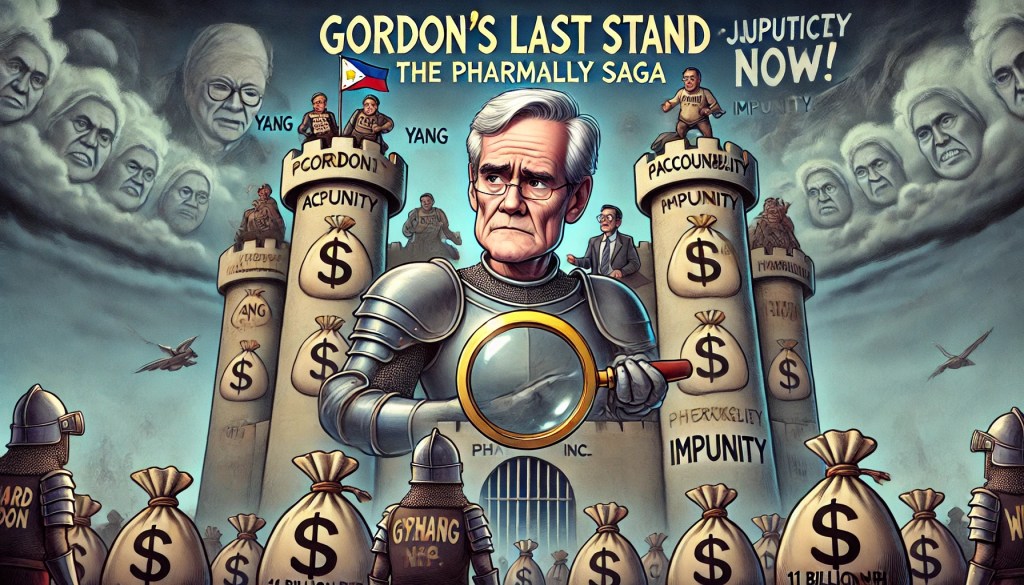
WITH every new detail, the Pharmally scandal pulls back the curtain on a disturbing pattern in Philippine governance. Richard Gordon, a crusader for accountability, finds himself at the center of a public reckoning that goes beyond money—it’s about the machinery of justice itself and the broken promise of reform. How much longer will Filipinos wait for accountability? And can this scandal finally tip the scales?
A Legacy of Relentless Accountability
Richard Gordon’s legacy is one of unyielding pursuit of truth and accountability. During his tenure as Chairman of the Senate Blue Ribbon Committee, he led numerous high-stakes investigations into corruption, most notably shining a spotlight on Pharmally Pharmaceutical Corp. and its alleged misuse of Php 11 billion in public funds. His frustration is palpable, as even after months of intense scrutiny, those implicated—like Michael Yang, a former economic advisor to President Rodrigo Duterte, and Lin Weixiong, Pharmally’s finance manager—have yet to be held accountable. The lavish purchases in Dubai, reportedly funded by diverted public money, are a harsh reminder of the reality for Filipinos who endured the pandemic without adequate resources while some profited obscenely.
Gordon’s assertion is that this corruption saga, enabled by political connections, went unchecked for far too long. The facts are clear: Pharmally, with just Php 625,000 in initial capital, somehow secured Php 11 billion in contracts. The Commission on Audit flagged these contracts for their irregularities, yet progress toward holding the implicated accountable has been dismally slow. The agencies with the authority to prosecute—such as the Department of Justice, Anti-Money Laundering Council, and the Ombudsman—seem to be treading water. Gordon has rightfully pointed out that these agencies have the machinery to act, yet they seem bogged down by bureaucracy or, worse, inhibited by political ties. His rallying cry, invoking the protection of taxpayers’ money, challenges the Filipino government to deliver justice in a system historically resistant to change.
Pharmally’s Political Shield
The Pharmally scandal exposes the sinister relationship between wealth, influence, and protection. Both Michael Yang and Lin Weixiong were allegedly shielded by their close associations with Duterte, who himself faces investigations at the International Criminal Court (ICC) over alleged human rights abuses. Yang, linked to Duterte since his days in Davao, has long been rumored to have ties to the drug trade and to clandestine financial dealings. His involvement in facilitating Pharmally’s government contracts underscores how politically connected figures can manipulate the system for personal gain.
Despite these allegations, the legal system has been agonizingly slow to react. As documented in previous Philippine scandals, wealth and connections afford a certain immunity, or at least indefinite delays. Consider the celebrated case of former President Joseph Estrada, convicted of plunder in 2007 yet later pardoned and allowed a return to politics. Despite strong evidence, he faced limited accountability, with the wheels of justice moving so slowly that consequences barely registered. In Pharmally’s case, those involved not only evaded accountability but profited on the run. The evidence is damning; real estate purchases totaling over $20 million in Dubai point to massive profiteering while the pandemic death toll climbed.
The Failures of Philippine Justice
The Pharmally case underscores systemic issues within the Philippine justice system—chiefly, its glacial pace and susceptibility to political pressure. Plunder cases, such as those under Republic Act No. 7080, should carry serious penalties including life imprisonment, asset forfeiture, and perpetual disqualification from public office. But past high-profile cases show a pattern of either exoneration or superficial punishment. Without decisive action from the Department of Justice, Anti-Money Laundering Council, and Ombudsman, Pharmally’s principals risk escaping unscathed, further eroding public trust in government institutions.
Gordon’s appeal to the Marcos administration is urgent and pointed: utilize the powers of the state to pursue the prosecution of those implicated and reclaim the illicit funds stashed abroad. However, political entanglements and the personal histories of certain officials present obstacles. The question remains whether President Marcos—whose family history also includes corruption allegations—has the political will to pursue justice without prejudice.
The Pushback: Challenges and Counterarguments
Critics of Gordon’s call for action argue that investigations should proceed cautiously to ensure fair trials. They point to due process, an argument often used to justify delays. However, delays in high-profile cases like Pharmally serve only to deepen public frustration. If past corruption cases serve as precedent, they suggest that justice delayed is indeed justice denied in the Philippines.
Another challenge to Gordon’s assertions is the blurred line between loyalty and accountability. The Philippines’ history is replete with political alliances that protect key players despite questionable actions. The connection between Pharmally’s principals and Duterte reveals a culture of patronage that, if not dismantled, will continue to erode public trust.
The Path Forward: Swift and Decisive Action
Gordon has presented a sound, evidence-based argument for urgency and decisive prosecution. The Department of Justice, Bureau of Internal Revenue, Ombudsman, and other concerned agencies must coordinate to prosecute civil, criminal, and administrative cases against those involved in the Pharmally case. Importantly, Philippine courts and law enforcement must not be seen as tools for political vendettas but as institutions committed to upholding the law.
Additionally, the Marcos administration must expedite efforts to reclaim the funds that Pharmally’s principals likely diverted. The Anti-Money Laundering Council should pursue foreign cooperation agreements to trace these assets, as plunder laws allow the state to recover ill-gotten wealth, especially when it has been smuggled abroad.
For the Filipino people, this case is an opportunity to demand integrity from their leaders and to rally for reforms that dismantle the “who you know” immunity that pervades the Philippine justice system. Corruption cases must not be left to stagnate in bureaucratic inaction; instead, they must be pursued with vigor, creating a precedent that corruption, even at the highest levels, is punishable.
Final Call
The Pharmally scandal stands as a litmus test for the Philippine justice system. Will it serve the public’s interests or bow to political pressures? Will the Marcos administration demonstrate the political will to bring those who stole from pandemic funds to justice? Or will this case become another chapter in the Philippine saga of impunity?
Only through swift and unyielding justice can the wounds of this scandal begin to heal. The verdict here may mark more than an end—it could be the beginning of a new era in Philippine governance, where accountability is no longer the exception, but the rule.
- ₱75 Million Heist: Cops Gone Full Bandit

- ₱6.7-Trillion Temptation: The Great Pork Zombie Revival and the “Collegial” Vote-Buying Circus

- ₱1.9 Billion for 382 Units and a Rooftop Pool: Poverty Solved, Next Problem Please

- ₱1.35 Trillion for Education: Bigger Budget, Same Old Thieves’ Banquet

- ₱1 Billion Congressional Seat? Sorry, Sold Out Na Raw — Si Bello Raw Ang Hindi Bumili

- “We Will Take Care of It”: Bersamin’s P52-Billion Love Letter to Corruption

- “Skewed Narrative”? More Like Skewered Taxpayers!

- “Scared to Sign Vouchers” Is Now Official GDP Policy – Welcome to the Philippines’ Permanent Paralysis Economy

- “Robbed by Restitution?” Curlee Discaya’s Tears Over Returning What He Never Earned

- “No Pressure” Luistro? The House Pork Bazaar Exposed
- “My Brother the President Is a Junkie”: A Marcos Family Reunion Special

- “Mapipilitan Akong Gawing Zero”: The Day Senator Rodante Marcoleta Confessed to Perjury on National Television and Thought We’d Clap for the Creativity



 KWEBA ni BAROK
Leave a comment