By Louis ‘Barok‘ C. Biraogo — November 14, 2024
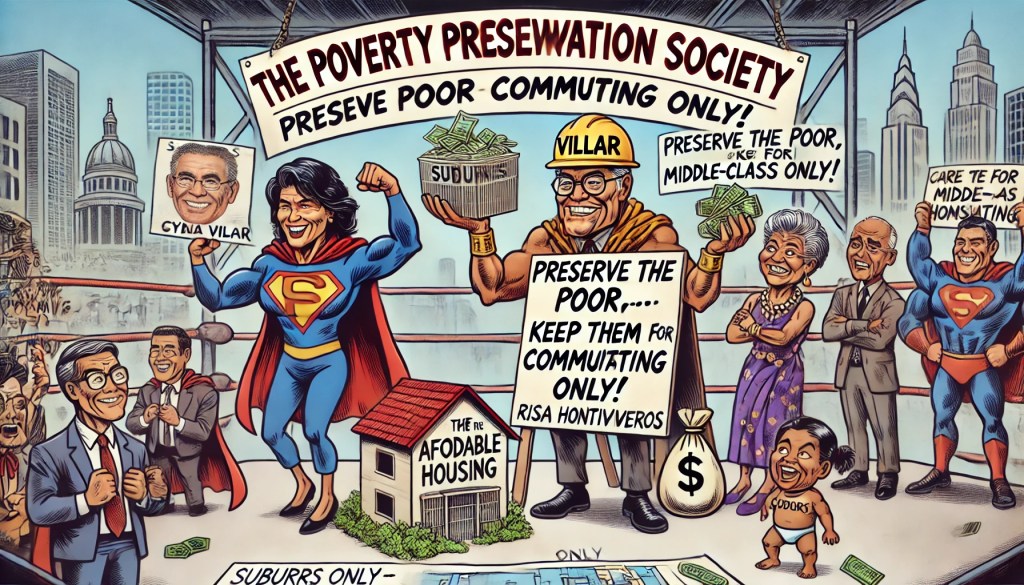
IN THE dystopian future Senator Cynthia Villar apparently fears, the nation’s poor might actually live near their workplaces—in buildings designed for people, no less! This terrifying vision was proposed by none other than the Department of Human Settlements and Urban Development, which Senator Risa Hontiveros, understandably, seemed to think was a good idea. Medium-rise condominiums! For low-income workers! In cities! Clearly, a nightmare Villar couldn’t let unfold.
Condominiums for the Poor? How Dare You!
The DHSUD has apparently forgotten a cardinal rule of Philippine real estate development: Only middle-class buyers get to live in urban condos. The poor should know their place—preferably miles away from job opportunities. In Villar’s view, proposing condos for low-income earners sounds as outrageous as suggesting that they be paid a living wage. She warns that these condos are a threat to, well, the very idea of poverty itself, which the poor might feel dangerously inclined to overcome if they don’t commute three hours each way for minimum-wage jobs.
Villar’s solution is simple: bring back the Community Mortgage Program (CMP), the tried-and-true way of keeping the poor occupied with the long-term project of owning land. Sure, they might live in makeshift housing and lack basic amenities, but as long as they have land, they’ll be rooted in Filipino ideals. Besides, we all know it’s only land ownership that separates middle-class citizens from the poor—what’s a little “home equity” in a concrete box when you can live on a plot of soil, right?
But What About the DHSUD’s Evil Master Plan?
On the other side of the debate, Hontiveros defends DHSUD’s plan as a bold, innovative program. “Condominiums,” she explains, are not only for the middle class. Through some financial wizardry, DHSUD has crunched the numbers, estimating that with subsidies, rent could go as low as P1,100 per month. Now, if you’re wondering if that’s less than the price of a meal for two in Manila, you’re absolutely right! But Villar isn’t buying it: in her world, the poor cannot possibly afford this price because they make only P500 a day. How dare they set aside two days of earnings for housing! Surely, they’d be happier in far-flung lots with no infrastructure, where they can truly “belong.”
To further fuel her suspicions, Villar accuses DHSUD of crafting this plan to give fat contracts to their construction buddies. Hontiveros fires back, arguing that the condos are necessary to keep the poor where they can easily access jobs and city services. But such amenities are clearly middle-class luxuries. Why should the poor expect to sleep within arm’s reach of their jobs, skipping the vital bonding exercise that is the overcrowded jeepney or endless MRT queue?
Conflict of Interest? Look Who’s Talking
Perhaps it’s no surprise that Villar, who happens to be part of a real estate dynasty that has built an empire on suburban housing, opposes this urban-centric plan. DHSUD’s scheme might just disrupt her family’s pristine pipeline of potential middle-class condo buyers, given that poor urbanites with their P1,100/month rent subsidies aren’t the kind of renters her family is trying to attract.
The Showdown: Whose Logic Wins?
In this clash of political titans, each side presents a compelling case. Villar’s claim that condos “aren’t for the poor” reminds us that poverty, like an endangered species, must be preserved in its natural habitat, at least a day’s commute from the central business district. Hontiveros, on the other hand, holds fast to the heretical belief that low-income earners, too, deserve the audacity of a 20th-century high-rise.
Let’s not forget the heart of the matter: land is expensive. Condo units make sense, as DHSUD points out, in limited urban spaces. Yet Villar, in her wisdom, can’t fathom such frivolity. After all, why should the government “waste” prime land on the poor when it could be better suited for another gated community?
“Helpful” Hints for Our Heroes: A Guide to Success (or Failure)
For Senator Villar: Consider rolling out a “Condos for a Cause” campaign. Raise funds to get high-rise properties off the ground—right out of reach for the poor. Perhaps, in collaboration with her family’s real estate empire, she could offer exclusive housing “packages” that require the poor to work only six days a week just to cover rent!
For Senator Hontiveros and DHSUD: Give the proposal a more appealing title. How about “Condos of Humility”? Rebrand the condos as spaces for character-building and teach essential virtues like “resilience” and “patience,” especially useful in dealing with multi-decade mortgages.
For Poor Filipinos: Stick to the time-honored tradition of “neighborly” low-rise lots and long commutes. Or better yet, ask Senator Villar’s real estate firm if they offer any discounts. If that doesn’t pan out, simply start saving now—just 50 years of socking away P500 a day should help!
Anyare, Villar? Where Do You Want the Poor?
So there we have it: a future where, under the wise guidance of Senator Villar, the poor will remain precisely where they belong—invisible from our view, conveniently distant from the condos and skyscrapers they helped build. And if DHSUD really cared, they’d understand that real compassion is ensuring the poor can wave hello to opportunity—from a few miles away. Who needs mixed-income housing when you can have scenic poverty instead?

- “Forthwith” to Farce: How the Senate is Killing Impeachment—And Why Enrile’s Right (Even If You Can’t Trust Him)

- “HINDI AKO NAG-RESIGN!”

- “I’m calling you from my new Globe SIM. Send load!”

- “Mahiya Naman Kayo!” Marcos’ Anti-Corruption Vow Faces a Flood of Doubt

- “Meow, I’m calling you from my new Globe SIM!”

- “No Special Jail for Crooks!” Boying Remulla Slams VIP Perks for Flood Scammers

- “PLUNDER IS OVERRATED”? TRY AGAIN — IT’S A CALCULATED KILL SHOT

- “Several Lifetimes,” Said Fajardo — Translation: “I’m Not Spending Even One More Day on This Circus”

- “Shimenet”: The Term That Broke the Internet and the Budget

- “We Did Not Yield”: Marcos’s Stand and the Soul of Filipino Sovereignty

- “We Gather Light to Scatter”: A Tribute to Edgardo Bautista Espiritu

- $150M for Kaufman to Spin a Sinking Narrative





 KWEBA ni BAROK
Leave a comment