By Louis ‘Barok‘ C. Biraogo — March 14, 2024
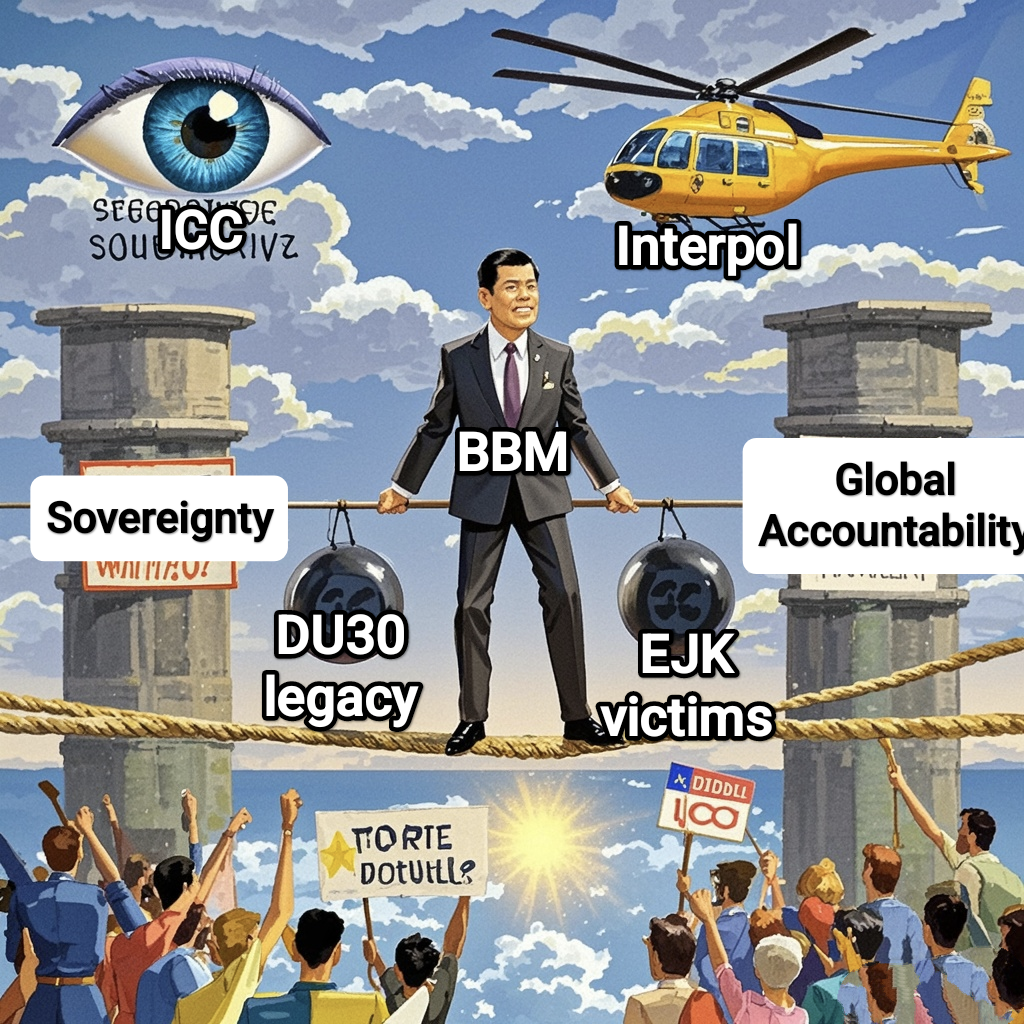
CAUGHT between asserting sovereignty and facing global scrutiny, the Philippines stands at a delicate moment of decision over Duterte’s ‘war on drugs’ legacy. While the Marcos administration has maintained the Philippines’ withdrawal from the Rome Statute, rejecting ICC jurisdiction, it has shown a conditional openness to cooperating with Interpol, should the organization issue a red notice at the ICC’s request. This nuanced stance underscores deep-rooted questions about international law, national sovereignty, the politics of accountability, and the broader global justice landscape.
Historical and Legal Context of the ICC and Interpol Red Notice
When the ICC began its preliminary examination of Duterte’s “war on drugs” in 2018, the Philippines’ response was swift: then-President Duterte announced the Philippines’ intent to withdraw from the Rome Statute. This withdrawal became effective in 2019, theoretically barring ICC jurisdiction on future matters but leaving questions open about accountability for alleged crimes committed while the Philippines was a party to the Rome Statute.
The ICC has nonetheless pressed forward, asserting that the Philippines remains accountable for alleged offenses occurring within its prior membership. The potential issuance of an Interpol red notice, however, brings a different dimension: while not an arrest warrant, a red notice alerts member states globally of a person’s wanted status for potential provisional arrest. For a nation like the Philippines, with an extensive overseas workforce and reliance on global cooperation networks, compliance with such international alerts can carry significant diplomatic and practical implications.
The Legal Rationale: Why Cooperate with a Red Notice?
- Sovereignty and International Responsibility: The Marcos administration may argue that upholding a red notice aligns with its broader commitment to law enforcement and rule of law. Philippine procedural laws, as well as past Philippine Supreme Court rulings, have repeatedly emphasized that compliance with international protocols, especially those not undermining sovereignty, is a duty bound by both practical governance and ethical standards.
- Interpol and Practical Necessity: The Philippines’ participation in Interpol reflects its practical need for collaboration in combating transnational crime. Given the country’s extensive OFW community and the potential exposure to criminality affecting Filipinos abroad, participation in Interpol’s alerts, including red notices, supports a reciprocal relationship. Denying cooperation in high-profile cases, even for political figures, could weaken future Philippine appeals for Interpol assistance.
- Ethics and Accountability Standards: Philippine ethical standards and the constitutional mandate on upholding justice can be viewed as extending to international accountability frameworks when necessary. Supporting the red notice could demonstrate a commitment to human rights and transparency, potentially enhancing the Philippines’ standing in global justice discussions.
- Precedents and Sovereignty Compatibility: The Philippine Supreme Court has often recognized international protocols that do not directly infringe on sovereignty or contradict Philippine constitutional law, notably in cases that affect national security or public welfare. While the ICC has no formal jurisdiction post-withdrawal, the Philippines could recognize the Interpol notice as a practical means of pursuing justice within acceptable sovereign boundaries.
The Legal Obstacles: Why Resist a Red Notice?
- Sovereign Rights and Jurisdictional Limits: A key argument against cooperating with the ICC via Interpol is rooted in sovereignty. The Marcos administration, like Duterte’s, has asserted that ICC jurisdiction ended with the Rome Statute withdrawal, an act expressly aimed at preserving Philippine sovereignty over such matters. This stance implies that cooperating with an ICC-backed red notice contradicts this sovereign right and undermines the 2019 withdrawal intent.
- Domestic Due Process Rights: The red notice could be seen as circumventing Philippine legal processes, particularly Duterte’s due process rights under Philippine law. Extraditing a former president without exhausting national-level remedies could be argued as inconsistent with domestic legal protections, especially when Philippine courts have yet to rule on Duterte’s liability conclusively.
- Political Stability and Practical Risks: Implementing the red notice could lead to political instability. Duterte’s supporters maintain a substantial influence, and potential internal unrest, protests, and even factional division could impact governance. Moreover, Marcos could face political repercussions, as cooperating with an ICC-driven process may alienate a key demographic and shift the internal political balance.
- Potential Diplomatic Fallout: If viewed as capitulating to ICC influence despite the official withdrawal, cooperation might set a precedent for other cases, risking diplomatic isolation. The Philippines could be seen as vulnerable to external pressures, potentially affecting future negotiations and relations with nations concerned about similar sovereignty issues.
The Strategic Imperative: The Best Way Forward
While both perspectives hold weight, arguments for honoring the red notice arguably have a practical and ethical advantage. Given the Philippines’ global interconnectivity and reliance on international cooperation, compliance would underscore the Marcos administration’s commitment to international standards without rejoining the ICC directly. The ethical implications of upholding justice mechanisms—even conditionally—may also reinforce the Philippines’ credibility on a broader international stage.
Recommendations
For the Marcos Administration:
- Continue Conditional Cooperation: By clarifying its stance as adherence to Interpol rather than the ICC, the Marcos administration can balance respect for sovereignty with international obligations.
- Strengthen Domestic Oversight: Ensure that any cooperation respects Philippine due process, perhaps by creating a transparent, domestically-based review mechanism for the red notice.
For Duterte:
- Consider Voluntary Cooperation: Engaging with international mechanisms on his terms could preempt harsher repercussions and show a willingness to defend his actions transparently.
For the ICC:
- Leverage Multilateral Diplomacy: Collaborate with other nations to encourage Philippine compliance within diplomatic bounds rather than coercive measures, thus respecting sovereignty while promoting accountability.
For Interpol:
- Emphasize Non-Political Standards: By clearly delineating the red notice as a law enforcement tool rather than an ICC-driven action, Interpol can maintain neutrality, encouraging Philippine cooperation without appearing politically partial.
For Filipinos:
- Engage in Public Discourse on Accountability: Citizens can push for clarity on international cooperation standards, advocating for a legal system that respects both national rights and international norms of justice.
As the Marcos administration charts its path forward, it holds a rare chance to redefine Philippine sovereignty on the global stage. By embracing a nuanced approach to international responsibility, the government could demonstrate that a nation can honor its own values without turning its back on global justice. In seizing this opportunity, the Philippines might just set a precedent that echoes far beyond its borders

- “Forthwith” to Farce: How the Senate is Killing Impeachment—And Why Enrile’s Right (Even If You Can’t Trust Him)

- “HINDI AKO NAG-RESIGN!”

- “I’m calling you from my new Globe SIM. Send load!”

- “Mahiya Naman Kayo!” Marcos’ Anti-Corruption Vow Faces a Flood of Doubt

- “Meow, I’m calling you from my new Globe SIM!”

- “No Special Jail for Crooks!” Boying Remulla Slams VIP Perks for Flood Scammers

- “PLUNDER IS OVERRATED”? TRY AGAIN — IT’S A CALCULATED KILL SHOT

- “Several Lifetimes,” Said Fajardo — Translation: “I’m Not Spending Even One More Day on This Circus”

- “Shimenet”: The Term That Broke the Internet and the Budget

- “We Did Not Yield”: Marcos’s Stand and the Soul of Filipino Sovereignty

- “We Gather Light to Scatter”: A Tribute to Edgardo Bautista Espiritu

- $150M for Kaufman to Spin a Sinking Narrative








 KWEBA ni BAROK
Leave a comment