Louis ‘Barok‘ C. Biraogo — November 26, 2024
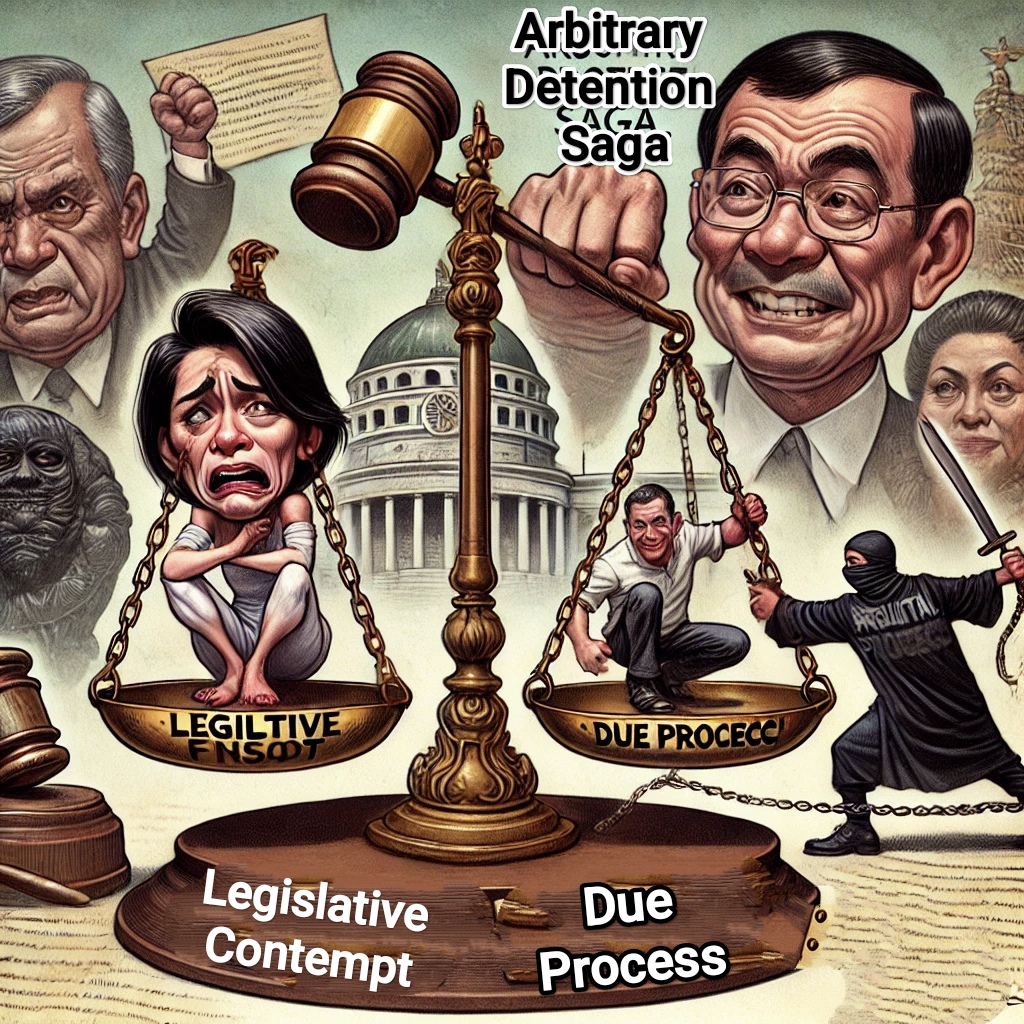
WHEN does accountability cross the line into coercion? For Zuleika Lopez, Chief of Staff to Vice President Sara Duterte, her detention on contempt charges may represent more than just the rule of law—it may signal the weaponization of legislative authority. This controversy raises uncomfortable questions: Are lawmakers protecting the public interest, or are they wielding their power unchecked?
The Storm Brews: A Look at the Controversy
Lopez’s detention arose during legislative hearings into the alleged misuse of confidential funds under the Office of the Vice President (OVP) and Department of Education during Duterte’s tenure. Cited for contempt, Lopez was initially detained in a House facility before being transferred to the Correctional Institution for Women. This move was criticized by former House Speaker Pantaleon Alvarez, who argued that the transfer lacked legal basis and violated jurisdictional norms. Alvarez also suggested that this action constituted arbitrary detention, potentially exposing those responsible, including current Speaker Martin Romualdez, to criminal liability.
The political backdrop is equally significant. Allegations of harassment and political pressure targeting Duterte and her allies add a layer of complexity, fueling claims that the transfer was motivated by partisan interests rather than legitimate legislative concerns.
The Legal Basis for Alvarez’s Claims
- Jurisdictional Overreach
- Alvarez contends that detention should be confined to facilities under the jurisdiction of the House of Representatives. House rules specify that individuals cited for contempt can be detained “in such place as the Chairperson or acting Chairperson may designate.” However, this provision is generally understood to refer to House-controlled facilities, not correctional institutions under the executive branch.
- Philippine Supreme Court Precedent: Arnault v. Nazareno (1950) underscored that legislative contempt power must be exercised within constitutional and procedural limits, emphasizing that detention is coercive rather than punitive.
- Violation of Due Process
- The abrupt transfer to a correctional facility without clear justification or procedural safeguards raises due process concerns. Lopez reportedly suffered a panic attack, highlighting the potential for undue harm.
- Constitutional protections under Article III, Section 1 (right to due process) and Section 12 (protection against coercion during investigations) may have been violated.
- Arbitrary Detention
- Under Article 124 of the Revised Penal Code, arbitrary detention occurs when a public officer detains a person without legal grounds. If the transfer lacked procedural and substantive justification, those responsible could face criminal liability.
- The transfer to a correctional facility typically reserved for convicted individuals suggests a punitive intent, contravening the coercive nature of legislative detention.
1. Challenging Alvarez’s Claims: The Legal Counterarguments
- Inherent Legislative Power
- Congress possesses broad discretion to enforce its rules and punish for contempt. The power to detain individuals who obstruct legislative inquiries is well-established under Arnault v. Nazareno.
- The House may argue that the phrase “such place as the Chairperson may designate” provides sufficient flexibility to transfer detainees to facilities like correctional institutions, particularly if security or logistical concerns warrant such a move.
- Legislative Autonomy and Separation of Powers
- The judiciary generally defers to legislative bodies regarding internal procedural matters. The Supreme Court in Cruz v. People (2000) reaffirmed the principle of separation of powers, which limits judicial intervention in legislative processes.
- Critics of Alvarez’s position might argue that challenging the detention location undermines Congress’s autonomy and its ability to perform investigative functions effectively.
- Proportional Response to Contempt
- If Lopez’s conduct significantly disrupted legislative proceedings, transferring her to a more secure facility could be justified as a proportionate response to ensure compliance.
The Contested Terrain: Who Holds the Advantage?
The arguments against the legality of Lopez’s detention in a correctional facility appear stronger. Alvarez’s position is bolstered by constitutional protections, procedural requirements, and established jurisprudence emphasizing the coercive (rather than punitive) nature of legislative contempt. The transfer to a correctional facility likely oversteps jurisdictional and proportionality boundaries, exposing potential violations of due process and arbitrary detention laws.
Recommendations
For Alvarez
- File a formal complaint or petition for judicial review to clarify the limits of legislative contempt power, particularly concerning detention locations.
- Advocate for stricter adherence to procedural safeguards in contempt proceedings to prevent future overreach.
For Speaker Romualdez and the House
- Review and amend House rules to provide clear guidelines on the detention of individuals cited for contempt, ensuring consistency with constitutional rights and jurisprudence.
- Establish oversight mechanisms to prevent the abuse of legislative powers for political purposes.
For Vice President Duterte and Lopez
- Explore legal remedies, including habeas corpus, to challenge the legality of the transfer.
- Engage in public discourse to emphasize the importance of due process and institutional accountability.
For the Filipino Public
- Demand transparency in legislative proceedings to ensure that the exercise of contempt power serves legitimate ends rather than political interests.
- Advocate for reforms to strengthen checks and balances, protecting individuals from potential abuses of authority.
Conclusion
The saga of Zuleika Lopez forces us to confront a critical question: When does the pursuit of accountability turn into overreach? As the Philippines navigates this controversy, it must tread carefully—balancing the need for order with respect for constitutional rights. History shows that unchecked power erodes trust; the challenge now is ensuring that this moment strengthens democracy, not weakens it.

- “Forthwith” to Farce: How the Senate is Killing Impeachment—And Why Enrile’s Right (Even If You Can’t Trust Him)

- “HINDI AKO NAG-RESIGN!”

- “I’m calling you from my new Globe SIM. Send load!”

- “Mahiya Naman Kayo!” Marcos’ Anti-Corruption Vow Faces a Flood of Doubt

- “Meow, I’m calling you from my new Globe SIM!”

- “No Special Jail for Crooks!” Boying Remulla Slams VIP Perks for Flood Scammers

- “PLUNDER IS OVERRATED”? TRY AGAIN — IT’S A CALCULATED KILL SHOT

- “Several Lifetimes,” Said Fajardo — Translation: “I’m Not Spending Even One More Day on This Circus”

- “Shimenet”: The Term That Broke the Internet and the Budget

- “We Did Not Yield”: Marcos’s Stand and the Soul of Filipino Sovereignty

- “We Gather Light to Scatter”: A Tribute to Edgardo Bautista Espiritu

- $150M for Kaufman to Spin a Sinking Narrative







 KWEBA ni BAROK
Leave a comment