By Louis ‘Barok‘ C. Biraogo – November 27, 2024
PHILIPPINE politics has rarely seen a confrontation this incendiary: Vice President Sara Duterte’s alleged threats against President Ferdinand Marcos Jr. have turned the corridors of power into a battlefield. As legal and ethical landmines threaten governance, this analysis dives deep into the arguments, laws, and solutions that could shape the nation’s future.
Setting the Scene: A Contextual Overview
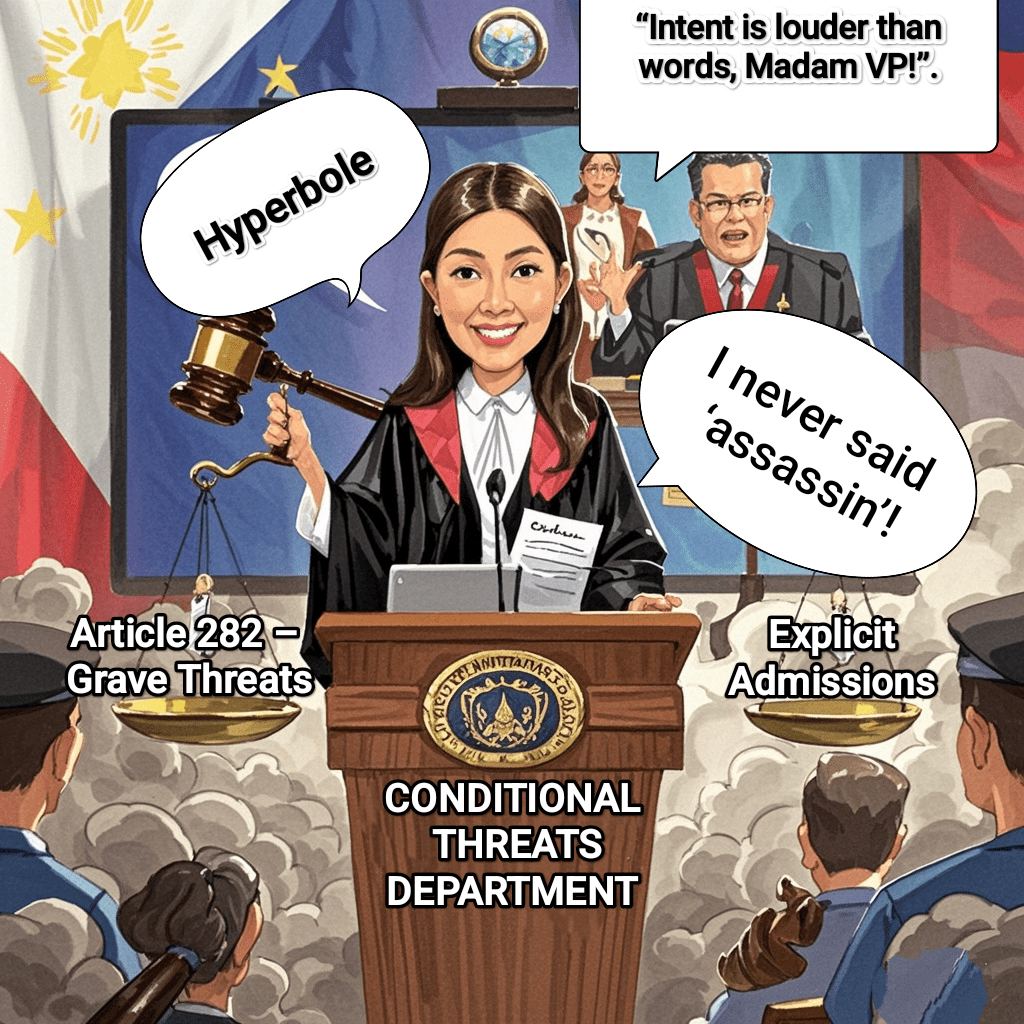
Vice President Sara Duterte’s remarks during a profanity-laced Zoom press conference have stirred a significant political and legal storm in the Philippines. While she claims not to have used the term “assassin,” her explicit admission of instructing a third party to kill President Ferdinand Marcos Jr., First Lady Liza Araneta-Marcos, and House Speaker Martin Romualdez in retaliation for her potential assassination has been interpreted by many as a credible threat. The Presidential Communications Office (PCO) escalated the matter, framing her statements as a national security concern and triggering investigations by the Department of Justice (DOJ) and the National Bureau of Investigation (NBI). Calls for impeachment further highlight the gravity of this controversy.
The Legal Case Against Duterte
- Grave Threats Under the Revised Penal Code (RPC)
- Article 282 of the RPC defines grave threats as the act of threatening another person with a crime, contingent or otherwise. Duterte’s remarks, even if conditional, fulfill the elements of this crime:
- Specific Threat: She identified targets (Marcos, his wife, Romualdez).
- Contingency: The instruction to kill them was dependent on her own death.
- Credibility: Duterte admitted having “talked” to someone who agreed to carry out her instructions, suggesting intent and capability.
- Article 282 of the RPC defines grave threats as the act of threatening another person with a crime, contingent or otherwise. Duterte’s remarks, even if conditional, fulfill the elements of this crime:
- Cybercrime Prevention Act of 2012
- Since her statements were made during an online press conference, they may constitute cyber libel or cyber-enabled grave threats. Section 6 of the Act increases penalties for crimes committed through technology.
- Ethical Violations and CPRA Breaches
- Duterte, as a lawyer and public official, is bound by the Code of Professional Responsibility and Accountability (CPRA). Her statements could violate provisions requiring lawyers to uphold the Constitution (Canon I), maintain public confidence in the legal profession (Canon II), and avoid actions that bring the legal profession into disrepute.
- Philippine Supreme Court Precedents
- People v. Bocar (1994): Upheld that conditional threats can constitute grave threats if intent and potential for harm exist.
In Re: Suspension of Atty. Marcelo (2015): Reinforced lawyers’ ethical obligations to avoid conduct detrimental to public interest.
- People v. Bocar (1994): Upheld that conditional threats can constitute grave threats if intent and potential for harm exist.
The Legal Merit of Duterte’s Arguments
- Conditional Nature of Remarks
- Duterte’s defense hinges on the argument that her words were a “conditional act of revenge” rather than an imminent, active threat. She can argue that Article 282’s requirements for immediacy and the intent to cause fear were not met.
- Hyperbole Defense
- Political rhetoric often involves exaggerated statements. Duterte can claim her remarks, while inflammatory, were an expression of frustration and not meant to be taken literally.
- Absence of Specific Terminology
- The government’s use of the term “assassin” may be viewed as an overreach. Duterte’s avoidance of this term could weaken the argument that she actively conspired to assassinate the President and others.
- Procedural Issues and Political Context
- Duterte could assert that the investigation is politically motivated, especially given her strained relationship with the Marcos administration. She may highlight the absence of due process and argue that the government’s framing of her remarks violated her right to a fair investigation.
- Supreme Court Precedents on Free Speech
- Chavez v. Gonzales (G.R. No. 168338, 2008): The Court underscored the broad protection afforded to free speech, even controversial or critical remarks. Duterte might argue that her statements fall within the ambit of protected speech, especially as a public official addressing grievances.
The Facts Speak for Themselves: An Objective Assessment
The legal arguments against Duterte hold more weight due to the explicit nature of her instructions, her acknowledgment of premeditated discussions, and her repeated insistence that her words were “no joke.” The “conditional revenge” defense is weak when juxtaposed with the gravity of her statements. Conversely, Duterte’s avoidance of the term “assassin” and her emphasis on political context may resonate with her supporters but do little to absolve her of legal liability.
Recommendations
- For Sara Duterte
- Legal Strategy: Focus on procedural issues, emphasizing potential due process violations and political motivations.
- Public Communication: Adopt a measured tone, apologizing for any unintended consequences of her remarks to mitigate public backlash.
- Compliance: Fully cooperate with the NBI and DOJ investigations while challenging findings through appropriate legal channels.
- For the Department of Justice
- Impartial Investigation: Ensure a fair and transparent inquiry to avoid perceptions of political persecution.
- Focus on Substance: Prioritize the core elements of Duterte’s statements over the specific terminology used.
- For the Filipino Public
- Demand Accountability: Citizens must call for thorough investigations and hold leaders accountable for their actions.
- Protect Democratic Institutions: Avoid letting political rivalries overshadow the importance of safeguarding institutions and ethical governance.
Conclusion
Sara Duterte’s technical defense of not using the word “assassin” sidesteps the substantive issues surrounding her remarks. While her arguments may find limited traction in procedural defenses, the explicit nature of her instructions significantly undermines her position. Moving forward, this controversy will test the Philippines’ commitment to legal accountability, ethical governance, and the rule of law.

- ₱75 Million Heist: Cops Gone Full Bandit

- ₱6.7-Trillion Temptation: The Great Pork Zombie Revival and the “Collegial” Vote-Buying Circus

- ₱1.9 Billion for 382 Units and a Rooftop Pool: Poverty Solved, Next Problem Please

- ₱1.35 Trillion for Education: Bigger Budget, Same Old Thieves’ Banquet

- ₱1 Billion Congressional Seat? Sorry, Sold Out Na Raw — Si Bello Raw Ang Hindi Bumili

- “We Will Take Care of It”: Bersamin’s P52-Billion Love Letter to Corruption
- “Skewed Narrative”? More Like Skewered Taxpayers!

- “Scared to Sign Vouchers” Is Now Official GDP Policy – Welcome to the Philippines’ Permanent Paralysis Economy
- “Robbed by Restitution?” Curlee Discaya’s Tears Over Returning What He Never Earned

- “My Brother the President Is a Junkie”: A Marcos Family Reunion Special

- “Mapipilitan Akong Gawing Zero”: The Day Senator Rodante Marcoleta Confessed to Perjury on National Television and Thought We’d Clap for the Creativity

- “Just Following Orders” Is Dead: How the Hague Just Turned Tokhang’s Finest Into International Fugitives


 KWEBA ni BAROK
Leave a comment