By Louis ‘Barok‘ C. Biraogo — December 11, 2024
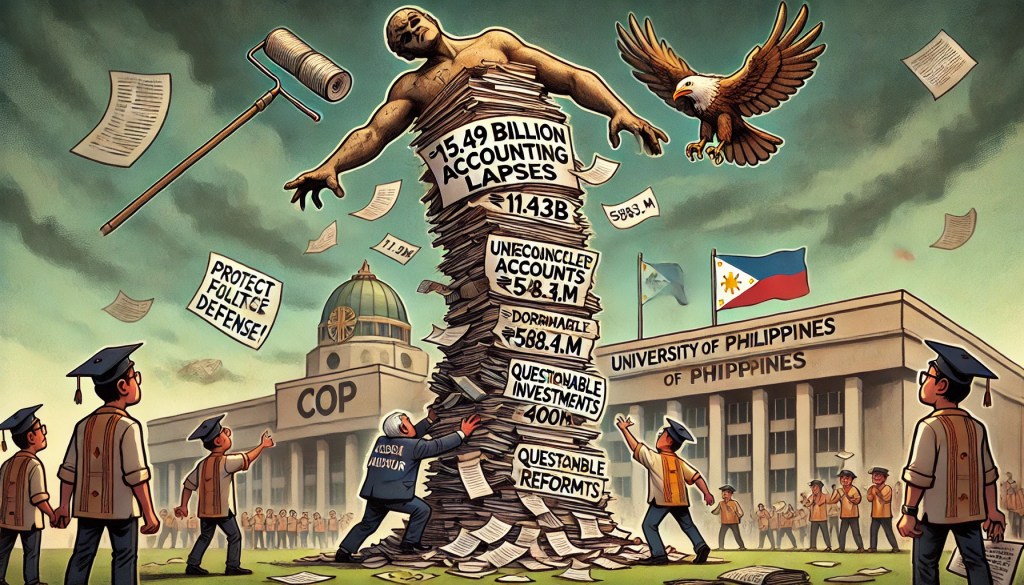
ONCE hailed as the crown jewel of Philippine academia, the University of the Philippines now faces a glaring question: how did ₱15.49 billion in accounting lapses for 2022 slip through the cracks? The Commission on Audit’s findings reveal more than just bookkeeping errors—they expose a potential crisis that could shake the institution to its core.
Overview of the Controversy
The COA report uncovers systemic accounting issues within UP, ranging from ₱11.43 billion in unreconciled discrepancies with funding agencies to ₱400 million in questionable investments. Other lapses include dormant accounts worth ₱583.4 million, negative cash balances of ₱74.7 million, and undocumented receivables and advances exceeding ₱1.3 billion. The findings paint a picture of an institution grappling with widespread financial mismanagement, exposing it to legal and reputational risks.
Examining the COA’s Report: A Deep Dive into the Findings
- Unreconciled Discrepancies (₱11.43 Billion): This substantial gap between UP’s financial records and those of its funding agencies reflects a breakdown in basic reconciliation processes. These lapses could suggest negligence or intentional disregard for financial protocols.
- Questionable Investments (₱400 Million): Funds earmarked for trust purposes were instead placed in long-term deposits and investments. Without proper guidelines or documentation, these actions could be deemed a violation of fiduciary duties under COA Circular No. 94-013 and the Government Auditing Code of the Philippines.
- Dormant and Misstated Accounts: Long-inactive accounts and erroneous reporting of assets, such as those in the UP Diliman University Hotel, reveal outdated financial systems and potential misappropriation risks.
- Negative Balances and Misstatements: Persistent unreconciled items, some dating back to 2007, reflect a failure to resolve legacy issues and adhere to Philippine Public Sector Accounting Standards (PPSAS).
The Legal Fallout: Assessing the Potential Consequences
Administrative Liabilities:
Public officials and employees found responsible for these lapses could face administrative sanctions under Republic Act No. 6713 (Code of Conduct and Ethical Standards for Public Officials and Employees). Sanctions may range from suspension to dismissal for gross neglect of duty.
Criminal Liabilities:
- Violation of Anti-Graft Laws: Misuse of public funds or negligence leading to losses could constitute a violation of Republic Act No. 3019 (Anti-Graft and Corrupt Practices Act), punishable by imprisonment and perpetual disqualification from public office.
- Technical Malversation: Reallocation of trust funds for unauthorized investments could be construed as technical malversation under the Revised Penal Code (Art. 220).
Civil Liabilities:
Individuals involved may be held personally liable for the restitution of misused funds under Republic Act No. 386 (Civil Code of the Philippines).
The Context of UP as a State University
UP’s status as a national university under Republic Act No. 9500 (UP Charter) complicates matters. While it enjoys institutional autonomy, it is still bound by laws governing public funds. The balance between academic freedom and fiscal accountability becomes a key issue.
The institution’s role as a public university means that lapses are not merely administrative issues but matters of public trust. This amplifies the pressure to address these discrepancies effectively.
The Case for UP: Presenting a Compelling Defense
Legal Strategies:
- Challenge COA Findings: UP could argue that discrepancies arose due to systemic issues in reconciling records with external agencies. Lack of proper communication channels between government offices may mitigate liability.
- Good Faith Defense: The absence of established investment guidelines could indicate an oversight rather than intentional misconduct. In “Araullo v. Aquino III” (G.R. No. 209287), good faith was a mitigating factor for public officials facing technical malversation charges.
- Institutional Autonomy Argument: UP’s unique governance structure under RA 9500 could shield it from some liabilities, emphasizing its academic mandate over administrative intricacies.
Mitigation and Reform:
- Immediate Rectification: Reconciling records, addressing dormant accounts, and revising financial guidelines can demonstrate a commitment to accountability.
- Internal Reforms: Establishing an independent auditing body within UP to monitor funds can serve as a compliance safeguard.
- Engaging Public Opinion: Highlighting UP’s pivotal role in nation-building could rally support for institutional reforms rather than punitive measures.
Beyond UP: The Wider Impact on Higher Education
This controversy extends beyond UP. It highlights systemic issues in financial governance within public institutions and underscores the need for enhanced oversight. Moving forward, reforms in state university governance should include:
- Adoption of standardized accounting systems.
- Increased funding tied to compliance benchmarks.
- Training programs for financial officers in public institutions.
Conclusion
This is more than a test of UP’s accounting practices—it is a test of its integrity and leadership. Will the nation’s most esteemed university rise to the challenge and lead by example? If UP can confront these failures with bold reforms and transparent governance, it won’t just restore trust—it will set a powerful precedent for accountability in public institutions.

- ₱75 Million Heist: Cops Gone Full Bandit

- ₱6.7-Trillion Temptation: The Great Pork Zombie Revival and the “Collegial” Vote-Buying Circus

- ₱1.9 Billion for 382 Units and a Rooftop Pool: Poverty Solved, Next Problem Please

- ₱1.35 Trillion for Education: Bigger Budget, Same Old Thieves’ Banquet

- ₱1 Billion Congressional Seat? Sorry, Sold Out Na Raw — Si Bello Raw Ang Hindi Bumili

- “We Will Take Care of It”: Bersamin’s P52-Billion Love Letter to Corruption

- “Skewed Narrative”? More Like Skewered Taxpayers!

- “Scared to Sign Vouchers” Is Now Official GDP Policy – Welcome to the Philippines’ Permanent Paralysis Economy
- “Robbed by Restitution?” Curlee Discaya’s Tears Over Returning What He Never Earned
- “No Pressure” Luistro? The House Pork Bazaar Exposed
- “My Brother the President Is a Junkie”: A Marcos Family Reunion Special

- “Mapipilitan Akong Gawing Zero”: The Day Senator Rodante Marcoleta Confessed to Perjury on National Television and Thought We’d Clap for the Creativity


 KWEBA ni BAROK
Leave a comment