By Louis ‘Barok‘ C. Biraogo — December 28, 2024
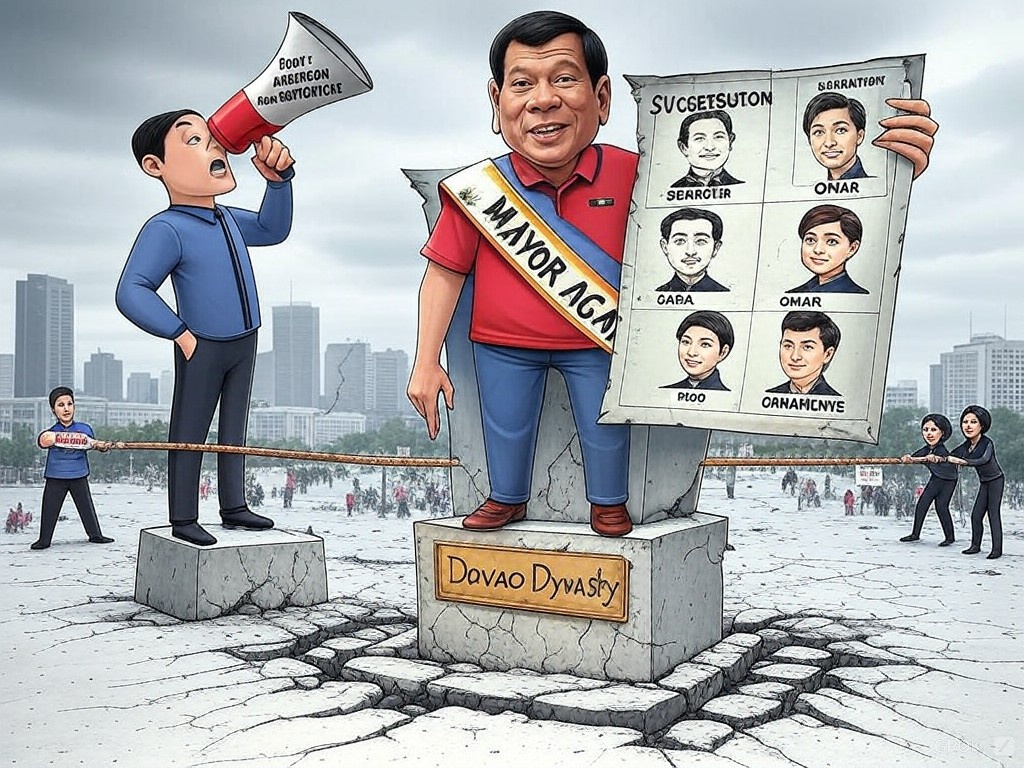
RODRIGO Duterte isn’t just running for mayor—he’s launching a litmus test for the Filipino people’s tolerance of political dynasties and nostalgia for strongman rule. Speaking to a massive crowd in Davao City, the former president declared, ‘Don’t abandon the Dutertes. We have not done you any wrong.’ But as cheers echoed through the streets, so did a troubling question: Is this the start of a new chapter, or the rehashing of an old playbook?
The Duterte Dynasty: A Family Affair in Davao Politics
Duterte’s return to local politics cannot be seen in isolation; it is an overt attempt to consolidate his family’s grip on power. His legacy is intertwined with the transformation of Davao City from a crime-ridden metropolis to one touted as a model of order under his iron-fisted rule. But this narrative obscures a deeper political strategy: the Duterte family’s succession plan.
By endorsing his son Sebastian as his running mate and hinting at future mayoralties for his grandsons Omar and Rigo, Duterte is entrenching a political dynasty that has ruled Davao almost uninterrupted for over three decades. This raises critical concerns about democratic representation in the region. Will the city’s electorate continue to vote for the familiar stability of the Dutertes, or could this dynastic approach provoke backlash from an increasingly disillusioned public?
Beyond Davao: National and International Ripples of Duterte’s Move
Duterte’s return comes at a moment of friction between his family and the Marcos administration. His daughter, Vice President Sara Duterte, faces multiple impeachment complaints, and her fiery rhetoric against President Marcos and Speaker Martin Romualdez signals a widening rift.
On the international stage, Duterte’s return may reignite concerns about his controversial policies, including the violent anti-drug campaign that left thousands dead and drew the ire of human rights advocates worldwide. The International Criminal Court (ICC) investigations into these extrajudicial killings loom large, raising speculation that Duterte’s local political involvement could be a shield against international scrutiny. His presence might also revive questions about his pivot toward China during his presidency, complicating the Marcos administration’s pro-West stance.
Davao’s Future: Progress or Peril Under Duterte’s Return?
Supporters argue that Duterte’s leadership could bring renewed economic growth and stability to Davao City. They point to his track record of infrastructure development and crime reduction. Yet the risks are equally stark. Critics fear that his return could usher in a resurgence of the authoritarian tendencies that marked his presidency, undermining human rights and exacerbating social inequalities.
Duterte’s assertion that his family has “never forsaken” Davao belies the complexities of his rule. While crime rates may have dropped, his methods—extrajudicial killings, fear-based governance—have left deep scars on the city’s social fabric. Can Davao thrive under a political dynasty that prioritizes control over pluralism?
The Shadow of Stability: Davao Under Duterte’s Rule
Duterte’s supporters often cite “political stability” as a hallmark of his governance. But stability, as it is framed here, hinges on suppressing dissent, consolidating power, and maintaining an aura of invincibility. True stability requires democratic institutions that can withstand challenges, not a reliance on one family’s dominance.
What Lies Ahead
Rodrigo Duterte’s return to Davao politics is more than a personal comeback; it is a litmus test for the durability of dynastic politics in the Philippines. As he vies for power once more, the people of Davao City—and the nation—must grapple with a critical question: does his leadership offer a path to progress, or is it a return to policies that prioritize control at the expense of democracy and human rights?
Duterte’s words echo like a drumbeat in Davao’s streets: ‘Don’t abandon the Dutertes.’ But the real question is whether his return marks the fortification of a political dynasty or the dawn of a rebellion against it. The stakes couldn’t be higher—for a city caught between loyalty and change, for a country at a crossroads, and for a legacy teetering on the edge of history.
- “Forthwith” to Farce: How the Senate is Killing Impeachment—And Why Enrile’s Right (Even If You Can’t Trust Him)
- “HINDI AKO NAG-RESIGN!”

- “I’m calling you from my new Globe SIM. Send load!”

- “Mahiya Naman Kayo!” Marcos’ Anti-Corruption Vow Faces a Flood of Doubt

- “Meow, I’m calling you from my new Globe SIM!”

- “No Special Jail for Crooks!” Boying Remulla Slams VIP Perks for Flood Scammers

- “PLUNDER IS OVERRATED”? TRY AGAIN — IT’S A CALCULATED KILL SHOT

- “Several Lifetimes,” Said Fajardo — Translation: “I’m Not Spending Even One More Day on This Circus”

- “Shimenet”: The Term That Broke the Internet and the Budget
- “We Did Not Yield”: Marcos’s Stand and the Soul of Filipino Sovereignty

- “We Gather Light to Scatter”: A Tribute to Edgardo Bautista Espiritu

- $150M for Kaufman to Spin a Sinking Narrative

 KWEBA ni BAROK
Leave a comment