By Louis ‘Barok‘ C. Biraogo — December 29, 2024
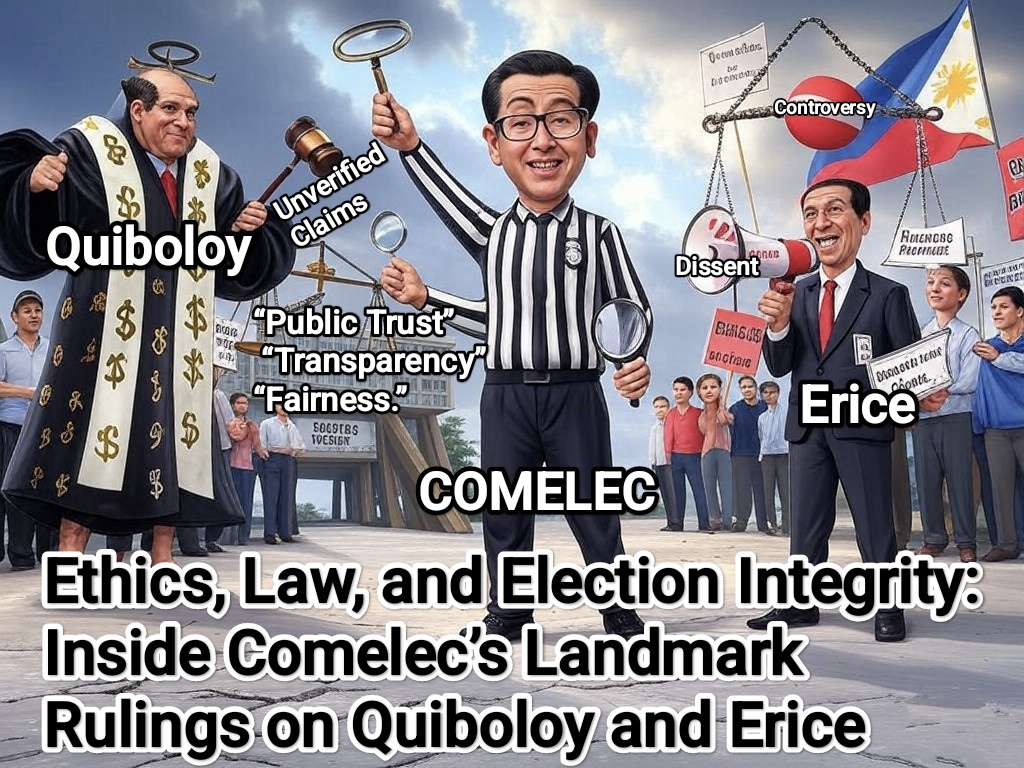
A preacher accused of heinous crimes gets the green light to run, while a veteran legislator is shown the door. The Comelec’s recent rulings on Apollo Quiboloy and Edgar Erice aren’t just about election laws—they’re a test of our nation’s values, public trust, and the fragile balance of electoral justice.
The Quiboloy Case: Examining the Legal Framework for Detained Candidates
Legal Framework
Quiboloy’s case centers on his right to run for public office despite facing multiple criminal charges, including indictments for sex trafficking and money laundering in the United States. Under Philippine law, the presumption of innocence until proven guilty is enshrined in Article III, Section 14(2) of the 1987 Constitution. Further, Section 12 of the Omnibus Election Code disqualifies candidates only upon conviction by final judgment of a crime involving moral turpitude or imprisonment of over one year.
Key Legal Arguments
- For Quiboloy’s Candidacy:
- Presumption of Innocence: Quiboloy’s legal team asserts that pending charges, no matter how severe, do not equate to a conviction.
- No Proof of Nuisance Candidacy: The Comelec found no evidence supporting claims that his candidacy mocked the electoral process or sought to evade prosecution.
- Against Quiboloy’s Candidacy:
- Ethical Concerns: Critics argue that allowing individuals facing serious charges to run undermines the moral fabric of public office.
- Practical Impediments: Quiboloy’s detention could hinder his ability to effectively serve if elected.
The Erice Case: Examining the Legal Framework for Undermining Elections
Legal Framework
Erice was disqualified for violating Section 261, Subsection Z11 of the Omnibus Election Code, which penalizes the deliberate spread of false and misleading information to disrupt elections. The provision aims to safeguard electoral integrity and prevent voter confusion.
Key Legal Arguments
- For Erice’s Disqualification:
- Election Integrity: The Comelec ruled that Erice’s dissemination of unverified claims against the P17.99 billion Miru Systems contract displayed intent to disrupt the elections.
- Limits of Free Speech: While freedom of speech is protected, the Supreme Court has held in Aquino v. Comelec that such rights are not absolute when they threaten public order or electoral integrity.
- Against Erice’s Disqualification:
- Chilling Effect on Criticism: Erice’s camp argues that the decision stifles legitimate political dissent, a cornerstone of democracy.
- Due Process Concerns: Questions arise about whether Erice received adequate opportunity to substantiate his claims or challenge the ruling.
Through the Lens of Law: Comparing the Comelec’s Decisions in the Quiboloy and Erice Cases
- Similarities:
- Both cases invoke constitutional rights: the right to suffrage in Quiboloy’s case and freedom of speech in Erice’s.
- Each decision reflects the Comelec’s mandate to balance individual rights against the collective good of electoral integrity.
- Differences:
- Nature of Conduct: Quiboloy’s case involves pending criminal charges unrelated to his candidacy, whereas Erice’s pertains directly to election-related misconduct.
- Jurisdictional Implications: Quiboloy faces both domestic charges filed in Philippine courts and international charges in the United States, whereas Erice’s case is exclusively domestic and directly tied to the Philippine electoral system.
The Comelec on Trial: Evaluating the Decisions in the Quiboloy and Erice Cases
Quiboloy Case
The Comelec’s ruling aligns with legal standards but draws criticism for its perceived disregard of ethical implications. The decision highlights a gap in Philippine law regarding the moral fitness of candidates with serious allegations.
Erice Case
While the Comelec is justified in penalizing disinformation, the ruling risks overreach if it inadvertently suppresses legitimate political critique. The lack of a clear standard distinguishing disruptive falsehoods from protected dissent poses concerns.
Recommendations
- For the Comelec:
- Establish clearer guidelines on nuisance candidacy and disinformation to ensure consistent and fair rulings.
- Enhance transparency in the decision-making process to bolster public confidence.
- For Candidates:
- Exercise ethical responsibility and respect for democratic processes, particularly in public discourse.
- Engage in legal reforms to address gaps in disqualification laws.
- For the Philippine Legal System:
- Amend election laws to include broader disqualification grounds for candidates facing serious charges, while safeguarding the presumption of innocence.
- Develop jurisprudence distinguishing malicious disinformation from protected speech to avoid overbroad applications of the law.
Conclusion
These rulings by the Comelec are not just decisions—they are turning points. Whether they will strengthen or erode public trust depends not only on the outcomes but on how we, as a nation, respond. Let this be a wake-up call: democracy thrives when vigilance becomes a habit, not an afterthought.

- “Forthwith” to Farce: How the Senate is Killing Impeachment—And Why Enrile’s Right (Even If You Can’t Trust Him)
- “HINDI AKO NAG-RESIGN!”

- “I’m calling you from my new Globe SIM. Send load!”

- “Mahiya Naman Kayo!” Marcos’ Anti-Corruption Vow Faces a Flood of Doubt

- “Meow, I’m calling you from my new Globe SIM!”

- “No Special Jail for Crooks!” Boying Remulla Slams VIP Perks for Flood Scammers

- “PLUNDER IS OVERRATED”? TRY AGAIN — IT’S A CALCULATED KILL SHOT

- “Several Lifetimes,” Said Fajardo — Translation: “I’m Not Spending Even One More Day on This Circus”

- “Shimenet”: The Term That Broke the Internet and the Budget

- “We Did Not Yield”: Marcos’s Stand and the Soul of Filipino Sovereignty

- “We Gather Light to Scatter”: A Tribute to Edgardo Bautista Espiritu

- $150M for Kaufman to Spin a Sinking Narrative


 KWEBA ni BAROK
Leave a comment