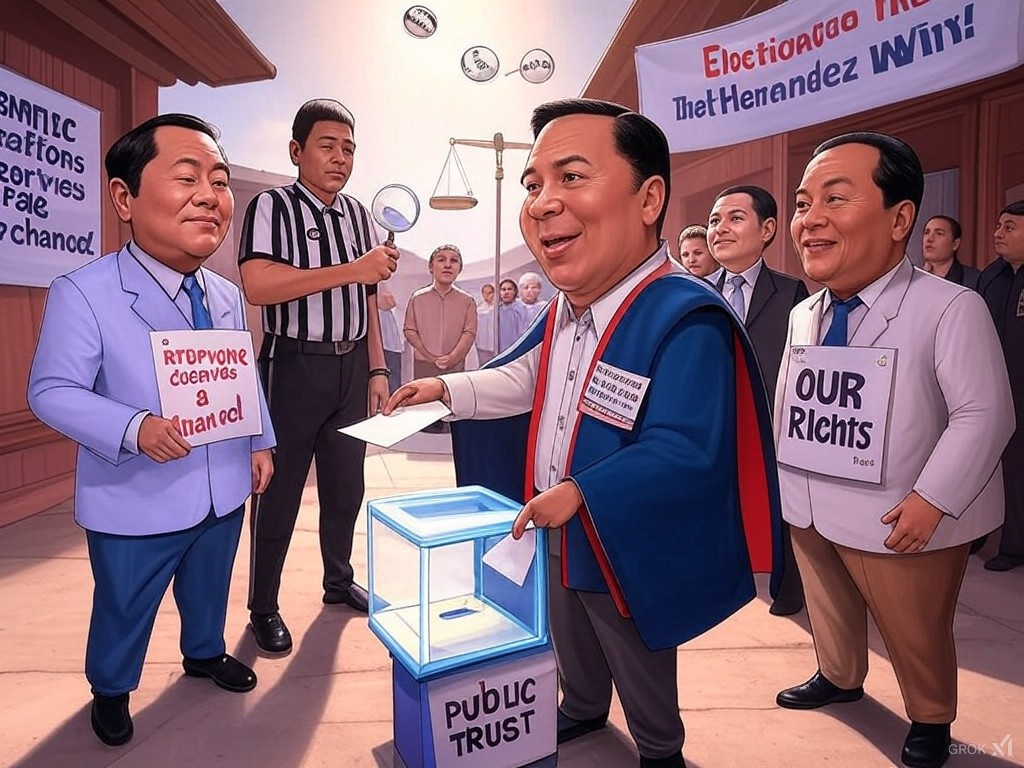
By Louis ‘Barok‘ C. Biraogo — January 21, 2025
IMAGINE stepping into the voting booth only to find three candidates with eerily similar names staring back at you. Is this democracy at work—or a deliberate attempt to muddy the waters? Laguna Governor Ramil Hernandez’s recent charges against two alleged nuisance candidates expose a high-stakes battle over voter rights, electoral ethics, and the role of the Commission on Elections (COMELEC). This analysis dives into the case’s complexities, offering fresh perspectives on its legal and moral dimensions.
Governor Hernandez’s Petition: Legal Grounds and Arguments
Key Legal Basis
Governor Hernandez’s petition to disqualify Winy and Dante Hernandez rests primarily on Section 69 of the Omnibus Election Code, which defines a nuisance candidate as one who:
- Prevents a faithful determination of the true will of the electorate.
- Seeks to confuse voters through similarity of names.
- Displays no bona fide intention to run for office.
The affidavit-complaints allege that:
- Winy Hernandez falsely claimed “Ram” as her nickname, despite being commonly known as “Winy” or “Winnie.”
- Dante Hernandez adopted the name “Romeo” to deliberately mislead voters.
Supporting Precedents
The 2022 case involving then-incumbent governor Henry Teves and Roel Degamo is a pivotal precedent. In that instance:
- The COMELEC invalidated votes obtained by a nuisance candidate with a similar name and credited them to Roel Degamo.
- The Supreme Court upheld the COMELEC’s decision, emphasizing the need to protect the electorate from confusion caused by name similarity.
Strengths
- The petition aligns with established legal standards for disqualifying nuisance candidates.
- Evidence, such as affidavits highlighting the respondents’ lack of genuine intent to use the contested nicknames, supports the claims.
- The ethical argument for electoral integrity resonates with public concerns about fair elections.
Weaknesses
- The petition heavily relies on intent, which can be challenging to prove without concrete evidence, such as direct communications or admissions of malice.
- The timing of the petition might raise concerns about political motives, especially given the governor’s influential position.
The Defense: Potential Counterarguments
Key Arguments
The respondents may argue that their candidacies are legitimate, invoking constitutional protections and challenging the sufficiency of evidence.
- Right to Political Participation
- Article V, Section 1 of the Philippine Constitution guarantees the right to vote and be voted for.
- Disqualifying candidates without compelling evidence infringes on their fundamental political rights.
- Lack of Evidence
- Section 69 requires proof of intent to confuse voters. The defense could argue that the petition lacks clear and convincing evidence.
- Nicknames such as “Ram” or “Romeo” may not be exclusive to Governor Hernandez and could be legitimately used.
- COMELEC’s Authority
- The COMELEC has the discretion to determine nuisance candidates. The defense might argue that the petition preempts this independent process.
- Chilling Effect on Democracy
- Disqualifying candidates based on subjective claims could set a dangerous precedent, discouraging grassroots candidates and favoring incumbents.
Strengths
- The constitutional argument holds significant weight and reflects the principle of inclusivity in Philippine elections.
- The burden of proof rests on the petitioner, making it challenging to establish intent without direct evidence.
Weaknesses
- If the respondents fail to demonstrate genuine intent to campaign seriously, their position weakens.
- Historical cases, such as the Degamo ruling, support stringent measures against name-based voter confusion.
The COMELEC’s Role and Responsibilities
The COMELEC plays a crucial role in adjudicating nuisance candidate cases. Under the Omnibus Election Code, it must:
- Investigate and resolve petitions promptly to prevent disruptions to the electoral process.
- Balance the right to political participation with the need to uphold fair and transparent elections.
Challenges
- Ensuring an expeditious yet thorough review process to avoid delaying ballot finalization.
- Addressing public skepticism about the impartiality of decisions involving high-profile figures like Governor Hernandez.
Potential Impact
- A ruling against the respondents could dissuade frivolous candidacies but also fuel allegations of bias in favor of powerful incumbents.
- Conversely, denying the petition might embolden similar strategies in future elections, undermining voter confidence.
Weighing the Arguments: A Comparative Assessment
- Governor Hernandez: His case is stronger if he can provide direct evidence of intent to mislead. The reliance on Section 69 and the Degamo precedent supports his claim.
- Alleged Nuisance Candidates: Their defense depends on disproving intent and leveraging constitutional protections.
Recommendations
For Governor Hernandez
- Strengthen the petition with irrefutable evidence, such as testimonies or public records disproving the respondents’ nicknames.
- Focus on the ethical implications of the respondents’ alleged actions to bolster public support.
For the Alleged Nuisance Candidates
- Provide evidence of genuine intent to run, including campaign plans and community support.
- Emphasize their constitutional right to participate in the democratic process.
For the COMELEC
- Implement transparent guidelines for assessing nuisance candidacy cases, ensuring consistency and fairness.
- Expedite the resolution of this case to minimize disruptions to the election timeline.
- Consider reforms allowing motu proprio action in local elections, akin to national positions.
Conclusion
This case reminds us that democracy is not just about rules but about vigilance. As COMELEC decides the fate of Winy and Dante Hernandez, it holds more than their political futures in its hands—it holds the public’s trust. The time to demand clarity, fairness, and accountability in our electoral processes is now. Because without these, elections become mere rituals, stripped of their true purpose: representing the people’s voice.

- “Forthwith” to Farce: How the Senate is Killing Impeachment—And Why Enrile’s Right (Even If You Can’t Trust Him)

- “HINDI AKO NAG-RESIGN!”

- “I’m calling you from my new Globe SIM. Send load!”

- “Mahiya Naman Kayo!” Marcos’ Anti-Corruption Vow Faces a Flood of Doubt

- “Meow, I’m calling you from my new Globe SIM!”

- “No Special Jail for Crooks!” Boying Remulla Slams VIP Perks for Flood Scammers

- “PLUNDER IS OVERRATED”? TRY AGAIN — IT’S A CALCULATED KILL SHOT

- “Several Lifetimes,” Said Fajardo — Translation: “I’m Not Spending Even One More Day on This Circus”

- “Shimenet”: The Term That Broke the Internet and the Budget

- “We Did Not Yield”: Marcos’s Stand and the Soul of Filipino Sovereignty

- “We Gather Light to Scatter”: A Tribute to Edgardo Bautista Espiritu

- $150M for Kaufman to Spin a Sinking Narrative






 KWEBA ni BAROK
Leave a comment