By Louis ‘Barok‘ C._№ Biraogo — January 22, 2025
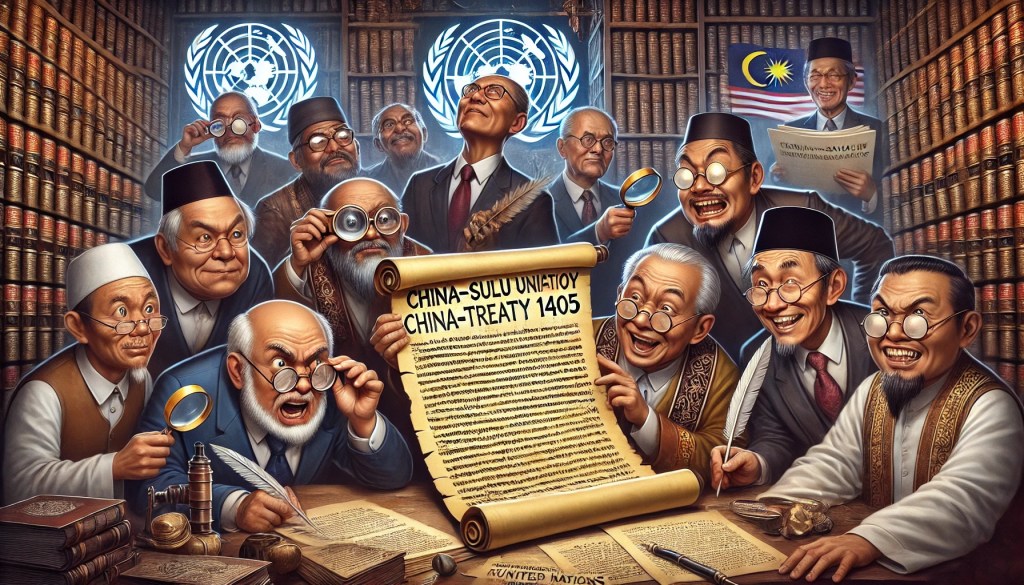
WHAT if the key to resolving the Sabah dispute lay buried in an 18th-century treaty and a series of overlooked legal precedents? The Mindanao Sulu Unification Movement (MSUM) has reignited this debate, invoking the China-Sulu Treaty in an audacious bid for UN recognition. But can history and law together tip the scales in one of Southeast Asia’s most heated territorial conflicts?
The MSUM’s Strategy: A Deep Dive into Their Historical and Legal Claims
Historical Events and Legal Precedents
The MSUM bases its claim on the Sultanate of Sulu’s historical sovereignty over North Borneo (Sabah), which it asserts predated both Spanish colonization of the Philippines and Malaysia’s formation. Key arguments include:
- The 1878 Agreement with the British North Borneo Company
- The Sultan of Sulu granted administrative rights to the British North Borneo Company in exchange for annual payments, interpreted as a lease rather than a cession of sovereignty.
- Malaysia, as the successor state, continues these payments but argues they are mere token gestures without territorial implications.
- Recognition by the British High Court and the U.S. Carpenter Agreement
- The MSUM highlights historical recognition of the Sultanate’s territorial jurisdiction, including legal rulings like the Carpenter-Kiram Agreement of 1915, which placed the Sultanate under U.S. protectorate while recognizing its titular sovereignty.
- Arbitral Award of 2022
- An arbitral tribunal awarded descendants of the Sultan $14.9 billion for Malaysia’s alleged breach of the 1878 agreement, though Malaysia disputes the award’s validity, arguing sovereignty is non-arbitrable.
The China-Sulu Treaty of 1405: Fact or Fiction?
Historical Evidence
While the MSUM claims the 1405 treaty under Admiral Sam Pao formalized trade and non-interference policies between the Ming Dynasty and the Sultanate of Sulu, historians question the existence and relevance of such a treaty:
- Authenticity: No definitive documentation exists proving a binding treaty was signed in 1405. The relationship likely resembled the tributary system, where Sulu sent tribute missions to China in exchange for trade privileges.
- Relevance: Even if genuine, a trade-based agreement from the 15th century has minimal bearing on modern territorial disputes, particularly regarding Sabah, which was never under direct Chinese administration.
The Sabah Dispute: Malaysia’s Legal and Historical Counterarguments
Malaysia’s sovereignty over Sabah rests on several key points:
- Formation of Malaysia in 1963
- Sabah became part of Malaysia through a referendum overseen by the United Nations, in which the majority of Sabahans supported joining Malaysia.
- Malaysia contends that this referendum supersedes historical agreements and reflects the people’s will.
- Interpretation of the 1878 Agreement
- Malaysia argues that the agreement with the British North Borneo Company constituted a cession of rights, not a lease, and that the annual payments are symbolic.
- Legal Finality
- Malaysia rejects the arbitration award and asserts that the Sabah claim is a resolved matter under international law.
The MSUM’s Case for Sabah: A Weighing of Strengths and Weaknesse
Strengths
- Historical Sovereignty: The Sultanate of Sulu’s pre-colonial control over Sabah provides a basis for ancestral claims.
- International Recognition: Past legal rulings and agreements lend some credibility to the claim.
- Symbolic Value: Invoking the China-Sulu relationship adds historical weight, even if its legal relevance is limited.
Weaknesses
- Modern Realities: The 1963 referendum and current geopolitical landscape diminish the relevance of pre-colonial claims.
- Legal Obstacles: Enforcing historical agreements in contemporary international law is fraught with challenges, especially against sovereign states.
- China-Sulu Treaty: The questionable authenticity and limited applicability of the 1405 treaty weaken its use as a cornerstone of the claim.
The Sabah Conundrum: Exploring Alternative Approaches for the Filipino Claimants
- Strengthen Legal Arguments
- Focus on enforcing the 2022 arbitral award and contesting Malaysia’s interpretation of the 1878 agreement in international courts.
- Diplomatic Engagement
- Foster regional dialogue with ASEAN nations to mediate the dispute and avoid escalating tensions.
- Garner international support by framing the claim as a matter of historical justice.
- Compromise Solutions
- Explore options for shared sovereignty or resource-sharing agreements with Malaysia to benefit both parties economically.
- Engage Sabahans
- Build trust with the people of Sabah by addressing their concerns and emphasizing potential benefits of renewed ties with the Sultanate.
Recommendations
For the MSUM and Philippine Government:
- Avoid overreliance on historically disputed treaties like the China-Sulu Treaty and focus on enforceable legal precedents.
- Prioritize collaboration with international legal experts to reinforce their case.
- Engage in public diplomacy to win international support and align with modern principles of self-determination.
For Malaysia:
- Address the underlying grievances of the Sulu heirs through transparent negotiations, potentially revisiting the 1878 agreement to ensure clarity.
For International Stakeholders:
- The United Nations or International Court of Justice could offer mediation or arbitration to ensure a peaceful resolution, though only with the agreement of both parties.
For Sabahans:
- Engage actively in discussions about their future, ensuring that their voices are central to any resolution.
Conclusion
As the MSUM wields the China-Sulu Treaty in its pursuit of Sabah, one question remains: can historical legacies shape modern outcomes? While the odds may not favor their claim, the effort underscores the importance of combining legal precision with diplomatic strategy. The Sabah dispute is not just about territory—it’s about the future of regional harmony and the lessons we choose to carry forward.

- ₱75 Million Heist: Cops Gone Full Bandit

- ₱6.7-Trillion Temptation: The Great Pork Zombie Revival and the “Collegial” Vote-Buying Circus

- ₱1.9 Billion for 382 Units and a Rooftop Pool: Poverty Solved, Next Problem Please

- ₱1.35 Trillion for Education: Bigger Budget, Same Old Thieves’ Banquet

- ₱1 Billion Congressional Seat? Sorry, Sold Out Na Raw — Si Bello Raw Ang Hindi Bumili

- “We Will Take Care of It”: Bersamin’s P52-Billion Love Letter to Corruption

- “Skewed Narrative”? More Like Skewered Taxpayers!

- “Scared to Sign Vouchers” Is Now Official GDP Policy – Welcome to the Philippines’ Permanent Paralysis Economy

- “Robbed by Restitution?” Curlee Discaya’s Tears Over Returning What He Never Earned

- “My Brother the President Is a Junkie”: A Marcos Family Reunion Special

- “Mapipilitan Akong Gawing Zero”: The Day Senator Rodante Marcoleta Confessed to Perjury on National Television and Thought We’d Clap for the Creativity

- “Just Following Orders” Is Dead: How the Hague Just Turned Tokhang’s Finest Into International Fugitives




 KWEBA ni BAROK
Leave a comment