By Louis ‘Barok‘ C. Biraogo — January 24, 2025
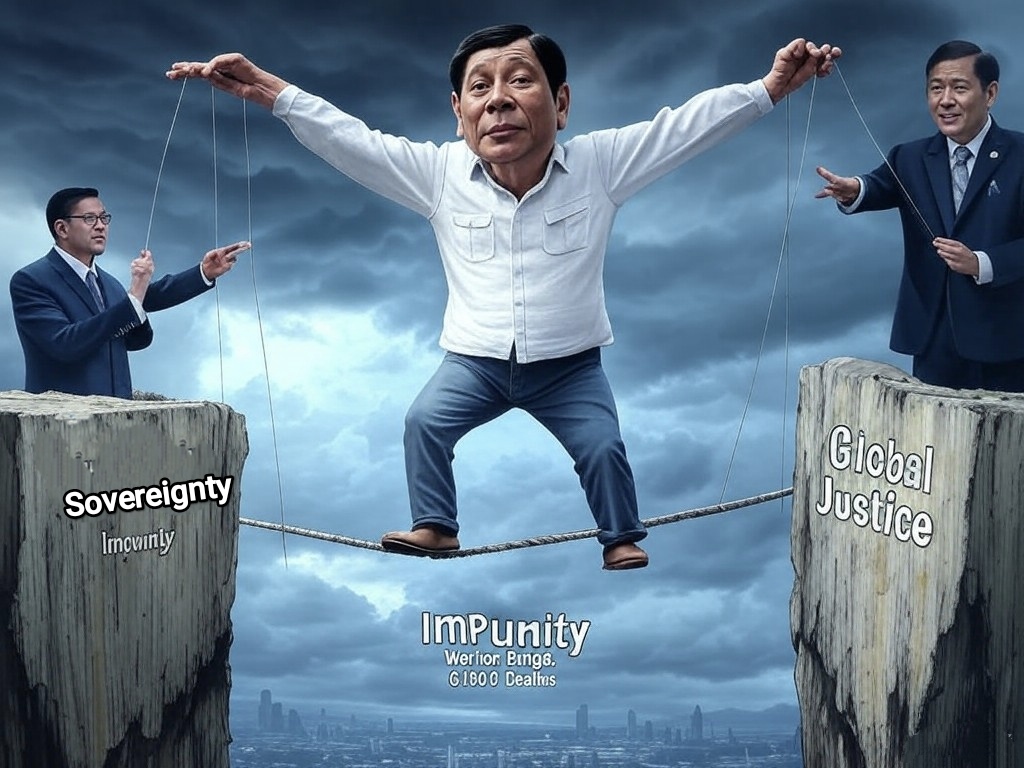
THE Philippines is teetering on the edge of a historic decision: will it defy the world to protect a former president, or will it surrender Rodrigo Duterte to face justice for the thousands killed in his brutal drug war? The government’s startling admission that it would ‘respond favorably’ to an Interpol request for Duterte’s arrest has ignited a firestorm of debate, forcing a nation to confront its darkest chapter.
The ICC’s investigation into Duterte’s alleged crimes against humanity—stemming from the extrajudicial killings of over 6,200 drug suspects during his presidency—has placed the Philippines in an unenviable position. The government’s decision to withdraw from the ICC in 2019, citing “baseless” and “outrageous” attacks on its sovereignty, was widely seen as an attempt to shield Duterte from accountability. But now, the specter of international justice looms large, and the Philippines must navigate a complex web of legal obligations, political loyalties, and moral imperatives.
Between Two Worlds: The Philippines’ Struggle to Balance Sovereignty and Global Comity
At the heart of this controversy is the tension between Philippine sovereignty and the principle of comity—the recognition of one nation’s laws by another. Executive Secretary Bersamin’s statement that the Philippines would honor an Interpol request, despite its withdrawal from the ICC, underscores this delicate balance.
Under Philippine law, the country’s withdrawal from the ICC does not absolve it of obligations incurred during its membership. The Vienna Convention on the Law of Treaties, to which the Philippines is a party, provides that withdrawal from a treaty does not affect rights, obligations, or legal situations created prior to withdrawal. This means that the ICC retains jurisdiction over crimes allegedly committed while the Philippines was still a member.
Moreover, the Philippines’ membership in Interpol complicates matters. Interpol’s constitution requires member states to cooperate in the pursuit of international criminals, and a “red notice” issued for Duterte would place significant pressure on the Philippine government. While a red notice is not an arrest warrant, it is a powerful tool that could force Manila to confront the ICC’s demands.
The Philippine Constitution also plays a role here. Article II, Section 2 declares that the Philippines “adopts the generally accepted principles of international law as part of the law of the land.” This provision has been interpreted by the Supreme Court in cases like Bayan v. Zamora (2000) to mean that international obligations, including those under treaties, are binding on the Philippine government.
Shadows of the Past: Revisiting Marcos and Estrada
This is not the first time the Philippines has faced a crisis of accountability. The ouster of Ferdinand Marcos in 1986 and the impeachment of Joseph Estrada in 2001 were watershed moments in the nation’s history, both marked by public outrage over corruption and abuse of power. Yet, in both cases, the pursuit of justice was fraught with political compromises. Marcos was allowed to flee to Hawaii, and Estrada was later pardoned by his successor, Gloria Macapagal Arroyo.
Duterte’s case, however, is different. The scale of the alleged crimes—thousands of extrajudicial killings—places it in the realm of crimes against humanity, a category of offenses that the international community has increasingly sought to prosecute. The ICC’s involvement raises the stakes, transforming what might have been a domestic issue into a global one.
The Chessboard of Power: Loyalty, Legacy, and Political Consequences
The current administration of President Ferdinand Marcos Jr. faces a delicate balancing act. On one hand, cooperating with the ICC could burnish the Philippines’ international reputation and signal a commitment to the rule of law. On the other hand, it risks alienating Duterte’s loyal base, which remains a potent political force.
Duterte himself has been characteristically defiant, declaring that he is willing to “go to prison and rot there for all time” if found guilty. This bravado, however, masks a deeper anxiety. The ICC’s investigation is not just about Duterte; it is about the system of impunity that allowed his drug war to flourish. A conviction would send a powerful message that no one, not even a former president, is above the law.
Recommendations: A Path Forward
- For the Philippine Government: The Marcos administration should fully cooperate with the ICC, not out of obligation but out of a commitment to justice. This would demonstrate that the Philippines is a nation that respects the rule of law, both domestically and internationally.
- For the ICC: The court must ensure that its proceedings are transparent and impartial. Any perception of bias could undermine its legitimacy and fuel nationalist backlash in the Philippines.
- For Civil Society: Filipino activists and human rights advocates must continue to push for accountability, both at home and abroad. The international community should support their efforts, providing resources and platforms to amplify their voices.
- For the International Community: Nations that value human rights and the rule of law should pressure the Philippines to cooperate with the ICC. This could include diplomatic measures, such as conditioning aid or trade agreements on compliance with international legal obligations.
Final Reflections: Conscience on Trial
The Philippines’ response to the ICC’s investigation is more than a legal or political issue; it is a test of conscience. Will the nation confront the dark legacy of Duterte’s drug war, or will it turn a blind eye to the suffering of thousands? The world is watching, and the stakes could not be higher.
In the end, the Philippines’ decision will not just be about Rodrigo Duterte—it will be about the kind of nation it aspires to be. Will it choose the path of justice, even when it’s hard, or will it falter, letting impunity prevail? The answer will define its future and its conscience.

- “Forthwith” to Farce: How the Senate is Killing Impeachment—And Why Enrile’s Right (Even If You Can’t Trust Him)
- “HINDI AKO NAG-RESIGN!”

- “I’m calling you from my new Globe SIM. Send load!”

- “Mahiya Naman Kayo!” Marcos’ Anti-Corruption Vow Faces a Flood of Doubt

- “Meow, I’m calling you from my new Globe SIM!”

- “No Special Jail for Crooks!” Boying Remulla Slams VIP Perks for Flood Scammers

- “PLUNDER IS OVERRATED”? TRY AGAIN — IT’S A CALCULATED KILL SHOT

- “Several Lifetimes,” Said Fajardo — Translation: “I’m Not Spending Even One More Day on This Circus”

- “Shimenet”: The Term That Broke the Internet and the Budget

- “We Did Not Yield”: Marcos’s Stand and the Soul of Filipino Sovereignty

- “We Gather Light to Scatter”: A Tribute to Edgardo Bautista Espiritu

- $150M for Kaufman to Spin a Sinking Narrative




 KWEBA ni BAROK
Leave a comment