
By Louis ‘Barok‘ C. Biraogo — January 28, 2025
Few words have shaped a nation’s identity as powerfully as the 14th Amendment to the U.S. Constitution. More than a legal provision, it is a moral covenant, forged in the aftermath of the Civil War—a solemn vow that all born on American soil are equal citizens. It reads: “All persons born or naturalized in the United States and subject to its jurisdiction, are citizens of the United States and of the State wherein they reside.” Ratified in 1868, this amendment was born out of the ashes of the Civil War, a direct response to the horrors of slavery and a commitment to ensuring that no one in America would ever again be denied the full rights of citizenship based on race or ancestry.
Yet, in 2018, the Trump administration sought to undermine this foundational principle by issuing an executive order aimed at redefining birthright citizenship. The Trump administration argued that children born to undocumented immigrants were not “subject to its jurisdiction” and therefore not entitled to automatic citizenship. This move was not just a legal overreach; it was a moral betrayal, an attempt to rewrite the Constitution to exclude the most vulnerable among us.
The Historical and Legal Foundations of Birthright Citizenship
The 14th Amendment was a radical act of inclusion, designed to ensure that formerly enslaved people and their descendants could never again be stripped of their rights. It was a repudiation of the Supreme Court’s infamous Dred Scott decision, which had declared that Black Americans could never be citizens. By guaranteeing birthright citizenship, the amendment sought to create a more inclusive and equitable society, one where no child would be born into a legal limbo.
The Supreme Court affirmed this principle in United States v. Wong Kim Ark (1898), ruling that a child born in the U.S. to Chinese immigrants was a citizen under the 14th Amendment. The Court’s decision was clear: birthright citizenship is a constitutional right, not a privilege to be granted or revoked at the whim of politicians.
The Trump administration’s attempt to reinterpret the “subject to its jurisdiction” clause was not only legally dubious but also historically ignorant. The phrase was never intended to exclude the children of undocumented immigrants; it was meant to exclude those who owed allegiance to a foreign power, such as diplomats or invading armies. To suggest otherwise is to distort history and undermine the very purpose of the 14th Amendment.
Fear Over Facts: The Misguided Logic Behind the Birthright Citizenship Crackdown
The Trump administration justified its executive order by invoking national security and immigration control, claiming that birthright citizenship incentivizes illegal immigration. This argument is not only unsupported by evidence but also deeply hypocritical.
There is no empirical data to suggest that birthright citizenship is a significant driver of illegal immigration. In fact, most undocumented immigrants come to the U.S. for work or to reunite with family, not to give birth. The administration’s focus on birthright citizenship was a distraction, a way to stoke fear and xenophobia while ignoring the real challenges of immigration reform.
Moreover, the administration’s rhetoric ignored the human cost of its policies. Families were already being torn apart at the border, children were being held in detention centers, and communities were living in fear of deportation. By targeting birthright citizenship, the administration sought to further marginalize these communities, creating a new class of stateless individuals who would be denied the most basic rights of citizenship.
The Rule of Law Prevails: How Legal Challenges Protected Birthright Citizenship
The executive order faced immediate and widespread legal challenges. States, advocacy groups, and legal scholars from across the political spectrum argued that the order was unconstitutional, violating both the plain text of the 14th Amendment and over a century of legal precedent.
Federal courts swiftly issued injunctions blocking the order, reaffirming the principle that birthright citizenship is a constitutional right. The Trump administration ultimately withdrew the order, but the damage had already been done. The debate over birthright citizenship had been reignited, and the administration’s rhetoric had further polarized an already divided nation.
The legal challenges were not just about the Constitution; they were about justice. They were about defending the rights of the most vulnerable and ensuring that America remains a nation where all are equal under the law.
The Human Cost and the Moral Imperative
In the words of Frederick Douglass, a fierce advocate for the 14th Amendment, “The destiny of the colored American… is the destiny of America.” From a global perspective, the fight for birthright citizenship is not just about the rights of immigrants; it is about the soul of a nation that has long stood as a symbol of promise. If America betrays this principle, it risks losing not only its moral authority but also its ability to inspire those who still look to it as a land of opportunity and justice.
Behind the legal arguments and political rhetoric are real people—families who have come to the U.S. in search of a better life, children who have known no other home but America, and communities that are being torn apart by fear and uncertainty.
Take, for example, the story of Maria, a young girl born in Texas to undocumented parents. Maria’s parents came to the U.S. fleeing violence and poverty, hoping to give their daughter a chance at a better future. Under the Trump administration’s executive order, Maria would have been denied citizenship, despite being born on American soil. She would have been rendered stateless, denied the rights and opportunities that come with citizenship.
This is the human cost of the Trump administration’s actions. It is not just a legal issue; it is a moral one. Birthright citizenship is not just a constitutional right; it is a fundamental principle of fairness and inclusion. It is a recognition that all children, regardless of their parents’ status, deserve a chance to thrive.
The World is Watching: A Call for America to Defend Its Founding Ideals
The Trump administration’s attempt to restrict birthright citizenship was not just an American issue; it was a global concern. For those of us outside the United States, it felt like a dangerous departure from the ideals that have long made America a symbol of hope and opportunity. The effort to rewrite the Constitution and redefine what it means to be American was seen as an attack on the principles of equality and inclusion—principles that resonate far beyond U.S. borders.
As the world watches, America must reaffirm its commitment to these values. Birthright citizenship is not just a legal right; it is a moral imperative, a reflection of the belief that no child should be born into statelessness or denied the chance to belong. It is a principle that echoes the struggles for justice and equality that have shaped not only American history but also global movements for human rights.
Birthright citizenship is a cornerstone of what many of us admire about American democracy: the promise that all who are born on its soil are equal, entitled to the full rights and protections of the law. This promise has inspired countless people around the world, offering a vision of a society where opportunity is not determined by ancestry or status. To see it undermined would be to witness the erosion of one of America’s most defining ideals.
Let America uphold the promise of the 14th Amendment. Let it remain a nation that leads not by power alone, but by example. The world is watching, and the stakes could not be higher.

- ₱75 Million Heist: Cops Gone Full Bandit

- ₱6.7-Trillion Temptation: The Great Pork Zombie Revival and the “Collegial” Vote-Buying Circus

- ₱1.9 Billion for 382 Units and a Rooftop Pool: Poverty Solved, Next Problem Please

- ₱1.35 Trillion for Education: Bigger Budget, Same Old Thieves’ Banquet

- ₱1 Billion Congressional Seat? Sorry, Sold Out Na Raw — Si Bello Raw Ang Hindi Bumili

- “We Will Take Care of It”: Bersamin’s P52-Billion Love Letter to Corruption

- “Skewed Narrative”? More Like Skewered Taxpayers!

- “Scared to Sign Vouchers” Is Now Official GDP Policy – Welcome to the Philippines’ Permanent Paralysis Economy

- “Robbed by Restitution?” Curlee Discaya’s Tears Over Returning What He Never Earned
- “No Pressure” Luistro? The House Pork Bazaar Exposed
- “My Brother the President Is a Junkie”: A Marcos Family Reunion Special

- “Mapipilitan Akong Gawing Zero”: The Day Senator Rodante Marcoleta Confessed to Perjury on National Television and Thought We’d Clap for the Creativity


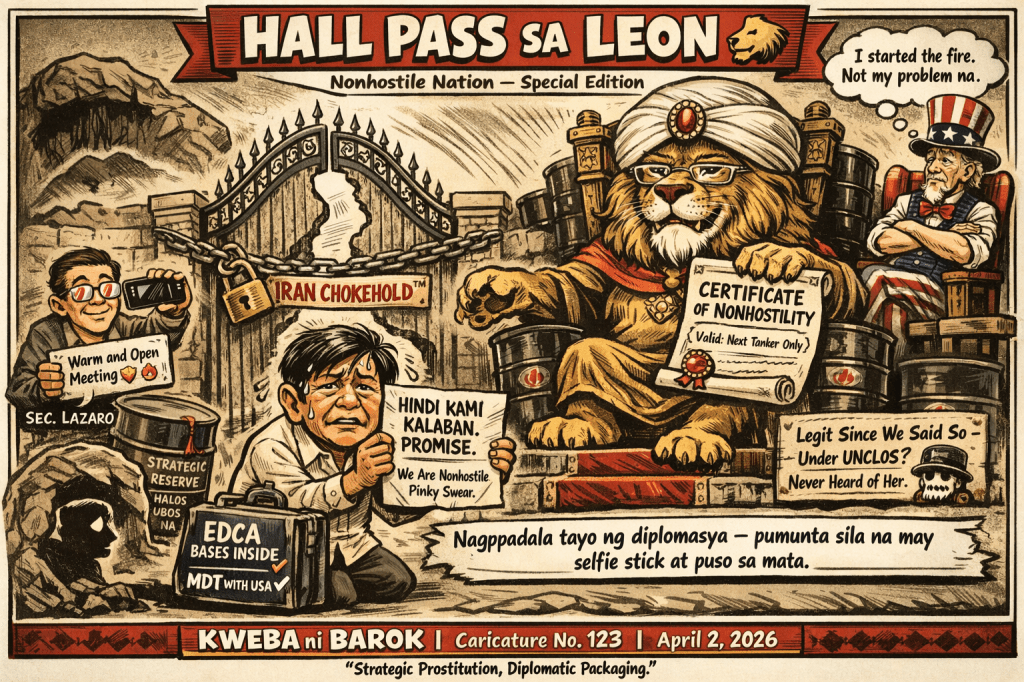
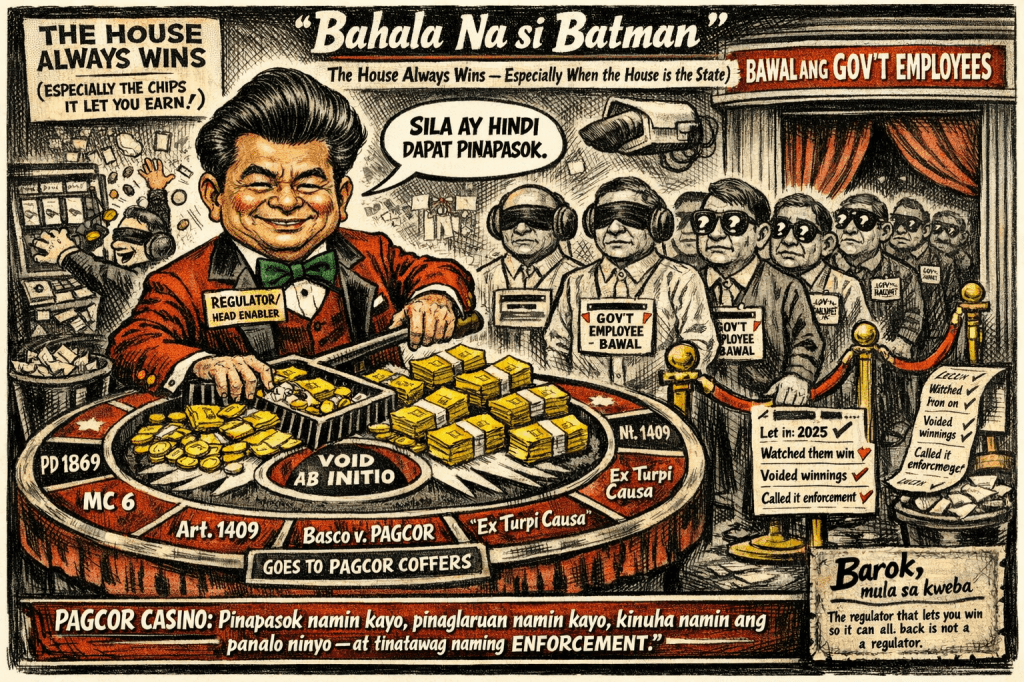
 KWEBA ni BAROK
Leave a comment