By Louis ‘Barok’ C Biraogo — January 29, 2025
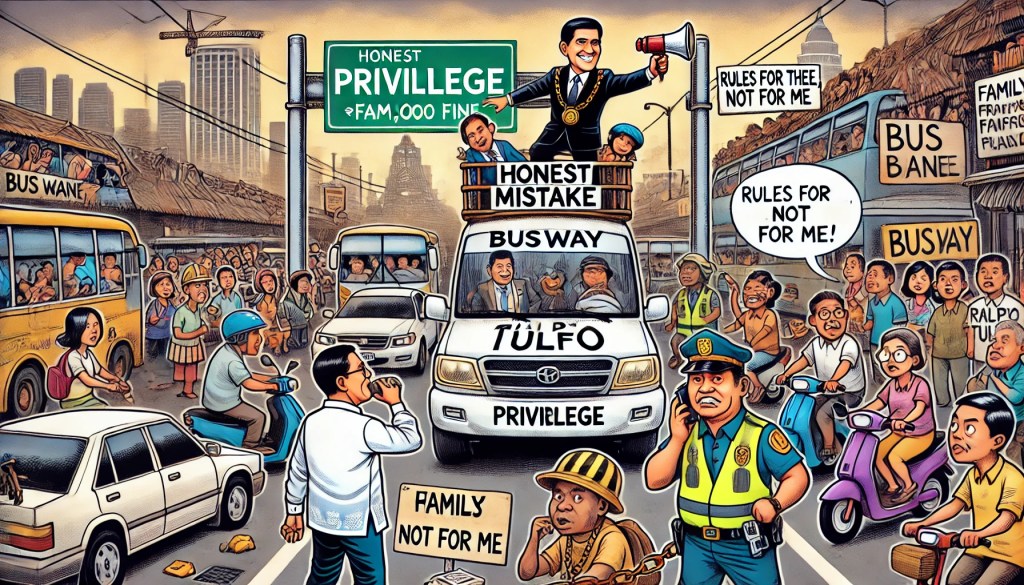
IN A city drowning in traffic chaos, the EDSA busway offers a rare glimmer of order and hope for commuters. But on January 23, 2025, even this fragile reprieve wasn’t spared from abuse. The culprit? A vehicle carrying Quezon City Second District Rep. Ralph Wendel Tulfo, whose actions now symbolize the growing chasm between the rulers and the ruled.
Legal Implications: Examining the Breach of Law and Accountability Boundaries
The facts are clear: Rep. Tulfo’s vehicle, driven by Kenneth De Guzman, illegally entered the EDSA busway, a lane reserved for authorized buses, emergency vehicles, and a select few high-ranking officials. The congressman is not among those authorized. A violation ticket was issued, and the ₱5,000 fine was paid. On the surface, the law was enforced. But was justice served?
The legal implications of this incident extend beyond the fine. The EDSA busway rules are unambiguous: private vehicles and unauthorized government vehicles are prohibited. The penalties escalate with repeated offenses, signaling the seriousness of the violation. Yet, Rep. Tulfo’s apology and his father’s reprimand—Sen. Raffy Tulfo, a prominent figure in Philippine politics—feel like a slap on the wrist compared to the daily struggles of ordinary Filipinos who face the full brunt of traffic laws.
The broader question is whether this enforcement was consistent with the law’s intent. Traffic laws exist not just to punish but to deter. When a public official flouts these rules, it undermines their purpose and erodes public trust. The apology and reprimand, while gestures of contrition, fall short of true accountability. If the law is to be respected, it must be applied equally, without deference to rank or privilege.
Perceptions of Power: Nepotism, Privilege, and Political Accountability
The political dynamics of this controversy are impossible to ignore. Sen. Raffy Tulfo’s defense of his son—framing the incident as an “honest mistake” and emphasizing that his son did not use his entitled “plate number 8”—reeks of privilege. The senator’s assertion that his son is “not an abuser” because he didn’t exploit his official plate is a low bar for ethical conduct. It suggests that the mere absence of overt abuse is enough to exonerate a public official from wrongdoing.
This incident also highlights the pervasive issue of nepotism in Philippine politics. The Tulfos are a powerful political family, and Sen. Tulfo’s defense of his son reinforces the perception that public officials operate under a different set of rules. When a senator chairs the very committee overseeing public services and uses his platform to shield his son from criticism, it sends a troubling message: that the powerful are above the law.
The integrity of governance hinges on accountability. Yet, in this case, the response from the political elite has been to minimize the incident rather than confront its implications. This is not just a failure of leadership; it is a betrayal of the public’s trust.
The Face of Disparity: A Symbolic Lens on Social Inequality
The social ramifications of this controversy are profound. In a country where traffic congestion is a daily struggle for millions, the EDSA busway is more than a lane—it is a symbol of hope for a more efficient and equitable public transportation system. When a public official bypasses the rules designed to benefit the masses, it is not just a violation of traffic laws; it is a violation of the social contract.
This incident underscores the deep-seated inequalities in Philippine society. For the average Filipino, a ₱5,000 fine is a significant financial burden. For a congressman, it is a minor inconvenience. The disparity in how laws are applied—and how they are perceived—fuels resentment and undermines the sense of fairness that is essential for social cohesion.
The symbolism of this incident is stark: a public official, entrusted with serving the people, instead uses his position to cut ahead in line. It is a metaphor for the broader challenges facing Philippine society, where the privileged few often seem to operate in a world apart from the struggles of the many.
Blueprint for Trust: Reforms to Foster Accountability and Integrity
To address the fallout from this incident and prevent similar controversies in the future, several reforms are urgently needed:
- Stricter Enforcement for Public Officials: Traffic laws must be applied equally, with no exceptions for public officials. Stricter penalties for officials who violate these laws could serve as a deterrent and restore public trust.
- Transparency in Exemptions: The criteria for exemption passes for the EDSA busway should be made clear and publicly accessible. Any misuse of these passes should be met with swift and severe consequences.
- Independent Oversight: An independent body should be established to investigate and adjudicate violations involving public officials, ensuring that political influence does not undermine accountability.
- Public Awareness Campaigns: The government should launch campaigns to educate the public about traffic laws and the importance of compliance, emphasizing that no one is above the law.
- Ethics Training for Officials: Mandatory ethics training for public officials could help reinforce the principles of accountability and service, reminding them that their actions have far-reaching consequences.
Conclusion: A Test of Leadership
The Tulfo busway controversy is more than a traffic violation; it is a test of leadership and a reflection of the challenges facing Philippine society. Will the political elite rise to the occasion, embracing accountability and reform? Or will they continue to operate under a different set of rules, further eroding public trust?
The answer will determine not just the future of the EDSA busway, but the future of governance in the Philippines. In a country where the gap between the powerful and the powerless is already vast, this incident is a stark reminder of the work that remains to be done. The road to justice is long, but it begins with holding everyone—even the privileged—accountable to the law.

- “Forthwith” to Farce: How the Senate is Killing Impeachment—And Why Enrile’s Right (Even If You Can’t Trust Him)
- “HINDI AKO NAG-RESIGN!”

- “I’m calling you from my new Globe SIM. Send load!”

- “Mahiya Naman Kayo!” Marcos’ Anti-Corruption Vow Faces a Flood of Doubt

- “Meow, I’m calling you from my new Globe SIM!”

- “No Special Jail for Crooks!” Boying Remulla Slams VIP Perks for Flood Scammers
- “PLUNDER IS OVERRATED”? TRY AGAIN — IT’S A CALCULATED KILL SHOT

- “Several Lifetimes,” Said Fajardo — Translation: “I’m Not Spending Even One More Day on This Circus”

- “Shimenet”: The Term That Broke the Internet and the Budget

- “We Did Not Yield”: Marcos’s Stand and the Soul of Filipino Sovereignty

- “We Gather Light to Scatter”: A Tribute to Edgardo Bautista Espiritu

- $150M for Kaufman to Spin a Sinking Narrative

 KWEBA ni BAROK
Leave a comment