
By Louis ‘Barok‘ C. Biraogo — January 30, 2025
IN THE 1960s, the Philippines was one of Asia’s most promising economies, often compared to rising powerhouses like South Korea. Today, that comparison is a painful reminder of lost potential. While other nations broke through economic barriers, the Philippines remains stuck in the ‘middle-income trap.’ A recent Nomura report projects that this status quo may persist until 2050—unless decisive reforms and strategic investments finally propel the nation forward.
The numbers tell a troubling story. Nomura’s Middle-Income Trap Escape Index (MITEI) scores the Philippines at 85, far below the threshold of 108 needed to indicate a likely transition to high-income status. This places the country in a “tight spot” alongside peers like Vietnam, Indonesia, and India. Even if the Philippines sustains a growth rate of 6%, geopolitical tensions, particularly with China, and a lack of foreign direct investment (FDI) inflows will continue to hinder progress.
Tracing the Trap: The Deep-Rooted Causes of Economic Stagnation
The middle-income trap is not merely a statistical anomaly; it is a reflection of systemic failures. The Philippines’ economy remains heavily reliant on low-value sectors such as remittances and business process outsourcing (BPO), which, while lucrative, do not foster the innovation and productivity needed for sustained growth. The country’s gross national income (GNI) per capita, though rising to $4,230 in 2023, still classifies it as a lower middle-income nation—a status it has held since 1987.
Several factors contribute to this stagnation:
- Lack of Innovation and Productivity Growth:
The Philippines invests minimally in research and development (R&D), stifling technological advancement and innovation. Without a shift from labor-intensive industries to high-value sectors, the economy cannot compete globally. - Governance and Corruption:
Political instability and corruption deter foreign investors and undermine public trust. Weak institutions and bureaucratic inefficiencies further exacerbate the problem, creating an environment hostile to long-term investment. - Income Inequality and Education Gaps:
High levels of income inequality limit access to quality education, perpetuating a cycle of low-skilled labor. The education system, focused on rote learning rather than critical thinking, fails to equip students with the skills needed for a modern economy. - Infrastructure Deficits:
Inadequate transportation and energy infrastructure increase costs, reduce productivity, and hinder competitiveness. Without significant investment in infrastructure, the Philippines cannot attract the FDI needed to drive growth.
The Price of Stagnation: How the Middle-Income Trap Hurts Filipinos
The middle-income trap is not just an abstract economic concept; it has real-world consequences. For millions of Filipinos, it means stagnant wages, limited job opportunities, and a lack of access to essential services. The country’s inability to attract high-value investments translates into fewer high-paying jobs, forcing many to seek employment abroad. This brain drain further weakens the domestic economy, creating a vicious cycle of underdevelopment.
Moreover, the geopolitical tensions between China and the Philippines pose a significant barrier to FDI. As global supply chains reconfigure, the Philippines risks being left behind, unable to capitalize on the exodus of investments from China. This underperformance in attracting FDI limits the boost to investment relative to peers, further entrenching the country in the middle-income trap.
Breaking Free: Key Reforms to Propel the Philippines Forward
Breaking free from the middle-income trap requires bold, transformative action. Here are key recommendations for policymakers, business leaders, and stakeholders:
- Invest in Innovation and Technology:
- Prioritize R&D funding to foster innovation and technological adoption.
- Embrace emerging technologies like generative AI to enhance productivity and competitiveness.
- Strengthen Governance and Institutions:
- Combat corruption through transparent policies and robust enforcement mechanisms.
- Streamline bureaucratic processes to improve efficiency and attract foreign investors.
- Reform the Education System:
- Shift from rote learning to a curriculum that emphasizes critical thinking, problem-solving, and digital skills.
- Invest in teacher training and ensure equitable access to quality education.
- Address Infrastructure Gaps:
- Accelerate infrastructure projects, particularly in transportation and energy, to reduce costs and improve connectivity.
- Leverage public-private partnerships to fund large-scale developments.
- Diversify the Economy:
- Reduce reliance on remittances and BPO by promoting high-value industries such as advanced manufacturing, renewable energy, and digital services.
- Encourage entrepreneurship and support small and medium-sized enterprises (SMEs) to drive innovation and job creation.
- Enhance Global Competitiveness:
- Resolve geopolitical tensions to attract FDI and integrate into global supply chains.
- Promote free trade agreements and open markets to expand export opportunities.
Rising to the Challenge: A Call for Bold Action
The Philippines’ middle-income trap is not an inevitability; it is a challenge that can be overcome with decisive action. The government, private sector, and civil society must work together to implement the reforms needed to unlock the country’s full potential.
The stakes are high. Without meaningful change, the Philippines risks losing another generation to stagnation and inequality. But with the right policies and investments, the country can chart a new course toward sustained growth and prosperity.
The clock is ticking, and the opportunity to change course is slipping away. We cannot afford to wait until 2050 to unlock the Philippines’ true potential. Every decision made today will shape the lives of future generations. The time to act is now—our future depends on it.
- ₱75 Million Heist: Cops Gone Full Bandit

- ₱6.7-Trillion Temptation: The Great Pork Zombie Revival and the “Collegial” Vote-Buying Circus

- ₱1.9 Billion for 382 Units and a Rooftop Pool: Poverty Solved, Next Problem Please

- ₱1.35 Trillion for Education: Bigger Budget, Same Old Thieves’ Banquet

- ₱1 Billion Congressional Seat? Sorry, Sold Out Na Raw — Si Bello Raw Ang Hindi Bumili

- “We Will Take Care of It”: Bersamin’s P52-Billion Love Letter to Corruption

- “Skewed Narrative”? More Like Skewered Taxpayers!

- “Scared to Sign Vouchers” Is Now Official GDP Policy – Welcome to the Philippines’ Permanent Paralysis Economy
- “Robbed by Restitution?” Curlee Discaya’s Tears Over Returning What He Never Earned

- “My Brother the President Is a Junkie”: A Marcos Family Reunion Special

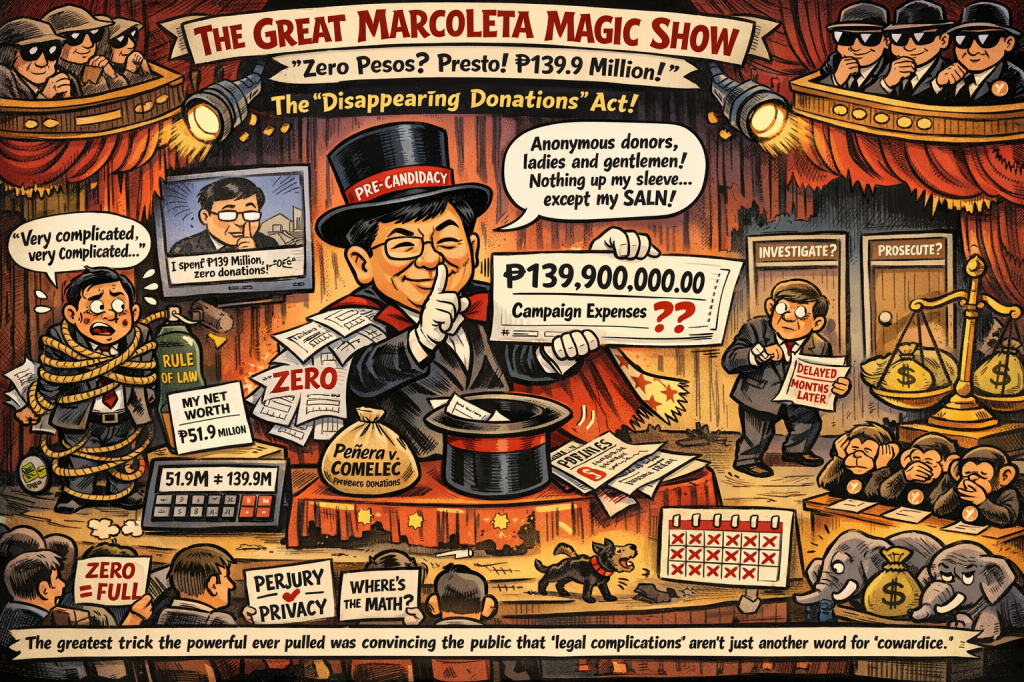
- “Mapipilitan Akong Gawing Zero”: The Day Senator Rodante Marcoleta Confessed to Perjury on National Television and Thought We’d Clap for the Creativity

- “Just Following Orders” Is Dead: How the Hague Just Turned Tokhang’s Finest Into International Fugitives

 KWEBA ni BAROK
Leave a comment