
By Louis ‘Barok‘ C. Biraogo — February 9, 2025
IS THE impeachment complaint against Vice President Sara Duterte a long-overdue reckoning, or just another political stunt? As the Senate prepares for one of the most high-stakes battles in recent history, Filipinos are left wondering: Is this a genuine pursuit of accountability, or a power play disguised as justice?
At its core, this case forces the Senate—and the nation—to decide: Is this a principled effort to uphold the rule of law, or just another ruthless power struggle? And beyond Sara Duterte, what does this battle mean for the fractured state of Philippine politics and the future of democracy in a landscape where former allies have become bitter rivals?
I. The Legal Landscape: Do the Allegations Hold Up?
The impeachment complaint against Duterte is built on four major allegations:
- Threats to assassinate public officials
- Misuse of confidential funds
- Involvement in extrajudicial killings (EJKs)
- Unexplained wealth and non-disclosure of assets
Each allegation must be evaluated under the 1987 Constitution’s grounds for impeachment: “culpable violation of the Constitution, treason, bribery, graft and corruption, other high crimes, and betrayal of public trust.”
A. Alleged Death Threats: Political Bluster or “Betrayal of Public Trust”?
Sara Duterte allegedly made threats to kill government officials, a claim that—if proven—could fall under “high crimes” or “betrayal of public trust.”
- Legal Basis: Article 133 of the Revised Penal Code criminalizes threats against public officials. RA 6713 (Code of Conduct for Public Officials) requires integrity and professionalism, which explicit threats violate.
- Relevant Precedent: Francisco v. House of Representatives (2003) reaffirmed that impeachment is a tool for accountability, not just political retaliation.
- Counterargument: Duterte’s team may argue the threats were rhetorical, taken out of context, or not serious enough to warrant impeachment.
Verdict: Weak as a legal basis for impeachment, unless there is concrete evidence that these were genuine, actionable threats.
B. Misuse of Confidential Funds: The Strongest Case?
The OVP and DepEd, both under Duterte, allegedly spent ₱125 million in confidential funds within a matter of days. If proven, this could constitute “graft and corruption” and “betrayal of public trust.”
- Legal Basis:
- RA 3019 (Anti-Graft and Corrupt Practices Act) penalizes officials who use public funds for personal or unauthorized purposes.
- PD 1445 (Government Auditing Code) mandates strict financial accountability.
- RA 6713 requires transparency in handling public resources.
- Relevant Precedent: In Estrada v. Desierto (2001), the Supreme Court held that corruption allegations against a sitting president were enough to justify an impeachment trial.
- Counterargument: Duterte’s defense may argue that the funds were lawfully spent, and there is no direct evidence of personal enrichment.
Verdict: This is the strongest legal argument for impeachment, as the rapid spending of confidential funds without oversight raises red flags.
C. Extrajudicial Killings: Unclear Waters
Allegations tie Duterte to EJKs in Davao City, echoing charges against her father, former President Rodrigo Duterte. If proven, this could qualify as “high crimes” under the Constitution.
- Legal Basis:
- RA 9851 (Crimes Against International Humanitarian Law) criminalizes extrajudicial killings.
- The Rome Statute (though the Philippines withdrew from the ICC) still influences international legal norms.
- Challenges:
- Unlike confidential funds, there is no clear paper trail proving Duterte personally ordered killings.
- The International Criminal Court (ICC) has struggled to pin down similar allegations against Rodrigo Duterte due to a lack of direct evidence.
- Counterargument: Duterte’s team will argue that any killings were part of law enforcement operations, not state-sponsored executions.
Verdict: While politically and morally significant, this charge lacks direct evidence linking Duterte to specific EJKs, making it the weakest impeachment argument.
D. Unexplained Wealth and Non-Disclosure of Assets: The Classic Corruption Case
Failure to disclose assets is a classic corruption allegation, and Duterte’s wealth has long been a topic of speculation.
- Legal Basis:
- RA 1379 (Forfeiture of Ill-Gotten Wealth) allows the government to seize unexplained assets.
- RA 6713 requires officials to fully disclose their Statements of Assets, Liabilities, and Net Worth (SALN).
- Relevant Precedent: In Ombudsman v. Sandiganbayan (2014), failure to disclose SALN was used to convict public officials.
- Counterargument: Duterte’s team may claim errors in filing or argue that her wealth comes from family assets.
Verdict: Potentially strong, but requires forensic financial investigation to prove.
II. The Procedural Battlefield: Can the Senate Convict?
A. Burden of Proof: Political or Legal Standard?
Should the Senate apply a strict criminal standard (beyond reasonable doubt) or a looser political standard (preponderance of evidence)?
- Estrada v. Desierto suggests impeachment can proceed even with circumstantial evidence.
- Francisco v. House of Representatives warns against treating impeachment as a purely political tool.
This ambiguity benefits Duterte, as senators can justify acquitting her by claiming “lack of strong evidence.”
B. Resignation: A Get-Out-of-Jail-Free Card?
If Duterte resigns before conviction, can the trial continue to disqualify her from future office?
- In Merceditas Gutierrez’s case, resignation halted impeachment.
- But in Estrada v. Desierto, disqualification was considered separate from removal.
If Duterte resigns, expect fierce legal debates over whether impeachment penalties (removal vs. disqualification) apply independently.
III. The Political Power Struggle: Who Wins?
A. What’s Marcos’ Endgame?
- A conviction weakens the Duterte dynasty, allowing Marcos Jr. to consolidate power.
- An acquittal risks alienating anti-Duterte allies but maintains political stability.
B. The Senate: Who Holds the Key Votes?
- The Senate’s Duterte loyalists will fight to acquit.
- Marcos-aligned senators may use the trial to weaken Duterte’s 2028 prospects.
Expect behind-the-scenes deals and shifting alliances.
IV. The Price of Impeachment: What’s at Stake for the Philippines?
- Public Trust in Institutions: If the trial is seen as political revenge, impeachment loses credibility.
- Confidential Funds Reform: Will this case push Congress to regulate discretionary funds?
- Future of Duterte’s Political Career: A conviction bars her from running in 2028.
V. Final Verdict: A Case on Shaky Ground
Strongest Charge: Misuse of confidential funds (RA 3019)
Weakest Charge: EJK allegations (lacks direct evidence)
Political Reality: Without overwhelming evidence, Senate acquittal is likely.
Impeachment is meant to be a tool for accountability, but in the Philippines, it often becomes a political survival game. The real test is not just whether Duterte is convicted—it’s whether the system can uphold transparency and justice without succumbing to partisan manipulation.
Acquittal or not, the damage is done. This impeachment has laid bare a system rigged in favor of the powerful, where laws bend but never break for those at the top. In the end, the real verdict won’t come from the Senate—it will come from the people.

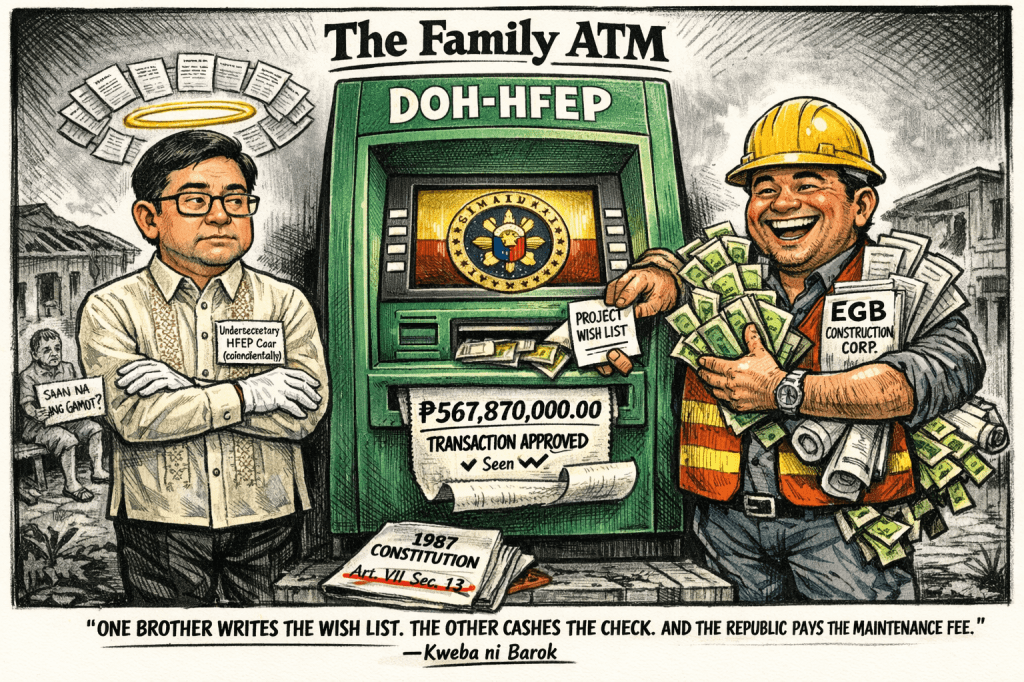
- Baggao Brothers Exposed: How One Undersecretary Built a P567M Family ATM at DOH

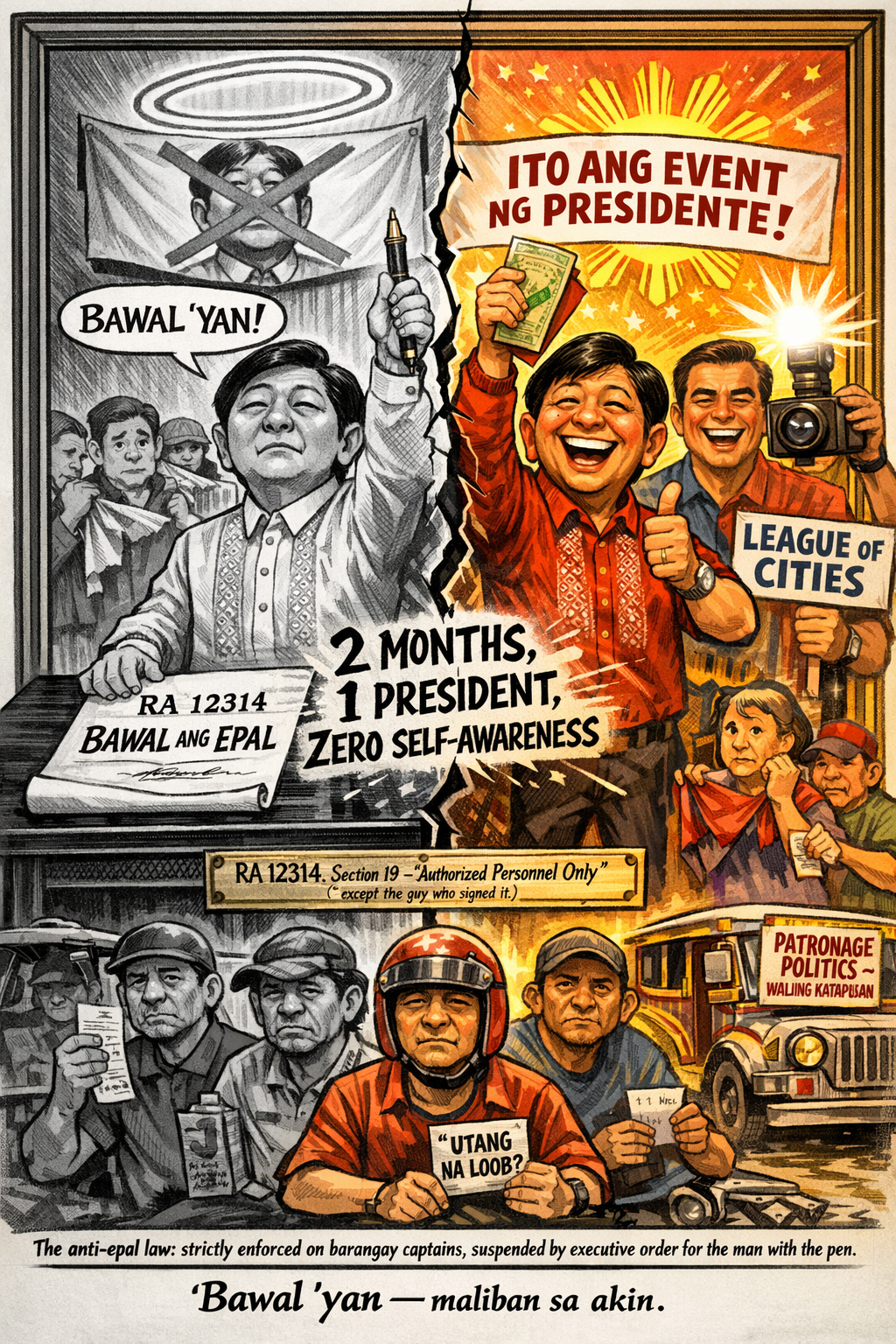
- Anti-Epal President Caught Red-Handed in Ayuda Selfie Scandal

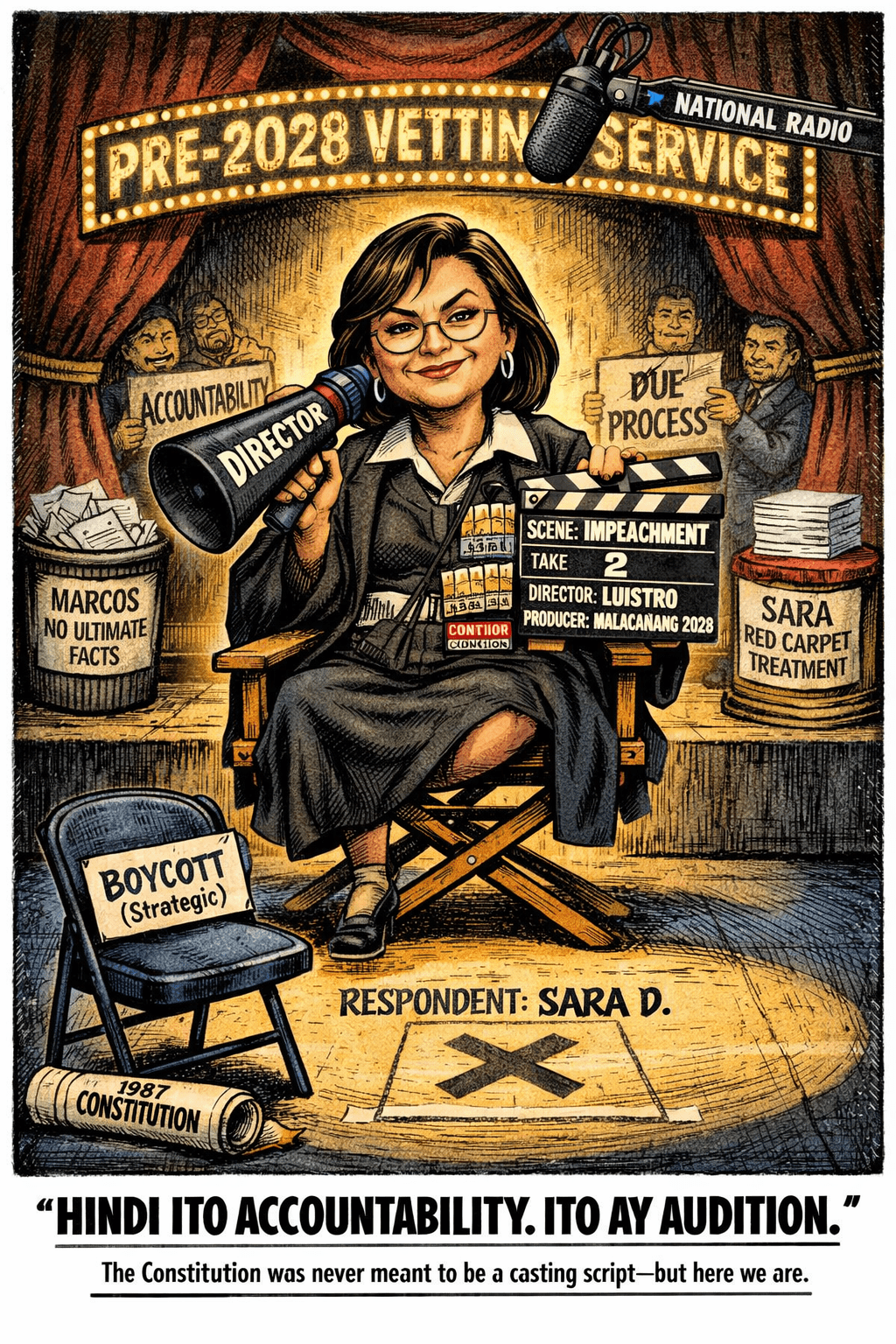
- Luistro’s “Fitness Test” Impeachment: 2028 Campaign Ad Masquerading as Justice

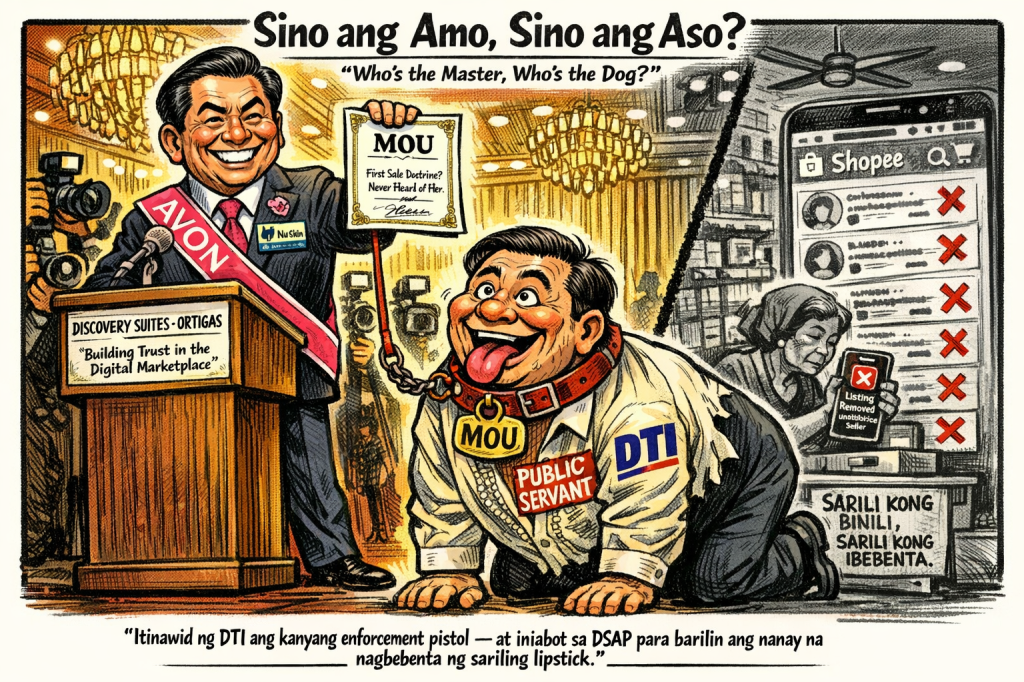
- DTI Becomes Avon’s Attack Dog: The MOU That Kills Your Right to Resell
- Procurement Drama That Wasn’t

- From EDSA to Armageddon: The Supreme Court’s Make-or-Break NCAP Verdict
- Cronies Win Again: Sandiganbayan Frees Coco Levy Thieves After 39 Years of Government Napping
- DENR: “We’re Bankrupt on Water!” After 18 Years of Helping Kill the Watersheds

- Selfie Secretary to Resilience Czar: How Frasco Landed the Ultimate Soft Landing

- “Education President” Marcos Jr.: P1.345T Budget, Zero Chalk for Teachers

- Comelec’s New Rule: Hide the Cash, Blame the Donors, Call It Legal

- DTI’s Award-Winning Book Is a Hot Mess—Now They’re Suing the Guy Who Read It

 KWEBA ni BAROK
Leave a comment