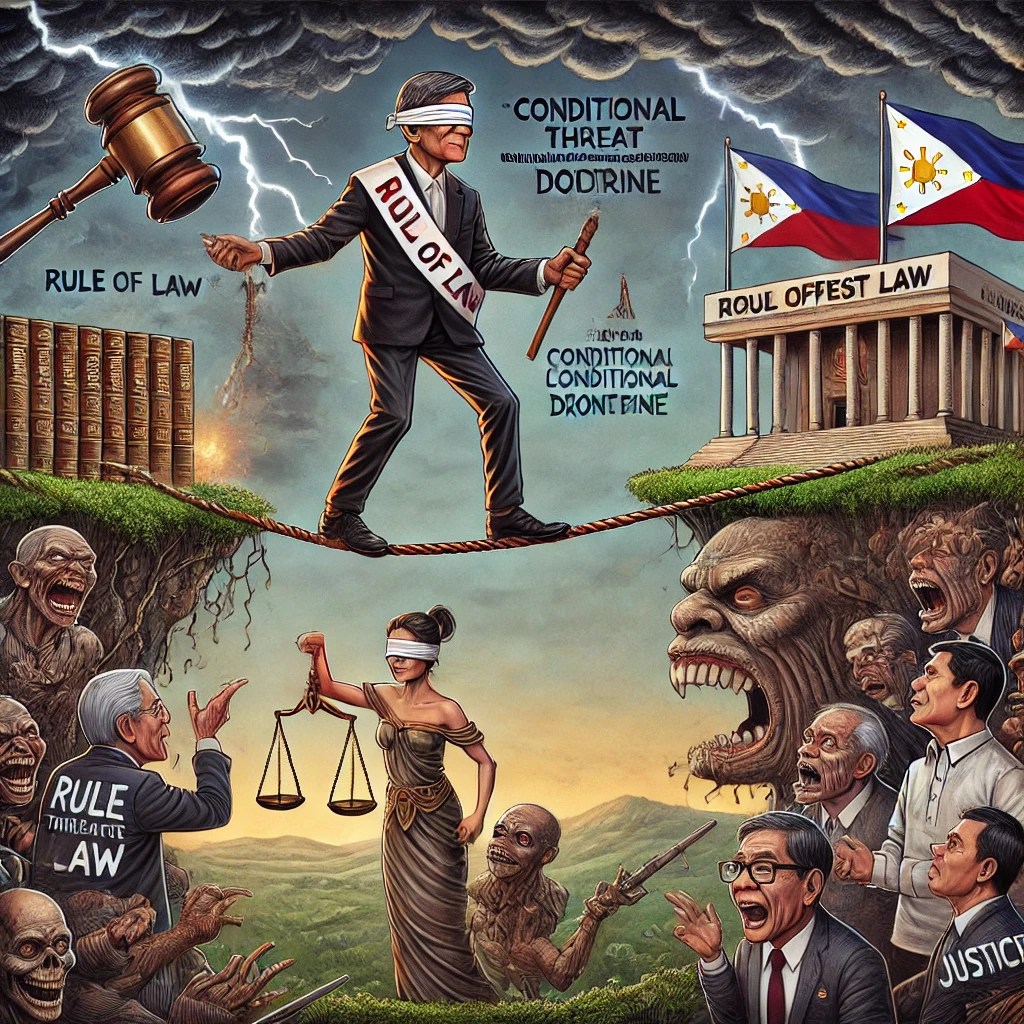
By Louis ‘Barok’ C Biraogo — Fabruary 14, 2025
WHEN a sitting Vice President threatens to assassinate a President, his wife, and the Speaker of the House, it’s not just a political scandal—it’s a constitutional crisis. Vice President Sara Duterte’s conditional order to kill President Ferdinand Marcos Jr., First Lady Liza Araneta-Marcos, and Speaker Martin Romualdez has shattered norms, exposed deep fissures in Philippine governance, and left the nation asking: How did we get here?
Chief Presidential Legal Counsel Juan Ponce Enrile, a fixture in Philippine politics whose career spans dictatorships and democracies, has sought to calm the waters. His legal argument: no charges may be filed at this time because the threat was conditional. But is this a careful legal analysis, or an attempt at damage control? The answer lies in the intersection of law, power, and the high-stakes chess game of Philippine politics.
The Legal Argument: Conditional Threats and Mens Rea
Enrile’s assertion is rooted in the principle that every crime requires both a guilty act (actus reus) and a guilty mind (mens rea). He argues that Duterte’s statement, while containing a directive to kill, is not immediately actionable because it hinges on a future event—her own assassination. Thus, the mens rea, or criminal intent, only materializes if and when that condition is met.
He further suggests that because the threat is conditional, it does not satisfy the requirements of Article 282 of the Revised Penal Code, which defines grave threats as statements that cause fear or anxiety about imminent harm. In Enrile’s view, without an immediate and certain danger, the law does not consider the statement a punishable offense at this time.
From a procedural standpoint, Enrile’s argument could carry weight. The law is often hesitant to penalize mere words without a clear and immediate threat. But to dismiss the statement entirely ignores the political implications and the possibility of incitement.
The Counterarguments: Is It a Threat, Incitement, or Neither?
While Enrile attempts to place Duterte’s statement in a legal gray area, precedent suggests that the courts have not been so lenient with threats, conditional or otherwise.
- Grave Threats Under Article 282 of the Revised Penal Code
- People v. De Guzman (1999) established that threats need not be explicit to qualify as grave threats.
- People v. Reyes (2001) ruled that the severity of the threat, not its immediacy, determines whether it constitutes a criminal offense.
- People v. Manalili (1999) found that even written threats could be considered grave threats despite a lack of immediate confrontation.
Applying these precedents, Duterte’s statement arguably meets the standard for grave threats. Her statement was direct, involved named individuals, and could reasonably incite fear. The fact that she holds the second-highest position in government makes the threat even more consequential.
- Inciting to Sedition Under Article 142
- If Duterte’s statement is seen as an attempt to sow distrust or incite violence against high-ranking officials, it could fall under inciting to sedition, which punishes speech that fosters rebellion or public disorder.
- Given the political climate, her words could embolden factions within government or the military, leading to instability.
- Ethical Standards and Public Order
- Duterte’s statement, even if legally ambiguous, is a clear violation of ethical standards for public officials. Elected leaders are expected to maintain public trust, not make incendiary remarks that could provoke violence.
- The Supreme Court has long upheld that public officials must be held to a higher standard in their conduct. Even if no criminal charge is filed, Duterte’s statement could justify an ethics complaint or impeachment proceedings.
The Political Context: A Nation in Turmoil
Sara Duterte’s statement does not exist in a vacuum. It is a symptom of the deepening rift within the ruling elite, particularly between the Marcos and Duterte factions. The political landscape has become a battlefield of influence, with both sides seeking to consolidate power.
- The Duterte camp sees itself as the rightful heir to strongman rule, viewing the Marcos administration as an opportunistic usurper of their brand of populism.
- The Marcos-Romualdez bloc, on the other hand, has steadily distanced itself from Duterte’s legacy, seeking to redefine its own grip on power.
By making this statement, Duterte may be signaling to her supporters that she is willing to go to war—literally—against her political rivals. The danger is that such rhetoric can embolden extremist elements who may act on their own initiative, plunging the nation into further political chaos.
Freedom of Speech vs. Public Order: Where Do We Draw the Line?
A fundamental tension in this case is the balance between freedom of speech and public order. The law protects free expression, but it also criminalizes speech that incites violence.
- In the U.S. Supreme Court case Brandenburg v. Ohio (1969), the test for incitement was whether speech was directed to inciting or producing imminent lawless action.
- The Philippines has similar protections under Article III, Section 4 of the 1987 Constitution, but these are not absolute. Speech that threatens national security or public order can be curtailed.
Duterte’s statement may not be an outright call to violence, but it comes dangerously close. If high-ranking officials normalize such rhetoric, it sets a precedent that could erode democratic norms and embolden political actors to take extralegal measures against opponents.
Steering Clear of Disaster: Strategies to Mitigate Conflict and Restore Trust
The path forward must be one of de-escalation, legal clarity, and political accountability.
- Legal Authorities Must Provide a Clear Ruling
- The Department of Justice and Supreme Court should clarify whether conditional threats fall under Article 282 and whether Duterte’s statement warrants criminal liability.
- Congress should consider legislation explicitly defining conditional threats in the context of public officials.
- Ethical and Disciplinary Action Should Be Pursued
- Even if no criminal charges are filed, Duterte’s statement warrants an ethics complaint or censure.
- The Office of the Ombudsman or Congress could launch an inquiry into whether such statements violate public trust.
- Political Leaders Must De-escalate Tensions
- Both the Marcos and Duterte camps must refrain from inflammatory rhetoric that could incite further political instability.
- Calls for dialogue and reconciliation must be pursued to prevent the situation from escalating into open conflict.
- The Public Must Demand Accountability
- Civil society groups should advocate for higher standards of conduct for public officials.
- The electorate must recognize the dangers of political violence and reject leaders who resort to such tactics.
Conclusion: A Test for the Rule of Law
At its core, this controversy is a test of whether the Philippines is governed by laws or by political expediency. Enrile’s assertion that no charges can be filed may be legally defensible, but it cannot obscure the moral and political gravity of Duterte’s statement.
The weaponization of threats in politics has dire consequences—not just for those in power, but for the stability of the nation. If leaders can casually speak of assassination orders without consequence, what does this say about the rule of law?
Sara Duterte’s words are more than just a legal puzzle—they are a warning of a nation teetering on the edge. Whether the Philippines heeds that warning or descends further into political chaos will depend on the choices made in the days ahead.

- ₱8B BBM Pork: CCTV for Every Captain’s Kumpare?
- ₱75 Million Heist: Cops Gone Full Bandit

- ₱6.7-Trillion Temptation: The Great Pork Zombie Revival and the “Collegial” Vote-Buying Circus

- ₱1.9 Billion for 382 Units and a Rooftop Pool: Poverty Solved, Next Problem Please

- ₱1.35 Trillion for Education: Bigger Budget, Same Old Thieves’ Banquet

- ₱1 Billion Congressional Seat? Sorry, Sold Out Na Raw — Si Bello Raw Ang Hindi Bumili

- “We Will Take Care of It”: Bersamin’s P52-Billion Love Letter to Corruption
- “Skewed Narrative”? More Like Skewered Taxpayers!

- “Scared to Sign Vouchers” Is Now Official GDP Policy – Welcome to the Philippines’ Permanent Paralysis Economy
- “Robbed by Restitution?” Curlee Discaya’s Tears Over Returning What He Never Earned

- “No Pressure” Luistro? The House Pork Bazaar Exposed
- “My Brother the President Is a Junkie”: A Marcos Family Reunion Special


 KWEBA ni BAROK
Leave a comment