
Sandiganbayan Slams COCOLIFE, Orders UCPB Shares Back to the Government—Here’s What It Means
By Louis ‘Barok‘ C. Biraogo — February 27, 2025
THE Sandiganbayan just dropped a legal bombshell that’s reverberating through Manila’s corridors of power and the coconut groves alike. In a February 24, 2025 ruling, the anti-graft court ordered United Coconut Planters Life Assurance Corporation (COCOLIFE) to cough up 255.8 million United Coconut Planters Bank (UCPB) shares to the Philippine government, declaring them coconut levy assets under the Coconut Farmers and Industry Trust Fund Act (CFITF Act). This isn’t just another chapter in the decades-long coco levy saga—it’s a seismic shift that could redefine how the government claws back ill-gotten wealth. Let’s unpack this legal heavyweight bout, round by round.
Case Overview: The Sandiganbayan Throws a Knockout Punch
The core question in this slugfest: Are UCPB’s shares in COCOLIFE “coconut levy assets” that belong to the Republic? The Sandiganbayan’s Second Division answered with a resounding yes in its 27-page decision, siding with the Presidential Commission on Good Government (PCGG) against COCOLIFE’s protests. The assets at stake? A hefty 255,823,678 shares of UCPB stock, now ordered reconveyed to the government for the benefit of coconut farmers.
The legal backbone of this ruling is Republic Act No. 11524, the CFITF Act, specifically Section 6, which mandates the return of assets tied to coconut levy funds—those taxes levied on farmers during the Marcos era that somehow ended up funding private empires. COCOLIFE argued these shares weren’t covered, but the Sandiganbayan wasn’t buying it, pointing to Supreme Court precedent and a clear legislative intent to bring these assets home.
Key players: COCOLIFE, the insurer fighting to keep its stake; UCPB, the bank caught in the crossfire; and the PCGG, the government’s relentless asset-recovery bulldog. This isn’t just about shares—it’s about justice for farmers who’ve waited decades to see those levy funds do some good.
Legal Framework Analysis: The CFITF Act Packs a Wallop
Section 6: The Reconveyance Mandate
Section 6 of the CFITF Act is the linchpin here. It splits coconut levy assets into two buckets: those already declared government-owned by the Supreme Court (to be reconveyed within one year of the Act’s 2021 effectivity) and others “later declared” as such, implying no final judicial stamp is needed for reconveyance. The Sandiganbayan seized on this, rejecting COCOLIFE’s claim that a Supreme Court ruling was a prerequisite. “The law is clear,” the court said—assets tied to levy funds are public, period.
A Brief History of Coco Levy Chaos
The coconut levy funds trace back to the Marcos regime, when Presidential Decree No. 755 (1975) greenlit their use to buy a bank (hello, UCPB) for farmers’ benefit. What followed was a classic tale of public funds morphing into private fortunes—think UCPB, San Miguel Corporation stakes, and yes, COCOLIFE. Fast-forward to RA 11524, enacted in 2021 under Duterte, aiming to right those wrongs by funneling recovered assets into a trust for farmers. It’s a redemption arc decades in the making.
Public Funds, Supreme Court Says So
The Supreme Court has been unequivocal: coconut levy funds are public. In COCOFED v. Republic (G.R. Nos. 177857-58, Jan. 24, 2012), the Court ruled these funds—prima facie public in character—belong to the government for farmers’ benefit. The Sandiganbayan leaned hard on this, noting that UCPB shares in COCOLIFE were bought with levy money, sealing their fate as public assets.
Defining “Coconut Levy Assets”
Under the CFITF Act, “coconut levy assets” is a broad net—any property acquired directly or indirectly with levy funds. The Sandiganbayan called it “squarely within” this definition, dismissing COCOLIFE’s semantic gymnastics. It’s a statutory catch-all designed to leave no levy-funded asset behind.
Jurisdictional Issues: Sandiganbayan’s Home Turf
The Anti-Graft Court’s Authority
The Sandiganbayan’s jurisdiction here is rock-solid, rooted in Presidential Decree No. 1606 (1978), as amended by RA 8249. It’s the go-to court for graft cases, including recovering ill-gotten wealth—a mandate covering “all incidents arising from” such disputes. COCOLIFE tried a Hail Mary, arguing this declaratory relief plea belonged in a Regional Trial Court. The Sandiganbayan swatted it down, citing its exclusive turf over coco levy recoveries.
COCOLIFE’s Jurisdictional Jab
COCOLIFE’s challenge was a long shot—claiming the Sandiganbayan overstepped by ruling on ownership without a Supreme Court nod. The court countered with precedent: its authority extends to ancillary issues like this, no higher blessing required.
Supreme Court Back-Up
The Supreme Court’s got Sandiganbayan’s back. In Republic v. Sandiganbayan (G.R. No. 118661, Jan. 29, 2007), the Court affirmed its jurisdiction over coco levy assets. Ditto in UCPB v. PCGG (G.R. No. 209447, Aug. 11, 2015), where jurisdictional whines from UCPB and COCOLIFE were shut down. This isn’t new territory; it’s well-trodden legal ground.
UCPB’s Legal Options: Time to Regroup or Throw in the Towel?
What’s on the Table
UCPB (via COCOLIFE) has a few moves left:
- Motion for Reconsideration (MR): File within 15 days of notice (Rule 52, Rules of Court)—so, by mid-March 2025. It’s a chance to reargue before the same bench.
- Appeal to the Supreme Court: A petition for review on certiorari under Rule 45, due within 15 days of an MR denial or the original decision if no MR is filed—think late March or early April 2025 deadlines.
- Settlement Talks: Off-the-record negotiations with the PCGG, though that’s a long shot post-ruling.
Procedural Hurdles
An MR needs “newly discovered evidence” or a clear legal error (Rule 37). An appeal demands a pure question of law—facts are off-limits (Rule 45). Timing’s tight, and the Supreme Court’s high bar for reversing Sandiganbayan means UCPB’s got to bring its A-game.
Odds of Success
Slim pickings here. The MR faces a skeptical Second Division already dug in on statutory interpretation. An appeal might get traction if UCPB can spin a novel legal angle, but the Supreme Court’s coco levy track record leans government-friendly. Settlement? Only if the PCGG blinks, which seems unlikely with victory in hand.
Grounds for an MR?
Maybe. COCOLIFE’s misreading-of-the-law argument flopped, but UCPB could push a due process angle—say, insufficient hearing on share origins. It’s a stretch, but it’s something.
Potential Appeal Arguments: UCPB’s Best Shots
Argument 1: Original Intent of PD 755
Pitch: The levy funds were meant for farmers’ private benefit, not government coffers (PD 755, §1).
Support: Civil Code Art. 4 (no retroactivity); Republic v. COCOFED (G.R. Nos. 147062-64, Dec. 14, 2001) nods to complexity.
Weakness: COCOFED v. Republic (2012) trumps this—public funds, end of story.
Argument 2: Share Origin Dispute
Pitch: Not all UCPB shares came from levy funds; some were legit investments.
Support: UCPB v. PCGG (2015) hints at mixed funding; due process under Const. Art. III, §1.
Weakness: Sandiganbayan says levy linkage is enough—burden’s on UCPB to prove otherwise.
Argument 3: CFITF Act Overreach
Pitch: Retroactive application of RA 11524 is unfair.
Support: Civil Code Art. 4; Const. Art. III, §22 (non-retroactivity of penal laws as analogy).
Weakness: The Act’s intent is remedial, not punitive—courts love that.
Government’s Counter-Arguments: The PCGG’s Ironclad Defense
Counter 1: Public Funds Are Non-Negotiable
Pitch: Supreme Court precedent (COCOFED v. Republic, 2012) locks levy funds as public.
Strength: It’s airtight—decades of rulings back this up.
Counter 2: Statutory Clarity
Pitch: Section 6 of RA 11524 doesn’t need Supreme Court sign-off for reconveyance.
Strength: The Sandiganbayan’s textual analysis is bulletproof; legislative intent is crystal clear.
Counter 3: Jurisdiction Is Settled
Pitch: Sandiganbayan’s authority is unassailable (Republic v. Sandiganbayan, 2007).
Strength: UCPB’s jurisdictional gripes are DOA—precedent’s too strong.
Practical Recommendations: Playing the Long Game
For UCPB
- File an MR: Buy time, test due process waters.
- Prep for Appeal: Focus on share origins—dig up evidence of non-levy funding.
- Negotiate Quietly: If the court route sours, pitch a farmer-benefit compromise to the PCGG.
For the Government
- Secure the Shares: Move fast to register those certificates—don’t let delays muck it up.
- Transparent Management: Set up a trust pronto, showing farmers the money’s real.
- Settlement Option: Offer COCOLIFE a face-saving out—like a phased reconveyance—if it speeds things up.
Middle Ground?
A joint fund splitting profits between COCOLIFE’s interests and farmers’ welfare could work, but the PCGG’s victory lap makes compromise unlikely.
Ripple Effects: How the Coco Levy Ruling Could Reshape the Landscape
Other Cases in the Crosshairs
This ruling’s a blueprint—expect the PCGG to flex it in pending coco levy disputes. Think CIIF oil mills or leftover SMC shares. The Sandiganbayan’s loose leash on “final declaration” requirements opens the floodgates.
Coconut Industry Impact
Farmers might finally see cash—if the government doesn’t botch the trust fund. But it’s a slow burn; don’t expect miracles overnight. The industry’s revival hinges on execution, not just court wins.
Ill-Gotten Wealth Chase
The PCGG’s on a roll—79 billion pesos already remitted, per 2024 reports. This adds momentum, signaling Marcos-era cronies aren’t untouchable. It’s a warning shot: the government’s asset-recovery machine is humming.
The Final Takeaway
The Sandiganbayan didn’t just rule—it dropped a legal anvil on COCOLIFE and UCPB, reinforcing that coconut levy assets are the people’s, not private playthings. UCPB’s got an uphill fight ahead, but the real winners (or losers) are the farmers still waiting for justice. This case isn’t over—it’s just heating up. Stay tuned.

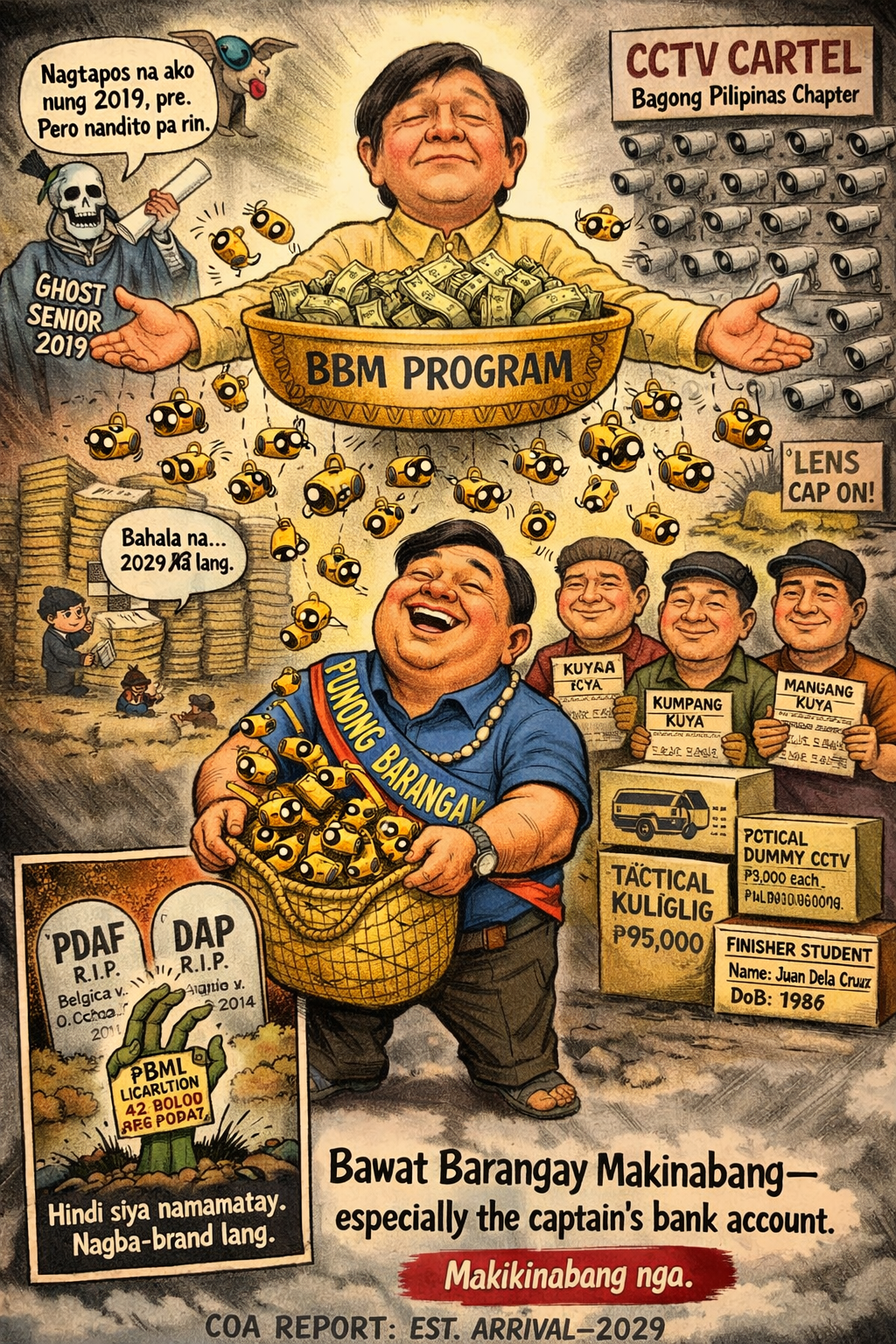
- ₱8B BBM Pork: CCTV for Every Captain’s Kumpare?
- ₱75 Million Heist: Cops Gone Full Bandit

- ₱6.7-Trillion Temptation: The Great Pork Zombie Revival and the “Collegial” Vote-Buying Circus

- ₱1.9 Billion for 382 Units and a Rooftop Pool: Poverty Solved, Next Problem Please

- ₱1.35 Trillion for Education: Bigger Budget, Same Old Thieves’ Banquet

- ₱1 Billion Congressional Seat? Sorry, Sold Out Na Raw — Si Bello Raw Ang Hindi Bumili

- “We Will Take Care of It”: Bersamin’s P52-Billion Love Letter to Corruption

- “Skewed Narrative”? More Like Skewered Taxpayers!

- “Scared to Sign Vouchers” Is Now Official GDP Policy – Welcome to the Philippines’ Permanent Paralysis Economy

- “Robbed by Restitution?” Curlee Discaya’s Tears Over Returning What He Never Earned

- “No Pressure” Luistro? The House Pork Bazaar Exposed
- “My Brother the President Is a Junkie”: A Marcos Family Reunion Special




 KWEBA ni BAROK
Leave a comment