The UN Vote That Shook the World: A New Era of Uncertainty
By Louis ‘Barok‘ C. Biraogo — February 27, 2025
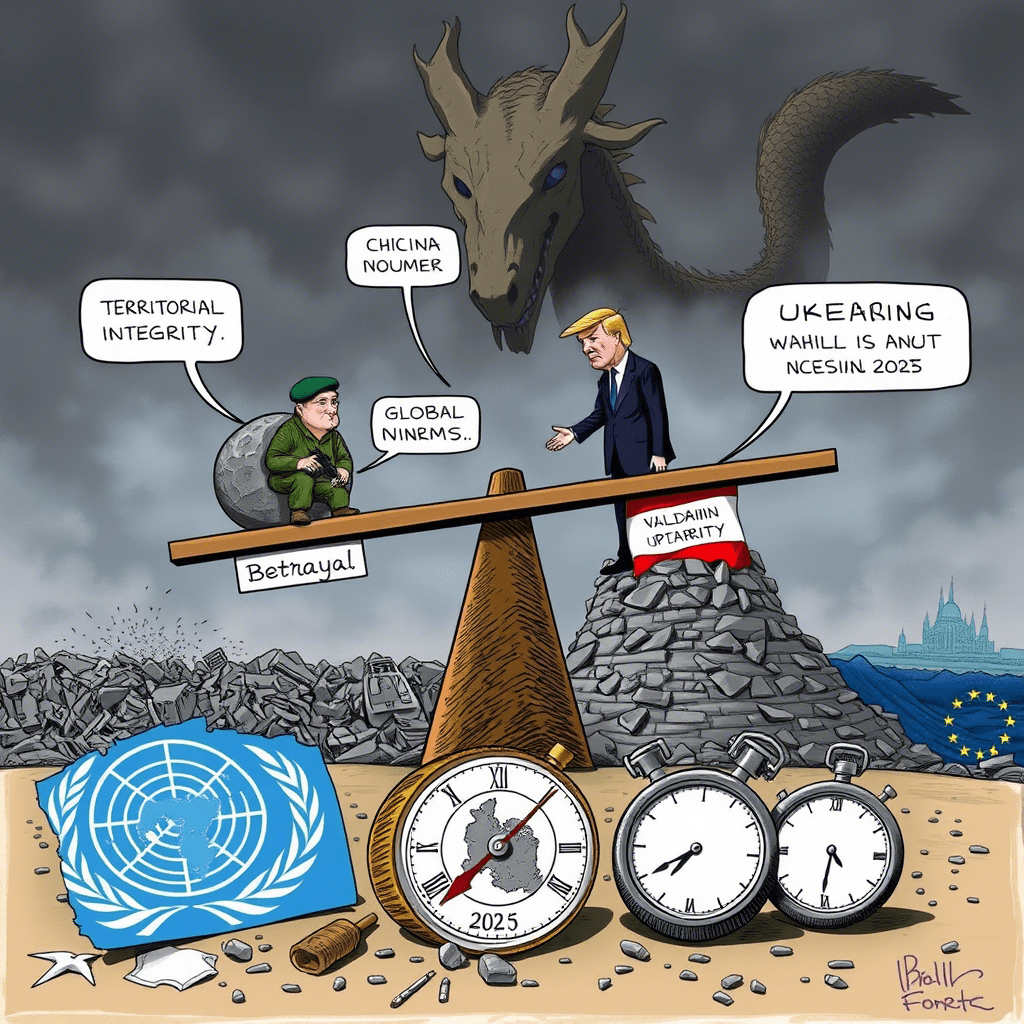
BETRAYAL tastes bitterest when it comes from a friend. For Oleksandr, a Ukrainian soldier shivering in a trench near Kursk, the news hit like a mortar shell: the United States—once Ukraine’s staunchest ally—had sided with Russia at the United Nations. As North Korean troops advanced alongside Russian forces, Oleksandr muttered, ‘It’s like a sci-fi nightmare.’ Three years into this brutal war, the unthinkable had become reality.
On February 25, 2025, the UN General Assembly voted 93-18, with 65 abstentions, to reaffirm Ukraine’s territorial integrity and demand Russia’s withdrawal. The numbers tell a story of erosion: in March 2022, 141 nations backed a similar call; in October 2022, 143 did. Today, support has withered by nearly a third. What’s more shocking? The United States, under President Donald Trump, joined Russia, Belarus, North Korea, and Sudan in the “no” column—a seismic shift from its prior resolute stance. Hungary, ever the Kremlin’s European outlier, followed suit. Meanwhile, abstentions swelled—India, China, and Brazil among them—hinting at a world growing weary or wary of this conflict.
Why does this matter? Because this vote isn’t just about Ukraine. It’s a mirror reflecting a fracturing global order, a test of whether might still makes right, and a warning for nations like the Philippines, nervously eyeing China across the South China Sea.
The Proof Is in the Numbers: A Side-by-Side Analysis
Let’s rewind. In March 2022, as Russian tanks rolled into Ukraine, the world rallied: 141 votes condemned Moscow, with only five dissenters—Russia, Belarus, North Korea, Eritrea, and Syria. By October, outrage over Russia’s sham annexations pushed support to 143. Fast forward to 2025, and the tally drops to 93. Opposition triples to 18; abstentions nearly double to 65. The United States’ flip is the headline, but Mali and Nicaragua also shifted from abstaining to opposing, lured by Russian military ties. India, a steadfast abstainer, holds its neutral line, balancing Russian oil with Western pressure.
This isn’t just math—it’s a map of shifting loyalties. The U.S. aligning with Russia signals a retreat from its role as guarantor of liberal norms. Europe, barring Hungary, stands firm, but the cracks are visible. What does it mean when the world’s superpower sides with the aggressor? For Ukraine, it’s a gut punch. For the globe, it’s a question mark over alliances we once took for granted.
The Turning Point: How We Got Here
The causality is a tangle of politics, pragmatism, and power plays. Start with Trump. His administration’s pivot—evident in Defense Secretary Pete Hegseth’s dismissal of Ukraine’s pre-2014 borders as “unrealistic”—reflects a non-interventionist streak married to a desire for détente with Vladimir Putin. Trump’s calls with Putin, bypassing Kyiv and Brussels, underscore this. Domestic pressures amplify it: with Americans reeling from inflation and war fatigue, why pour billions into a distant conflict? Economic logic nods approvingly—energy prices and supply chains might stabilize with a Russian thaw.
But is that the whole story? Diplomatic realignment looms large. Trump’s disdain for NATO and European “freeloaders” suggests a strategic recalibration, perhaps to focus on China. Yet this risks miscalculation—Richard Gowan of the International Crisis Group notes the U.S. underestimated European resolve. Secondary factors, like Russian lobbying in the Global South, explain the abstention surge, but the primary driver is Trump’s vision: a dealmaker’s peace, even if it means ceding ground to Moscow.
The World Remade: How Everything Changed
The implications ripple outward. NATO, already strained by Trump’s skepticism, faces a cohesion crisis. If the U.S. wavers, can Europe hold the line alone? France and Britain, mulling rare vetoes at the Security Council, signal defiance, but their leaders’ White House visits this week test their resolve. The EU might hasten its push for strategic autonomy—more tanks, fewer transatlantic ties. For Ukraine, it’s dire: less U.S. aid could force a grim settlement.
Globally, territorial sovereignty takes a hit. If Russia’s land grab gains tacit acceptance, what stops others? China watches closely—Taiwan could be next. The UN’s credibility frays; if it can’t unite against aggression, future conflicts may bypass it entirely. And nuclear non-proliferation? A cornered Russia, emboldened by this vote, might lean harder on its arsenal, chilling arms control talks.
A Nation at Risk: The Philippines’ Struggle for Survival
Half a world away, Manila feels the tremors. The Philippines, locked in a South China Sea standoff with China, relies on the U.S. Mutual Defense Treaty. But if Washington abandons Ukraine, will it stand firm in Asia? Beijing might see a green light to press its claims—more ships, more reefs, more tension. Economically, the Philippines could suffer if global instability spikes energy costs or if U.S. aid wanes, pushing it toward China’s orbit. Diplomatically, Manila has options: deepen ties with Japan and Australia, bolster ASEAN unity, or hedge with neutrality. Each path carries risks.
What Now?
For stakeholders, action is urgent. Ukraine must rally its European backers—Germany, France, Britain—and lobby the Global South, where moral clarity still sways votes. Short-term, it’s about survival; long-term, it’s proving resilience. The U.S. should clarify its stance—Trump’s team could frame this as pragmatism, not capitulation, but transparency is key. Progressives will demand a return to principle; realists will urge a China-first pivot. Europe must double down on defense spending, showing it can stand without Uncle Sam.
The Philippines? Diversify—fast. Strengthen regional alliances, modernize its military, and court investment beyond the U.S. and China. A multipolar world demands agility.
Back to Oleksandr. He’s not just a soldier; he’s a symbol of what’s at stake. Can the world still muster the will to defend the defenseless? Or will expediency trump justice? This vote doesn’t end the war, but it may mark the moment we chose convenience over conscience—a choice we’ll live with for decades.

- “Forthwith” to Farce: How the Senate is Killing Impeachment—And Why Enrile’s Right (Even If You Can’t Trust Him)

- “HINDI AKO NAG-RESIGN!”

- “I’m calling you from my new Globe SIM. Send load!”

- “Mahiya Naman Kayo!” Marcos’ Anti-Corruption Vow Faces a Flood of Doubt

- “Meow, I’m calling you from my new Globe SIM!”

- “No Special Jail for Crooks!” Boying Remulla Slams VIP Perks for Flood Scammers

- “PLUNDER IS OVERRATED”? TRY AGAIN — IT’S A CALCULATED KILL SHOT

- “Several Lifetimes,” Said Fajardo — Translation: “I’m Not Spending Even One More Day on This Circus”

- “Shimenet”: The Term That Broke the Internet and the Budget

- “We Did Not Yield”: Marcos’s Stand and the Soul of Filipino Sovereignty

- “We Gather Light to Scatter”: A Tribute to Edgardo Bautista Espiritu

- $150M for Kaufman to Spin a Sinking Narrative




 KWEBA ni BAROK
Leave a comment