By Louis ‘Barok‘ C. Biraogo — February 28, 2025
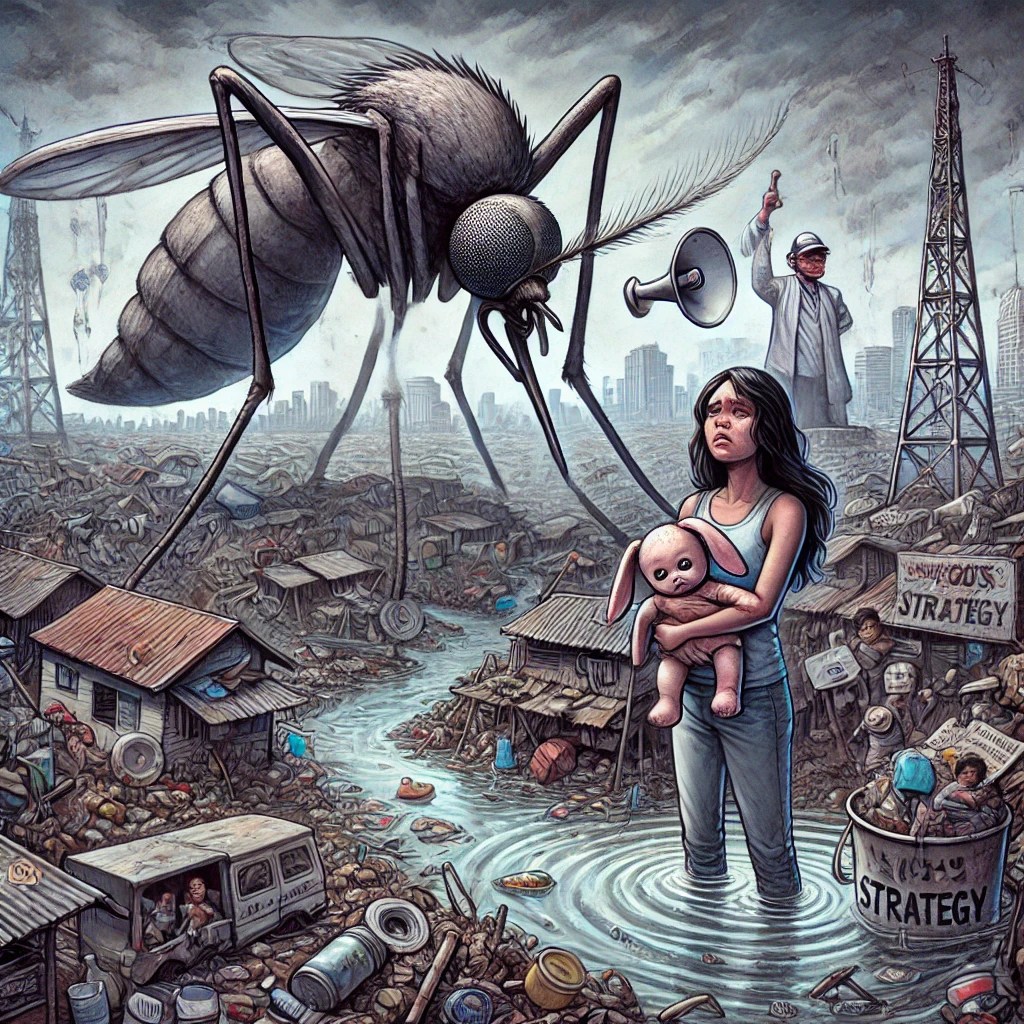
MARICEL clutches her daughter’s tattered bunny doll, its single eye staring blankly back at her. Four-year-old Ana used to chase dragonflies in the alleyways of their Quezon City barangay, her laughter echoing through the narrow streets. Now, that laughter is gone. Ana is one of 11 children claimed by dengue in the city this year—a number that feels hollow when you realize it’s not just a statistic, but a child who once dreamed of chasing dragonflies forever. “We cleaned what we could,” Maricel whispers, her voice breaking as she gestures to their yard, free of standing water. “But the canal behind us? It’s still clogged. No one comes to fix it.” Her grief is a haunting reminder of a crisis that refuses to end. How many more children must die before the Philippines takes real action?
This isn’t just Maricel’s tragedy—it’s a national emergency unfolding in slow motion. Quezon City, the sprawling heart of Metro Manila, declared a dengue outbreak this February after cases soared by over 200 percent compared to last year, reaching nearly 2,400. Across 76 of its 142 barangays, the mosquito-borne disease has breached alert or epidemic thresholds. Nationally, the Department of Health (DOH) tracks a troubling surge, with Calabarazon, the National Capital Region, and Central Luzon bearing the brunt. Dengue is endemic here, its spikes typically tied to the rainy season’s latter half. But this year’s early onslaught—fueled by climate change and La Niña’s unseasonal downpours—has caught the country off guard. Warmer temperatures and erratic rains have turned urban puddles and neglected drains into mosquito nurseries, while rapid urbanization and strained healthcare systems amplify the toll. The stakes are stark: a second infection can spiral into hemorrhagic shock, a killer that stalks survivors like a shadow.
Leading the charge is Health Secretary Teodoro Herbosa, a doctor whose tenure blends pragmatism with urgency. He’s zeroed in on the hardest-hit regions, pushing resources where the data screams loudest—a triage approach that’s slowing the climb in Quezon City, where Mayor Joy Belmonte notes a flicker of hope in rising awareness and health-seeking behavior. Herbosa’s fingerprints are on the Alas Kwatro Kontra Mosquito campaign, a 4 p.m. ritual urging Filipinos to scour their communities for breeding sites. It’s a simple idea with traction: since its launch, barangays reporting cleanups have seen case drops of up to 15 percent, per DOH estimates. His 5S strategy—search and destroy breeding sites, seek early consultation, self-protect, support fogging, and sustain hydration—marries prevention with treatment, a framework the World Health Organization endorses as dengue’s frontline defense. Yet Herbosa knows the clock is ticking. “Rain is falling elsewhere now,” he warned recently. “If we don’t clean up, the outbreak will spread.”
But how effective are these tools against a foe as relentless as the Aedes aegypti mosquito? Alas Kwatro’s success hinges on compliance—Barangay captains rally volunteers, yet in urban slums, trash piles and stagnant canals defy hourly sweeps. The 5S strategy shines on paper, but its execution falters: fogging battles insecticide resistance, and early consultation stumbles when clinics are hours away or understaffed. Resource allocation tilts toward hotspots, leaving rural areas vulnerable as rains shift. And climate adaptation? It’s a buzzword without teeth when urban planning lags and drainage systems rot. The DOH’s playbook is sound, but it’s a half-built bridge over a swelling river.
The barriers are as structural as they are human. Local governance is a patchwork—some barangays act swiftly, others dawdle, paralyzed by bureaucracy or apathy. In cities like Quezon, shantytowns sprawl without sanitation, their residents storing water in buckets that double as mosquito havens. Healthcare groans under the weight of poverty; a nurse in Manila told me she triages dengue cases by instinct, not labs, because test kits run dry. Education campaigns falter when families prioritize daily survival over lectures about larvae. These aren’t excuses—they’re the gritty reality of a nation racing to outpace a virus.
Then there’s the specter of corruption, a quiet rot that could undermine every peso spent. Dengue funds flow through opaque channels—procurement of fogging chemicals raises eyebrows when contracts favor connected suppliers over quality. In one region, a whistleblower alleged inflated budgets for cleanup drives, with cash siphoned before a single ditch was cleared. Political clout skews priorities; a mayor might push for showy fogging over silent sanitation fixes to win votes. Accountability dissolves in a haze of missing receipts and untracked outcomes. The DOH isn’t blind to this—Herbosa has called for vigilance—but without audits or transparency, trust erodes.
Look abroad, and lessons gleam. Singapore’s war on dengue blends strict fines with cutting-edge surveillance, slashing cases despite its tropical clime. Brazil’s community brigades pair locals with health workers to hunt breeding sites, a model the Philippines echoes but lacks in scale. Cuba’s integrated approach—vector control, public education, and rapid response—offers a blueprint for a resource-strapped nation. Why not here? The gap isn’t ambition but execution.
So what’s the path forward? Empower communities with incentives—cash or tax breaks for barangays that cut cases. Deploy tech: digital maps to track outbreaks in real time, not weeks late. Revisit vaccination, learning from Dengvaxia’s scars with transparent trials to rebuild faith. Forge alliances—urban planners, scientists, even telecoms to text alerts—because health isn’t the DOH’s burden alone. And lock down corruption with digitized procurement, public dashboards, and whistleblower shields. These aren’t dreams; they’re doable, if the will holds.
Maricel’s daughter deserved better—not just a cleaner canal, but a system that didn’t let her slip through. Dengue isn’t a faceless plague; it’s a test of our humanity, our ingenuity, our resolve. Will we rise to it, or mourn more dolls left unheld? The answer rests not just with Herbosa or the DOH, but with every Filipino who decides a child’s life is worth the fight—and with leaders who prove the system can match that grit with justice.

- “Forthwith” to Farce: How the Senate is Killing Impeachment—And Why Enrile’s Right (Even If You Can’t Trust Him)
- “HINDI AKO NAG-RESIGN!”

- “I’m calling you from my new Globe SIM. Send load!”

- “Mahiya Naman Kayo!” Marcos’ Anti-Corruption Vow Faces a Flood of Doubt

- “Meow, I’m calling you from my new Globe SIM!”

- “No Special Jail for Crooks!” Boying Remulla Slams VIP Perks for Flood Scammers

- “PLUNDER IS OVERRATED”? TRY AGAIN — IT’S A CALCULATED KILL SHOT

- “Several Lifetimes,” Said Fajardo — Translation: “I’m Not Spending Even One More Day on This Circus”

- “Shimenet”: The Term That Broke the Internet and the Budget

- “We Did Not Yield”: Marcos’s Stand and the Soul of Filipino Sovereignty

- “We Gather Light to Scatter”: A Tribute to Edgardo Bautista Espiritu

- $150M for Kaufman to Spin a Sinking Narrative



 KWEBA ni BAROK
Leave a comment