By Louis ‘Barok‘ C. Biraogo — March 7,2025
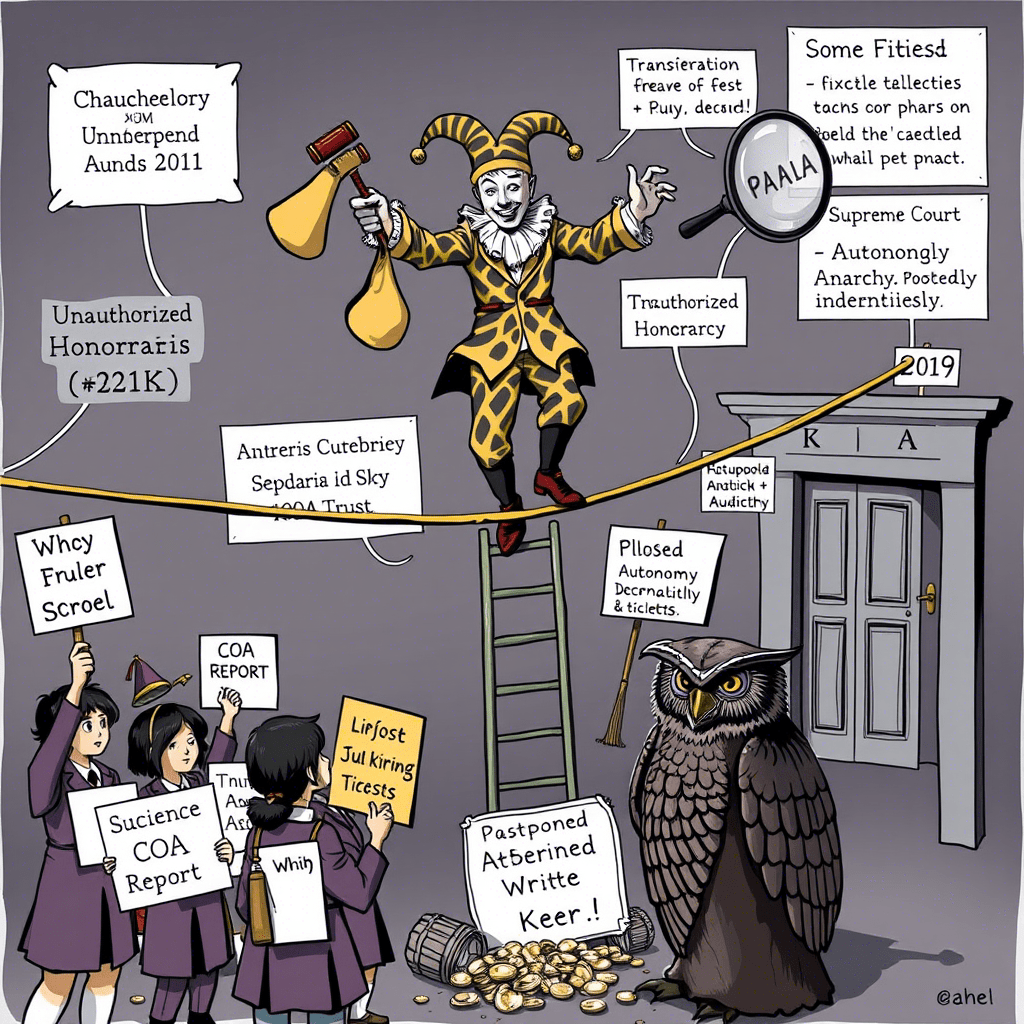
₱100 MILLION. That’s how much the University of the Philippines (UP) Baguio failed to spend over five years—while students begged for funding. Add ₱222,000 in unauthorized honoraria payments, and you have a fiscal management scandal that’s shaking the foundations of transparency and accountability in state universities. Sparked by a 2023 Commission on Audit (COA) report and fueled by student protests, this controversy raises critical legal questions. As a Philippine legal expert, Let’s dissect the violations, assess liabilities, and propose actionable solutions to restore trust in public institutions.”*
1. Potential Violations and Legal Issues
The COA report and student grievances point to several red flags:
- Unused GAA Funds (₱100 million, 2018–2023): The failure to utilize over ₱100 million in appropriated funds over five years, while denying student funding requests citing budget shortages, suggests mismanagement or neglect of fiscal duties. This could breach general principles of public fund utilization and UP’s obligations under its charter.
- Unauthorized Honoraria Payments (₱222,000): Disbursing honoraria to committee chairs and members without legal basis flags potential irregular expenditure under COA rules, possibly escalating to graft or malversation if intent or negligence is proven.
- Transparency Deficit: The administration’s reluctance to engage openly (e.g., skipping the Feb. 21 town hall) clashes with principles of accountability in public institutions, potentially violating ethical standards for public officers.
These issues implicate statutes like Republic Act (RA) 9500 (UP Charter), RA 3019 (Anti-Graft Act), the Revised Penal Code (RPC), Civil Service Commission (CSC) regulations, and COA circulars. Let’s break it down.
2. Specific Liabilities Under Relevant Laws
Republic Act 9500 (UP Charter of 2008)
RA 9500 grants UP fiscal autonomy (Section 4), allowing flexibility in fund management, but it’s not a blank check. Funds must still align with the “purposes of the University” and comply with “existing laws and regulations.” The ₱100 million in unspent GAA funds could signal a failure to execute mandated programs, potentially breaching Section 13 (budget implementation duties). The unauthorized honoraria payments might also violate Section 4’s implicit requirement for lawful expenditure, exposing officials to scrutiny for exceeding autonomy’s bounds.
Republic Act 3019 (Anti-Graft and Corrupt Practices Act)
Section 3(e) of RA 3019 targets public officers who cause “undue injury” to the government or act with “manifest partiality, evident bad faith, or gross inexcusable negligence.” Denying student funding while sitting on ₱100 million could be framed as undue injury to students and the institution, especially if bad faith (e.g., hoarding funds) or negligence (e.g., poor planning) is shown. The ₱222,000 honoraria, if paid without legal basis, might also reflect partiality or negligence, triggering liability. Penalties include imprisonment (6–15 years) and perpetual disqualification from office.
Revised Penal Code (Malversation Provisions)
- Article 217 (Malversation of Public Funds): Applies if a public officer “appropriates, takes, or misappropriates” funds or permits others to do so. The unused ₱100 million doesn’t directly fit here unless evidence shows personal use—unlikely based on current data. However, the ₱222,000 honoraria could qualify if officials knowingly disbursed funds without authority, with prima facie evidence arising from failure to account for them upon demand. Penalties range from prisión correccional to reclusion perpetua, depending on the amount, plus fines and disqualification.
- Article 220 (Technical Malversation): Might also apply if funds were diverted to unauthorized purposes, even without personal gain.
Civil Service Commission Regulations
CSC rules (e.g., 2017 Revised Rules on Administrative Cases) classify dishonesty, grave misconduct, or neglect of duty as grounds for dismissal. Sitting on ₱100 million while claiming budget cuts could be neglect or dishonesty if officials misrepresented financial status. The honoraria payments, if unauthorized, might constitute grave misconduct. Penalties include suspension or dismissal, forfeiture of benefits, and disqualification from public service.
Commission on Audit Rules and Circulars
- COA Circular 2012-003: Deems expenditures “irregular” if they lack legal basis or proper documentation. The ₱222,000 honoraria falls squarely here, requiring disallowance and restitution.
- COA Circular 2015-002: Mandates timely fund utilization—leaving ₱100 million idle could breach this, though it’s not explicitly “misuse.” COA can issue notices of disallowance (NDs), holding certifying officers liable unless overturned.
3. Administrative Accountability and Procedural Requirements
Administrative Accountability of University Officials
UP Baguio officials—Chancellor Addawe, budget officers, and certifying personnel—face administrative exposure. Under CSC rules, accountability hinges on their roles:
- Chancellor: As head, he’s accountable for overall fiscal management. Neglect in utilizing GAA funds or approving irregular payments could trigger liability for gross negligence or misconduct.
- Budget and Disbursing Officers: Certifying availability of funds or propriety of payments (e.g., honoraria) makes them jointly liable under COA rules if expenditures are disallowed.
The Supreme Court in Dr. Dante G. Velasco, et al. v. Commission on Audit (G.R. No. 189999, September 27, 2016), a key honoraria disallowance case, emphasized personal liability for unauthorized payments by state university officials, though good faith may mitigate penalties. Here, UP Baguio officials might invoke fiscal autonomy under RA 9500, but COA’s oversight authority prevails unless the payments comply with legal standards.
Procedural Requirements for Fund Management
State universities must:
- Plan and Execute Budgets: RA 9500 and GAA provisions require UP to program funds per approved purposes, with annual reports to COA and Congress.
- Authorize Expenditures: DBM Circulars (e.g., NBC 541) and COA rules demand legal basis for payments—honoraria need DBM or statutory approval.
- Report and Liquidate: Unspent funds must be justified, not rolled over indefinitely, per COA Circular 2015-002.
The ₱100 million backlog suggests procedural lapses in planning or liquidation, while the honoraria skips authorization steps entirely.
4. Supreme Court Jurisprudence
Public Fund Utilization in Educational Institutions
- Belgica v. Ochoa (G.R. No. 208566, 2013): The Court struck down the PDAF, stressing that public funds must serve lawful, specific purposes. UP Baguio’s unused funds could be analogized—hoarding appropriations while denying student needs might not pass muster as “public purpose.”
- Dr. Dante G. Velasco, et al. v. Commission on Audit (G.R. No. 189999, September 27, 2016): This case involves the disallowance of honoraria and benefits for state university officials (specifically, the Polytechnic University of the Philippines). The Court upheld COA’s authority to disallow unauthorized payments, emphasizing strict compliance with compensation laws.
Fiscal Autonomy Limitations
- CSC v. DBM (G.R. No. 158791, 2005): Fiscal autonomy doesn’t exempt agencies from accountability or COA oversight. UP’s RA 9500 defense might falter if funds were mismanaged beyond autonomy’s scope.
- PhilHealth v. COA (G.R. No. 222710, 2024): The Court clarified that autonomy ends where legal compliance begins—UP can’t dodge COA scrutiny by citing RA 9500.
COA’s Oversight Authority
- COA v. PhilHealth (G.R. No. 222129, 2024): COA’s audit powers don’t extend to administrative penalties, but it can flag irregularities and demand restitution. UP Baguio’s NDs for honoraria align with this, though sanctions fall to courts or the Ombudsman.
5. Recommendations
For Stakeholders Seeking Accountability
- File Complaints: Students and faculty can lodge administrative cases with the CSC or Ombudsman for neglect/misconduct, citing COA findings. Criminal charges (e.g., RA 3019, RPC) need probable cause—escalate to the Ombudsman with evidence.
- Demand Records: Use RA 11032 (Ease of Doing Business Act) to request financial reports, forcing transparency.
- Engage the BOR: Push the Board of Regents to investigate, leveraging Student Regent Duran’s access.
For Administration Addressing Transparency
- Hold Public Forums: Ditch closed-door talks—open town halls rebuild trust. Explain the ₱100 million delay and honoraria basis.
- Release Reports: Publish a detailed breakdown of GAA fund status and expenditure policies, preempting further protests.
- Cooperate with COA: Address NDs promptly, appealing or justifying disbursements to avoid escalation.
Preventive Measures for Future Compliance
- Budget Oversight Committee: Form a multi-stakeholder body (students, faculty, admin) to monitor fund allocation.
- Training: Equip officials with COA/DBM compliance workshops—ignorance isn’t a defense.
- Policy Update: Codify internal rules on honoraria and fund liquidation, aligning with RA 9500 and COA standards.
Conclusion
The UP Baguio saga isn’t a clear-cut tale of corruption—yet. The ₱100 million in unused funds hints at inefficiency, not theft, while the ₱222,000 honoraria screams procedural sloppiness. RA 9500’s autonomy shield holds only if UP can prove lawful intent, but RA 3019, RPC, and COA rules loom large if bad faith or negligence surfaces. Supreme Court precedents hammer home accountability over autonomy’s limits, and COA’s role as fiscal watchdog is unshakable. Stakeholders have tools to press for answers, and the administration can still course-correct with transparency. Without hard evidence of guilt, this is a legal puzzle, not a conviction—but the framework’s clear: public funds demand public trust.

- “Forthwith” to Farce: How the Senate is Killing Impeachment—And Why Enrile’s Right (Even If You Can’t Trust Him)

- “HINDI AKO NAG-RESIGN!”

- “I’m calling you from my new Globe SIM. Send load!”

- “Mahiya Naman Kayo!” Marcos’ Anti-Corruption Vow Faces a Flood of Doubt

- “Meow, I’m calling you from my new Globe SIM!”

- “No Special Jail for Crooks!” Boying Remulla Slams VIP Perks for Flood Scammers

- “PLUNDER IS OVERRATED”? TRY AGAIN — IT’S A CALCULATED KILL SHOT

- “Several Lifetimes,” Said Fajardo — Translation: “I’m Not Spending Even One More Day on This Circus”

- “Shimenet”: The Term That Broke the Internet and the Budget

- “We Did Not Yield”: Marcos’s Stand and the Soul of Filipino Sovereignty

- “We Gather Light to Scatter”: A Tribute to Edgardo Bautista Espiritu

- $150M for Kaufman to Spin a Sinking Narrative




 KWEBA ni BAROK
Leave a comment