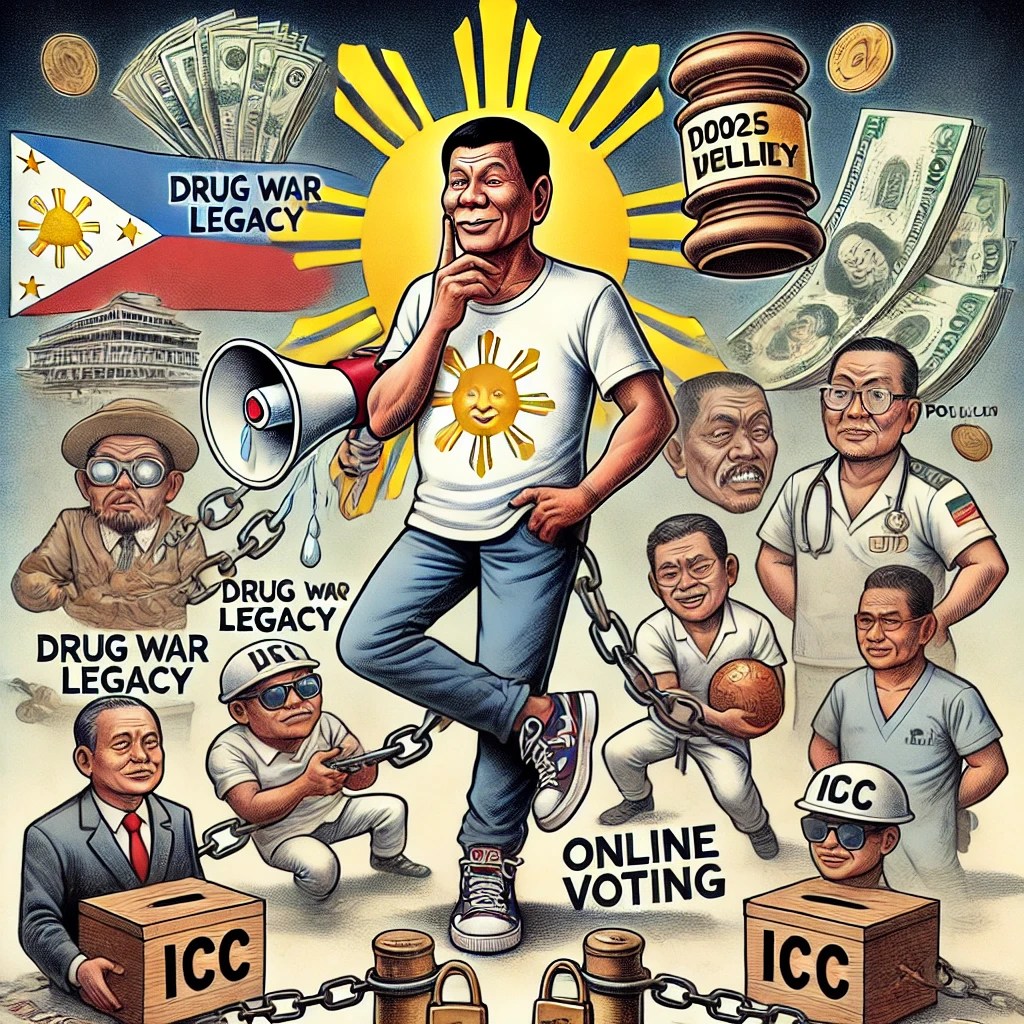
The Filipino Diaspora’s Silent Thunder
By Louis ‘Barok‘ C .Biraogo — March 10, 2025
WAS it a campaign stop—or an escape plan? As Rodrigo Duterte boarded a commercial flight to Hong Kong on March 7, 2025, the whispers followed him through Manila’s Ninoy Aquino International Airport. The former Philippine president, architect of a drug war that left thousands dead, smiled for selfies while fans chanted his name—”Duterte, Duterte”—a diminished echo of the roar that once carried him to power. Officially, he was headed to rally Overseas Filipino Workers behind his party’s senatorial candidates. Unofficially, speculation swirled: with the International Criminal Court’s investigation intensifying, was the strongman making a strategic retreat disguised as a campaign tour?
For the 2.33 million Filipinos working abroad, scenes like this carry a deeper resonance. They are the nation’s economic backbone, sending home $33.5 billion in 2023 alone—10% of the Philippines’ GDP. In Hong Kong, where Duterte rallied supporters on March 9, the OFW community is a political goldmine: the territory hosts the highest number of registered absentee voters among foreign destinations. Yet their voices, so vital to the economy, remain a whisper in the ballot box. Duterte’s trip isn’t just a political stunt; it’s a spotlight on a diaspora whose untapped power could reshape Philippine democracy—if only it were fully unleashed.
A Nation Divided: Duterte’s Legacy in Context
Duterte’s Hong Kong sortie is no isolated event—it’s a thread in the tangled weave of Philippine politics, where populism, dynasties, and global pressures collide. His six-year presidency left a stark legacy: thousands dead in a drug war that polarized the nation, a pro-China tilt that rankled allies, and a cult of personality that still grips millions. Now, as the May 2025 midterm elections loom, he’s back on the stump, backing a Partido Demokratiko ng Pilipinas (PDP) slate that includes loyalists like Senator Bong Go and controversial figures like detained televangelist Apollo Quiboloy.
This isn’t just about nostalgia. Duterte’s resurgence pits him against President Ferdinand “Bongbong” Marcos Jr., whose 2022 victory marked the return of another political dynasty. The two camps—once allied when Duterte’s daughter Sara ran as Marcos’ vice president—have splintered. Marcos, with his polished “unity” narrative and pro-Western pivot, contrasts sharply with Duterte’s rough-edged defiance. The Hong Kong rally is a salvo in this feud, a bid to rally the grassroots against Marcos’ elite coalition. Yet it’s also a reminder of a deeper malaise: a democracy strained by dynastic rule, where the Duterte and Marcos families together hold sway over vast swaths of power—Sara as vice president, Sebastian as Davao City mayor, and Bongbong atop the heap.
The Unsung Power of the OFW Vote
Enter the OFWs, a diaspora whose influence is both outsized and underutilized. In 2016, they backed Duterte overwhelmingly, drawn to his promise to protect the “common Filipino”—a pledge that rang true for workers toiling abroad, far from home. Today, his appeal endures among them, fueled by a mix of nostalgia and frustration with Manila’s elite. Social media amplifies this bond: posts on X and Facebook from Hong Kong OFWs buzzed with excitement over his visit, framing him as their champion against a distant, uncaring establishment.
The numbers tell a different story. Of the 1.6 million OFWs registered to vote in 2016, only 430,000 cast ballots—a turnout dwarfed by the 54 million domestic voters. Hong Kong’s OFW voters, though numerous, face hurdles: polling stations at consulates, rigid schedules, and a process unchanged since the 2003 Overseas Absentee Voting Act. Yet their potential is undeniable. With online voting on the horizon for 2025—a reform long championed by OFW advocates—they could swell to 1.5 million voters, enough to tip tight senatorial races where margins often hover in the low millions.
Duterte knows this. His rhetoric—tough on crime, soft on the working class—strikes a chord with OFWs who see in him a reflection of their own struggles. Marcos, by contrast, has yet to court them with the same fervor, leaving a gap Duterte exploits. But the OFWs’ power isn’t just in numbers; it’s in their remittances, which shape family votes back home. A 2018 study found provinces with high OFW populations enjoy better governance—proof their economic clout trickles into politics. Why, then, does their electoral voice lag?
The ICC Shadow: Justice vs. Sovereignty
Hovering over Duterte’s trip is the ICC, probing alleged crimes against humanity in his drug war—a campaign that left widows grieving and morgues overflowing. The “escape” speculation flared when he left Manila just as unverified reports hinted at an imminent arrest warrant. His supporters scoff, calling it a smear; critics see a fugitive ducking justice. The truth is murkier: the Philippines quit the ICC in 2019, and Marcos has signaled non-cooperation, though his administration’s mixed messages leave room for doubt.
For OFWs, this tension cuts deep. Many still hail Duterte as a hero who cleaned up streets they left behind; others, exposed to global norms abroad, question the bloodshed. Social media, their lifeline to home, swirls with both praise and condemnation—posts lauding his defiance of “Western meddling,” countered by calls for accountability. The ICC saga tests a core Philippine dilemma: Can a nation assert sovereignty while reckoning with its past? Duterte’s enduring pull suggests many Filipinos, especially OFWs, prioritize the former over the latter.
Democracy’s Achilles’ Heel: Dynasties and Populism
The Duterte-Marcos rivalry lays bare a structural flaw: political dynasties choke Philippine governance. The Dutertes dominate Mindanao; the Marcoses, the north. Both wield populism—Duterte’s visceral, Marcos’ polished—to mask elite entrenchment. The PDP slate, with figures like Quiboloy, reeks of cronyism; Marcos’ coalition, though broader, leans on old money and new allies. For OFWs, this leaves little room for fresh voices—ironic, given their distance from Manila’s power games offers a clearer view of its rot.
Social media, where OFWs consume news, amplifies this trap. Algorithms feed them Duterte’s defiance or Marcos’ promises, rarely challenging the dynasty-driven status quo. A PIDS study found OFWs crave “incorruptible” leaders, yet their votes often prop up the same old clans. It’s a paradox born of disconnection: abroad, they see governance models that work—Singapore’s efficiency, say—but at home, they back familiarity over reform.
Breaking Barriers: Unleashing the Diaspora
Philippine democracy isn’t doomed, but it’s limping. Duterte’s Hong Kong gambit, the ICC cloud, and the OFW vote point to a system crying for renewal. Here’s how to start:
- Empower the OFW Vote: Fast-track online voting for 2025. COMELEC’s delays are inexcusable—cybersecurity fears pale next to the disenfranchisement of millions. Pair this with voter education to combat misinformation, ensuring OFWs’ choices reflect their aspirations, not just their feeds.
- Break the Dynasty Grip: Cap political terms across family lines—say, no more than two relatives in high office at once. It won’t end dynasties overnight, but it’ll crack their stranglehold, giving outsiders a shot.
- Bridge Justice and Sovereignty: The ICC impasse demands a middle ground. A truth commission, domestic but independent, could probe the drug war’s toll without ceding control to The Hague. Justice needn’t mean capitulation.
- Amplify Grassroots Voices: Subsidize campaigns for non-dynastic candidates, especially those with OFW ties. Their remittances already fund families—let their ideas fund a new politics.
Duterte’s rally in Hong Kong wasn’t merely a political maneuver—it was a revelation. Beyond the strongman’s defiant smile stood thousands of Filipino workers whose remittances build hospitals they’ll never visit and schools their children attend through pixelated screens. These OFWs, invisible architects of the Philippines’ economy, hold in their calloused hands the power to topple despots or cement dynasties. As Manila’s elite play constitutional chess, democracy’s true guardians scrub foreign floors and build distant skyscrapers, waiting for the moment when their whispers become thunder.

- “Forthwith” to Farce: How the Senate is Killing Impeachment—And Why Enrile’s Right (Even If You Can’t Trust Him)
- “HINDI AKO NAG-RESIGN!”

- “I’m calling you from my new Globe SIM. Send load!”

- “Mahiya Naman Kayo!” Marcos’ Anti-Corruption Vow Faces a Flood of Doubt

- “Meow, I’m calling you from my new Globe SIM!”

- “No Special Jail for Crooks!” Boying Remulla Slams VIP Perks for Flood Scammers

- “PLUNDER IS OVERRATED”? TRY AGAIN — IT’S A CALCULATED KILL SHOT

- “Several Lifetimes,” Said Fajardo — Translation: “I’m Not Spending Even One More Day on This Circus”

- “Shimenet”: The Term That Broke the Internet and the Budget

- “We Did Not Yield”: Marcos’s Stand and the Soul of Filipino Sovereignty

- “We Gather Light to Scatter”: A Tribute to Edgardo Bautista Espiritu

- $150M for Kaufman to Spin a Sinking Narrative



 KWEBA ni BAROK
Leave a comment