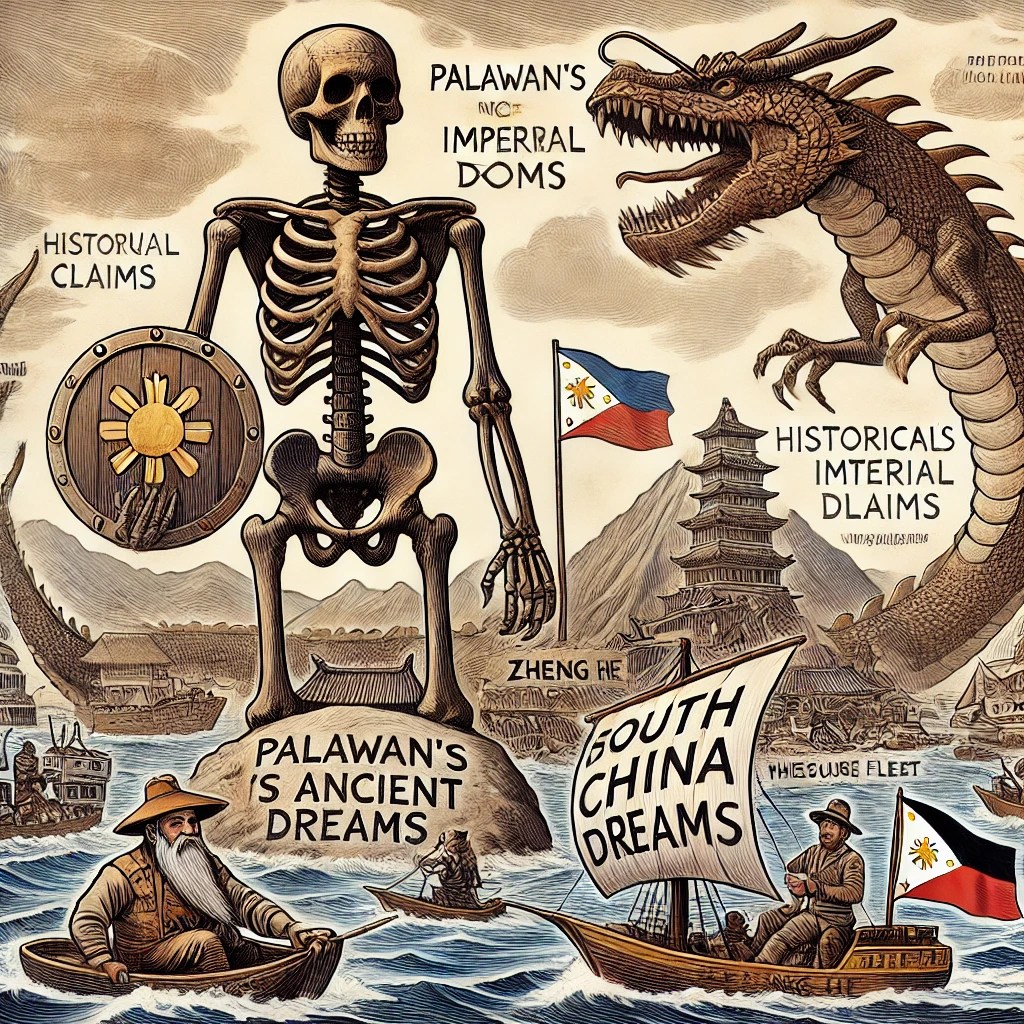
By Louis ‘Barok‘ C. Biraogo — March 15, 2025
THE air was heavy with salt and history as I stood at the mouth of Tabon Cave, a jagged limestone gateway towering above the South China Sea. Below, Tagbanua fishermen’s voices rose and fell with the rhythm of the waves, while inside the cave, shadows clung to secrets older than time. Maria, a guide with eyes that seemed to hold centuries, knelt and brushed her hand over the cave floor. ‘This is ours,’ she said, her voice steady but fierce. ‘Not theirs.’ Her words echoed through the chamber, where the bones of Tabon Man—37,000 to 47,000 years old—lay silent, a testament to a story that refuses to be forgotten.
Her “theirs” referred to a startling claim rippling across Chinese social media in 2025: that Palawan, this emerald isle of 1.1 million Filipinos, belongs to China, once governed by the Ming Dynasty admiral Zheng He. It’s a narrative as audacious as it is flimsy, and it threatens not just Palawan but the stability of Southeast Asia. As a journalist who’s tracked China’s ambitions from Tibet to Taiwan, I see a familiar pattern—historical revisionism wielded as a geopolitical cudgel. Yet, in Palawan’s caves, the truth is etched in stone, offering the Philippines both a shield and a clarion call.
Skeletons Shatter a Sailor’s Tale
China’s claim hinges on Zheng He, the 15th-century eunuch-explorer whose fleets sailed from 1405 to 1433, reaching India and Africa. Nationalists now assert he “discovered” Palawan, dubbing it “Zheng He Island.” But history offers no such footnote. Chronicles like Ma Huan’s Yingya Shenglan chart Zheng He’s routes along mainland Asia’s coasts—Malacca, Java, Sumatra—not the 600-kilometer detour to Palawan. “There’s no record of him stepping foot here,” says Filipino historian Xiao Chua. “It’s a fantasy stitched from whole cloth.”
Contrast this with Tabon Man. Unearthed in 1962 by anthropologist Robert Fox, these fossils—skulls, jaws, teeth—date to a time when the South China Sea’s shores were 30 kilometers west of today’s Palawan, a world of hunters wielding stone tools and weaving plant fibers 39,000 years ago. No Chinese artifacts grace these caves; instead, they cradle a pre-Mongoloid people, ancestors to the Tagbanua and Palaw’an who still fish these waters. China’s presence arrives millennia later—Song Dynasty ceramics from the 10th century signal trade, not dominion. Zheng He’s ships, grand as they were, pale beside Palawan’s 50,000-year human tapestry.
This isn’t just archaeology; it’s a moral rebuttal. China’s narrative seeks to erase a people’s past, to claim a land its ancestors never touched. The evidence is unequivocal: Palawan is Filipino, not by fiat, but by the stubborn persistence of its first inhabitants.
Beijing’s History Heist Across Asia
Palawan is no anomaly in China’s revisionist playbook. I’ve seen this script before. In Tibet, Beijing calls a millennia-old kingdom an “original province,” ignoring its independence until Mao’s 1949 annexation. Xinjiang’s Uighurs, with their Turkic roots, are recast as eternal Chinese subjects, their mosques razed to fit the tale. Taiwan, settled by Han Chinese only in the 17th century, is deemed an ancient birthright, its democracy a mere footnote to be erased. Even Siberia and Okinawa flicker in ultranationalist dreams, territories “lost” to Russia and Japan.
The Zheng He myth is a softer salvo—disinformation over tanks—but its intent is the same: to stretch China’s historical shadow across Asia. Jarius Bondoc’s report in The Philippine Star nails it: “That explorer Zheng He ‘discovered’ Palawan isn’t the only historical lie Communist Chinese is peddling.” What’s chilling is the timing. As China militarizes reefs 300 kilometers from Palawan, this claim feels less like nostalgia and more like a prelude to pressure—testing Manila’s resolve and the world’s attention.
Dominoes Teetering in Southeast Asia
The geopolitical stakes are stark. Palawan isn’t just an island; it’s a linchpin. Its western waters, part of the Philippines’ EEZ, host the Malampaya gas field and lie astride shipping lanes China covets. If Beijing presses this claim, it risks fracturing ASEAN, where Vietnam and Malaysia already chafe at South China Sea incursions. “We cannot let this stand,” Palawan Governor Victorino Dennis Socrates told me last month. “It’s not just our land—it’s our future.”
For the U.S.-Philippines alliance, this is a crucible. The 1951 Mutual Defense Treaty binds Washington to Manila, but its scope—focused on armed attack—leaves Palawan’s land claim in a gray zone. Joint drills in 2025 signal resolve, yet ambiguity lingers. China’s gambit could embolden further tests, from Scarborough Shoal to Sabah, unraveling Southeast Asia’s fragile security.
ASEAN’s cohesion hangs in the balance. A united front could deter Beijing, but Cambodia’s pro-China tilt and Laos’ silence weaken the bloc. The Philippines, with its legal win at the 2016 PCA ruling, holds a trump card—yet enforcing it demands allies. Left unchecked, China’s revisionism could turn the South China Sea into a Beijing lake, with Palawan as its first domino.
Fortress Palawan: A Three-Pronged Stand
The Philippines can’t match China’s might, but it can outmaneuver its myths. Here’s how, in three phases blending grit and hope.
Sound the Alarm (Next 12 Months)
First, go loud with the truth. Launch a global campaign spotlighting Tabon Man—films, UNESCO exhibits, X posts—drowning China’s Zheng He tale in facts. “Our history is our strength,” says archaeologist Hermine Xhauflair, whose 2023 study dated Palawan’s fiber tech to 39,000 years ago. Diplomatically, file a UN protest, citing the PCA ruling and Palawan’s 1898 Treaty of Paris roots. Rally ASEAN for a joint rebuke, even if it’s symbolic. Legally, clarify the U.S. treaty’s scope—Palawan’s fate can’t hinge on semantics.
Steel and Strategy (1–3 Years)
Next, harden the island. Deploy anti-ship missiles and drones under the U.S. Enhanced Defense Cooperation Agreement—quietly, to avoid a flare-up. Economically, shift trade from China (20% of exports) to Japan and the EU, while fast-tracking Malampaya’s expansion with Western firms. Build a Quad coalition—U.S., Japan, Australia, India—for exercises off Palawan. “We need friends who show up,” National Security Adviser Eduardo Año told me. China respects strength, not pleas.
Roots of Resilience (3–10 Years)
Finally, root Palawan in permanence. Invest in sustainable tourism and renewables—its caves and corals can fund its future. Preserve Tagbanua culture—land rights, schools—binding them to the fight. Forge a regional security pact, perhaps an ASEAN-plus framework with Japan and South Korea, to lock in stability. This isn’t just defense; it’s defiance with a purpose—a Palawan that thrives, not just survives.
Standing Firm Amid the Storm
China’s claim is a lie, but it’s not invincible. Beijing craves legitimacy as much as territory—expose the former, and the latter crumbles. The Philippines must wield its history as a weapon, its allies as a shield, and its people as a voice. This isn’t blind idealism; it’s realpolitik with a moral spine. Engage China where possible—trade talks, climate pacts—to keep channels open, but never at the cost of Palawan’s truth.
Standing in that cave, I felt the weight of 50,000 years. Maria’s words lingered: “This is ours.” She’s right. The bones beneath her feet prove it, and the world must ensure it stays that way. The Philippines can win this—not with guns alone, but with the stubborn, quiet power of a past that refuses to be rewritten.

- ₱75 Million Heist: Cops Gone Full Bandit

- ₱6.7-Trillion Temptation: The Great Pork Zombie Revival and the “Collegial” Vote-Buying Circus

- ₱1.9 Billion for 382 Units and a Rooftop Pool: Poverty Solved, Next Problem Please

- ₱1.35 Trillion for Education: Bigger Budget, Same Old Thieves’ Banquet

- ₱1 Billion Congressional Seat? Sorry, Sold Out Na Raw — Si Bello Raw Ang Hindi Bumili

- “We Will Take Care of It”: Bersamin’s P52-Billion Love Letter to Corruption

- “Skewed Narrative”? More Like Skewered Taxpayers!

- “Scared to Sign Vouchers” Is Now Official GDP Policy – Welcome to the Philippines’ Permanent Paralysis Economy

- “Robbed by Restitution?” Curlee Discaya’s Tears Over Returning What He Never Earned

- “My Brother the President Is a Junkie”: A Marcos Family Reunion Special

- “Mapipilitan Akong Gawing Zero”: The Day Senator Rodante Marcoleta Confessed to Perjury on National Television and Thought We’d Clap for the Creativity

- “Just Following Orders” Is Dead: How the Hague Just Turned Tokhang’s Finest Into International Fugitives






 KWEBA ni BAROK
Leave a comment