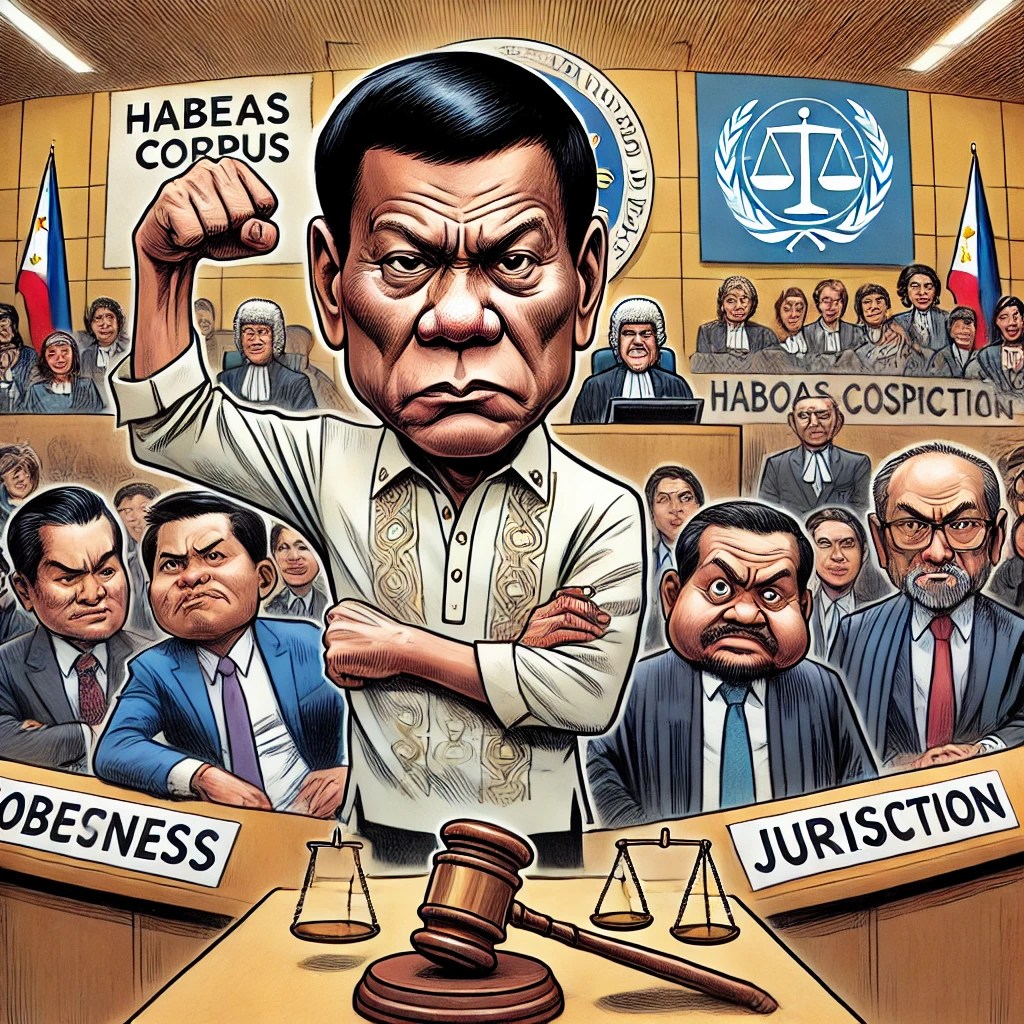
By Louis ‘Barok‘ C Biraogo — March 19, 2025
RODRIGO Duterte is in The Hague, his kids are in court, and the Philippines is in chaos. The former president’s transfer to the International Criminal Court (ICC) has ignited a legal showdown, with his children filing habeas corpus petitions to bring him back. But the Department of Justice (DOJ) isn’t backing down—armed with mootness arguments and jurisdictional defenses, they’re fighting to keep Duterte in ICC custody. As your Kweba ng Katarungan analyst, I’m diving into this legal maelstrom to break down the DOJ’s strategy, evaluate Undersecretary Nicholas Felix Ty’s role, and uncover what this means for Philippine law and politics. Ready? Let’s go.
The DOJ’s Iron Fist: Mootness, Jurisdiction, and a Global Flex
The DOJ, stepping in after the Solicitor General’s recusal, is swinging hard: the habeas corpus petitions filed by Duterte’s children—Veronica, Sebastian, and Paolo—are dead on arrival. Their argument? Duterte is now in ICC custody in The Hague, rendering the petitions moot. Here’s the blow-by-blow:
1. Mootness Mayhem: Habeas Corpus KO’d by Geography
The DOJ lands a clean hit with Section 2, Rule 102 of the Rules of Court, which limits habeas corpus to the territorial jurisdiction of the Philippines. With Duterte in Dutch custody, the Supreme Court’s authority can’t reach him. Case closed.
This argument holds water. In Mejoff v. Director of Prisons (1951), the Supreme Court ruled that habeas corpus doesn’t extend beyond Philippine borders. The mootness doctrine, as seen in David v. Macapagal-Arroyo (2006), further supports the DOJ’s position—once the act in question (Duterte’s transfer) is completed, judicial relief becomes ineffective. However, the petitioners could counterpunch by arguing that the transfer itself was illegal, keeping the issue alive.
2. Jurisdiction Joust: ICC’s Global Grapple Holds Firm
The DOJ doubles down, asserting that Duterte’s arrest and transfer were lawful under Republic Act No. 9851, Section 17, which allows Philippine authorities to surrender suspects to international tribunals like the ICC if they are already prosecuting the case. Duterte’s public statements in November 2024 and a pre-Hague Facebook video suggest he willingly submitted to the ICC’s jurisdiction.
RA 9851 aligns with the Rome Statute’s complementarity principle (Article 17), but the Philippines’ withdrawal from the ICC in 2019 complicates matters. While the ICC’s investigation into Duterte’s drug war covers crimes committed before the withdrawal, the lack of a treaty framework post-2019 raises questions about the legal basis for the transfer. Duterte’s apparent consent could strengthen the DOJ’s case, but the absence of formal documentation leaves room for challenge.
3. Interpol’s Tag-Team Takedown
The DOJ invokes Article 2 of the Interpol Constitution, which mandates member states to assist in international law enforcement efforts. They argue that helping Interpol serve the ICC warrant was a duty, not an overreach.
This argument has merit. In Government of the United States v. Puruganan (2002), the Supreme Court recognized Interpol’s role in facilitating international arrests, provided domestic laws are followed. Duterte’s arrest at Ninoy Aquino International Airport appears procedurally sound, but the lack of a formal extradition hearing could be a vulnerability the petitioners might exploit.
Ty’s Legal Thunder: Brilliance Meets Blind Spots
Undersecretary Nicholas Felix Ty, the DOJ’s lead strategist, delivers a strong performance. His key arguments include:
- Mootness Muscle: Linking habeas corpus’s territorial limits to Duterte’s ICC custody is a solid one-two punch, supported by Mejoff v. Director of Prisons.
- Statutory Slam: Grounding the transfer in RA 9851 avoids the complications of the ICC withdrawal.
- Consent Counter: Framing Duterte as a willing participant shifts the burden of proof to the petitioners.
However, Ty’s arguments aren’t flawless. His reliance on RA 9851 post-ICC withdrawal is legally tenuous without a treaty framework. Additionally, his portrayal of Interpol’s role as a duty rather than a discretionary act could be challenged.
Constitutional Chaos: Marcos’ Foreign Policy Power Move
The DOJ’s trump card is President Marcos Jr.’s foreign policy prerogative under Article VII, Section 1 of the Philippine Constitution. They argue that cooperating with Interpol and the ICC is a political question beyond judicial review, citing Pimentel v. Executive Secretary (2005).
This is a strong argument. In Bayan v. Zamora (2000), the Supreme Court held that foreign policy decisions are generally non-justiciable unless they involve grave abuse of discretion. However, the petitioners could invoke Article III, Section 1 (due process) to argue that surrendering a citizen without a formal hearing violates constitutional rights. The Court’s ruling in Marcos v. Manglapus (1989) suggests that executive actions with constitutional implications are subject to judicial scrutiny.
Fight Plan: How to Survive the Legal Brawl
Here’s the playbook for the key players:
- Duterte’s Children: Abandon habeas corpus—it’s a dead end. Instead, file a petition for certiorari challenging the legality of the arrest and transfer under RA 9851 and due process grounds. Probe the validity of Duterte’s consent and push the Supreme Court to clarify the Philippines’ post-ICC obligations.
- DOJ: Strengthen the RA 9851 argument with concrete evidence of Duterte’s consent. Provide a detailed account of Interpol’s involvement to demonstrate procedural compliance. Avoid overreliance on the political question doctrine, as courts may scrutinize executive actions that impact constitutional rights.
- Marcos Administration: Frame the cooperation with Interpol as a fulfillment of international obligations, not an endorsement of the ICC.
- Supreme Court: Rule on mootness but address the broader legal questions, given the public interest. Clarify the Philippines’ obligations to the ICC post-withdrawal to set a precedent for future cases.
The Final Bell
The DOJ’s mootness argument lands a solid blow—habeas corpus can’t reach beyond Philippine borders. Undersecretary Ty’s legal strategy is strong but not without vulnerabilities. President Marcos’ foreign policy prerogative is a powerful shield, but due process concerns linger.
The Supreme Court’s ruling won’t just decide Duterte’s fate—it will redraw the boundaries of power, sovereignty, and international justice. With every argument and every decision, the legal framework of the nation is being rewritten. But make no mistake: this battle is bigger than one man. The verdict is coming, and when it does, the entire nation will be watching. Buckle up—the final chapter is yet to be written.

- ₱8B BBM Pork: CCTV for Every Captain’s Kumpare?

- ₱75 Million Heist: Cops Gone Full Bandit

- ₱6.7-Trillion Temptation: The Great Pork Zombie Revival and the “Collegial” Vote-Buying Circus

- ₱1.9 Billion for 382 Units and a Rooftop Pool: Poverty Solved, Next Problem Please

- ₱1.35 Trillion for Education: Bigger Budget, Same Old Thieves’ Banquet

- ₱1 Billion Congressional Seat? Sorry, Sold Out Na Raw — Si Bello Raw Ang Hindi Bumili

- “We Will Take Care of It”: Bersamin’s P52-Billion Love Letter to Corruption

- “Skewed Narrative”? More Like Skewered Taxpayers!

- “Scared to Sign Vouchers” Is Now Official GDP Policy – Welcome to the Philippines’ Permanent Paralysis Economy

- “Robbed by Restitution?” Curlee Discaya’s Tears Over Returning What He Never Earned

- “No Pressure” Luistro? The House Pork Bazaar Exposed

- “My Brother the President Is a Junkie”: A Marcos Family Reunion Special






 KWEBA ni BAROK
Leave a comment