By Louis ‘Barok‘ C. Biraogo — March 22, 2025
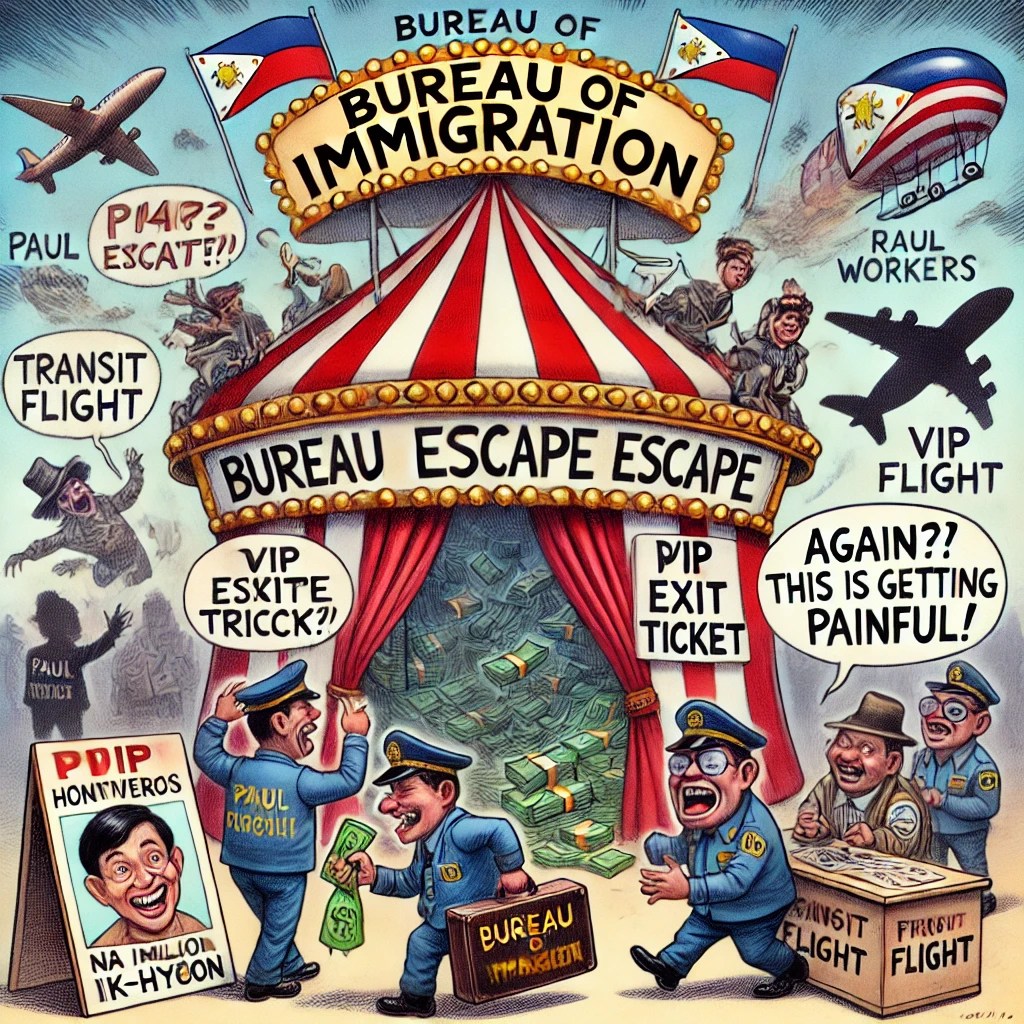
ANOTHER day, another Bureau of Immigration (BI) scandal, but this one’s shaping up to be a real game-changer. A Korean fugitive, Na Ik-hyeon, spills the beans on a P14 million escape plot involving BI insiders, while a lax transit flight policy lets Pogo workers vanish into thin air. This isn’t just a legal mess—it’s a political powder keg and an administrative trainwreck. Let’s dissect the carnage, from the laws broken to the senators fuming, and figure out how to stop this circus from rolling again.
1. Legal Analysis: “Caught with Their Hands in the Till”
The news report lays bare a litany of legal violations that would make any law professor wince. From bribery to border control failures, the implications are as serious as they are sprawling.
Violations and Statutory Breaches
BI Personnel’s Role in Na Ik-hyeon’s Escape
The star of this legal drama is Article 223 of the Revised Penal Code (RPC)—Infidelity in the Custody of Prisoners. This provision nails public officers who “connive with or consent to” a prisoner’s escape, slapping them with prision correccional (2 years, 4 months, and 1 day to 6 years) and temporary special disqualification. The BI’s “Paul” and “Raul” allegedly pocketed P6 million to spring Na Ik-hyeon on March 4, 2025, after two botched tries. That’s textbook infidelity—corrupt, calculated, and criminal. Commissioner Joel Anthony Viado’s confirmation of criminal charges against three dismissed personnel aligns with this, though the pseudonyms suggest more culprits might still be lurking (RPC).
Then there’s Article 210 (Direct Bribery)—public officers agreeing to perform an act constituting a crime for money. The P6 million payoff fits like a glove, with penalties of prision mayor (6 years and 1 day to 12 years), perpetual disqualification, and fines triple the bribe’s value. That’s a hefty P18 million fine on top of jail time.
Na Ik-hyeon’s Escape
For Na himself, the RPC doesn’t directly penalize detainees who escape immigration custody—Article 157 (Evasion of Service of Sentence) applies only to convicted prisoners serving sentences. Na, arrested on May 31, 2023, for a fake passport and pending deportation for fraud in South Korea, was a detainee, not a convict. However, the Philippine Immigration Act of 1940 (CA 613) steps in. Section 37(a) lists grounds for deportation—like using fraudulent documents—and Section 37(b) allows re-arrest if a deportee bolts. His recapture on March 9, 2025, in Angeles City proves this mechanism works, but the lack of a specific criminal penalty for his escape is a glaring gap (CA 613).
Transit Flight Policy
The BI’s policy letting deportees book transit flights isn’t illegal per se—CA 613, Section 38 gives the Commissioner discretion on removal destinations, silent on flight routes. But when 21 Chinese Pogo workers vanished in Malaysia on March 7, 2025, en route to Guangzhou, or when Vietnamese deportees detoured to Phnom Penh instead of Hanoi, it’s clear this discretion is a security sieve. Section 8 mandates the BI to prevent entry or stay of “undesirable aliens,” yet this policy practically hands them an exit ramp to scam hubs like Cambodia. Legally permissible? Sure. Smart? Hardly.
Ethical Standards and Precedents
RA 6713: Code of Conduct and Ethical Standards
BI personnel flunked Republic Act No. 6713 big time. Section 4 demands integrity, professionalism, and justice—qualities absent when “Paul” and “Raul” turned custody into a cash cow. This isn’t just a legal violation; it’s a betrayal of public trust, warranting administrative sanctions like dismissal, which Viado delivered (RA 6713).
Supreme Court Guidance
G.R. No. 242957 (2023): The Board of Commissioners of the Bureau of Immigration v. Yuan Wenle offers a roadmap. The Court upheld Summary Deportation Orders but stressed due process—notice, hearing, and counsel access. While not about escapes, it underscores the BI’s duty to manage detainees transparently and securely. The transit flight fiasco and Na’s breakout suggest a failure to extend this diligence to removal processes (G.R. No. 242957).
Accountability and Implications
The BI personnel face a legal reckoning—criminal charges under RPC Articles 223 and 210, plus administrative axing. But the transit flight policy’s broader fallout is thornier. It’s not illegal, yet it’s a national security liability, enabling transnational crime. The BI’s legal accountability here hinges on whether its discretion under CA 613 was exercised negligently—a question ripe for judicial or legislative scrutiny.
2. Political Analysis: “Senators Smell Blood in the Water”
This isn’t just a legal headache; it’s a political firestorm. The Senate’s March 19, 2025, hearing turned the BI into a punching bag, and the gloves are off.
The Senate Showdown
Hontiveros’ Lament
Senator Risa Hontiveros, chairing the justice subcommittee, didn’t mince words: “This is getting more and more painful.” Her exasperation over Na’s testimony and the transit flight escapes signals a crusade against BI incompetence. Her push for direct flights and border coordination reflects a senator ready to rewrite the rules (Inquirer).
Gatchalian’s Gripe
Senator Sherwin Gatchalian’s “It doesn’t make sense” jab at Viado over the Chinese Pogo workers’ Malaysia vanishing act was a masterclass in incredulity. His insistence on deportees returning “to their country of origin” directly challenges the BI’s laissez-faire flight policy, amplifying the call for reform (Philstar).
Political Pressure and Public Backlash
The Senate’s probe into Pogo-related crimes already had the BI on notice, but Na’s P14 million confession and the transit flight debacles have turned up the heat. Public perception? Think pitchforks and torches. When BI insiders take bribes and deportees waltz off to Cambodia, trust in border control evaporates. This isn’t just a PR hit—it’s a mandate for accountability that could sway voters and policymakers alike.
Reform on the Horizon?
The senators’ rhetoric points to legislative fixes. Mandating direct flights could amend CA 613 or spawn new BI regulations. Hontiveros’ border coordination idea hints at treaties or agency overhauls. With Pogo scandals still simmering, expect bills tightening immigration enforcement to hit the Senate floor soon. The political will is there; the question is execution.
3. Administrative Performance Critique: “The BI’s House of Cards”
The BI’s handling of Na Ik-hyeon’s escape and the transit flight policy is a masterclass in how not to run an agency. Systemic rot and sloppy protocols are the culprits.
Response to Na’s Escape
Dismissing three personnel and filing charges is a start—Viado’s not asleep at the wheel (Philstar). But letting Na slip out during a court hearing on March 4, 2025, after two failed attempts, screams oversight failure. How do you miss a P6 million deal under your nose? The ongoing probe into other personnel suggests corruption’s not a one-off—it’s a culture.
Transit Flight Fiasco
The policy has serious flaws—21 Chinese Pogo workers disappeared in Malaysia, 10 Vietnamese diverted to Phnom Penh, and three Pogo bosses slipped away via Hong Kong. Commissioner Viado pointed to cost-saving as a rationale, but the lack of oversight during layovers has allowed deportees to escape (GMA News). Without monitoring or escorts, the approach falls short. What’s intended as efficiency ends up compromising security.
Systemic Weaknesses
- Corruption: P6 million buys an escape? That’s a neon sign screaming lax integrity checks.
- Oversight: Court transfers and transit flights lack security protocols—basic stuff the BI flubbed.
- Policy Gaps: CA 613’s silence on flight routes is no excuse for not plugging obvious holes.
Unexpected Bombshell
Na’s Senate testimony isn’t just a confession—it’s a ledger. P8 million to Kim Song-hwan, P6 million to BI insiders, three attempts detailed like a crime novel. This isn’t a lone wolf; it’s a window into a broken system where cash trumps custody. That level of candor from a fugitive is a wake-up call the BI can’t ignore.
4. Recommendations: “Fixing the BI Before It Breaks Again”
This mess demands more than Band-Aids. Here’s how to shore up the legal, political, and administrative wreckage.
Legal Reforms
- Close the Escape Loophole: Amend CA 613 to criminalize escapes by immigration detainees, mirroring RPC Article 157’s bite for convicts. A prision correccional penalty would deter runners like Na.
- Tighten Bribery Penalties: Boost RPC Article 210 fines—say, five times the bribe—to hit corrupt officials where it hurts. P30 million for “Paul” and “Raul” sounds about right.
Political Action
- Legislate Direct Flights: Pass a bill mandating direct deportation flights for high-risk aliens (e.g., Pogo workers). Tie it to CA 613, Section 38, and fund it with Pogo taxes—ironic justice.
- Senate Oversight: Form a permanent committee to monitor BI compliance. Hontiveros and Gatchalian could lead, keeping the pressure on.
Administrative Overhauls
- Anti-Corruption Bootcamp: Mandatory integrity training and random audits for BI staff. Polygraphs for high-risk posts aren’t overkill when P6 million’s on the table.
- Secure Transfers: Court appearances need armed escorts and real-time tracking—Na’s breakout was too easy.
- Transit Flight Lockdown: Ban layovers for deportees. If direct flights cost more, negotiate with airlines or tap international partners. Escorts until boarding are non-negotiable.
- Whistleblower Hotline: Protect and reward tipsters. Na’s testimony proves insiders know the dirt—give them a safe way to spill it.
Conclusion: “Time to Stop the Bleeding”
The BI’s latest saga—Na Ik-hyeon’s P14 million escape and the transit flight free-for-all—is a triple threat: legally damning, politically explosive, and administratively embarrassing. Laws were broken, senators are raging, and the agency’s credibility is in tatters. But it’s not hopeless. With targeted reforms—legal teeth, political muscle, and administrative spine—the BI can claw back from this abyss. Until then, it’s a border agency that can’t keep its own house in order, let alone the country’s.
The stakes are high. The BI’s failures aren’t just bureaucratic missteps; they’re a threat to national security and public trust. The agency’s inability to secure detainees and enforce deportation protocols has turned it into a laughingstock—a revolving door for fugitives and a gateway for transnational crime. The time for half-measures and excuses is over. The BI must act decisively to restore its integrity and functionality.
Key Citations
- Revised Penal Code
- CA 613: Philippine Immigration
- RA 6713: Code of Conduct
- G.R. No. 242957 (2023)
- Inquirer Article
- Philstar Reports
- GMA News

- ₱8B BBM Pork: CCTV for Every Captain’s Kumpare?

- ₱75 Million Heist: Cops Gone Full Bandit

- ₱6.7-Trillion Temptation: The Great Pork Zombie Revival and the “Collegial” Vote-Buying Circus

- ₱1.9 Billion for 382 Units and a Rooftop Pool: Poverty Solved, Next Problem Please

- ₱1.35 Trillion for Education: Bigger Budget, Same Old Thieves’ Banquet

- ₱1 Billion Congressional Seat? Sorry, Sold Out Na Raw — Si Bello Raw Ang Hindi Bumili

- “We Will Take Care of It”: Bersamin’s P52-Billion Love Letter to Corruption

- “Skewed Narrative”? More Like Skewered Taxpayers!

- “Scared to Sign Vouchers” Is Now Official GDP Policy – Welcome to the Philippines’ Permanent Paralysis Economy

- “Robbed by Restitution?” Curlee Discaya’s Tears Over Returning What He Never Earned

- “No Pressure” Luistro? The House Pork Bazaar Exposed
- “My Brother the President Is a Junkie”: A Marcos Family Reunion Special





 KWEBA ni BAROK
Leave a comment