By Louis ‘Barok’ C Biraogo — March 23, 2025
RODRIGO Duterte’s arrest on March 11, 2025, is more than just the downfall of a former strongman—it is a seismic test of the limits of international justice. The decision to use an Interpol “red diffusion” rather than a standard “red notice” has exposed critical gaps in global law enforcement, raising urgent questions about sovereignty, legal precedent, and the Philippines’ place in the world order. As the dust settles from the arrest that has shaken both Manila and The Hague, the world is left wondering: Is this a triumph for human rights or a dangerous precedent for political intervention?
Legal Mechanisms: Red Notice vs. Red Diffusion
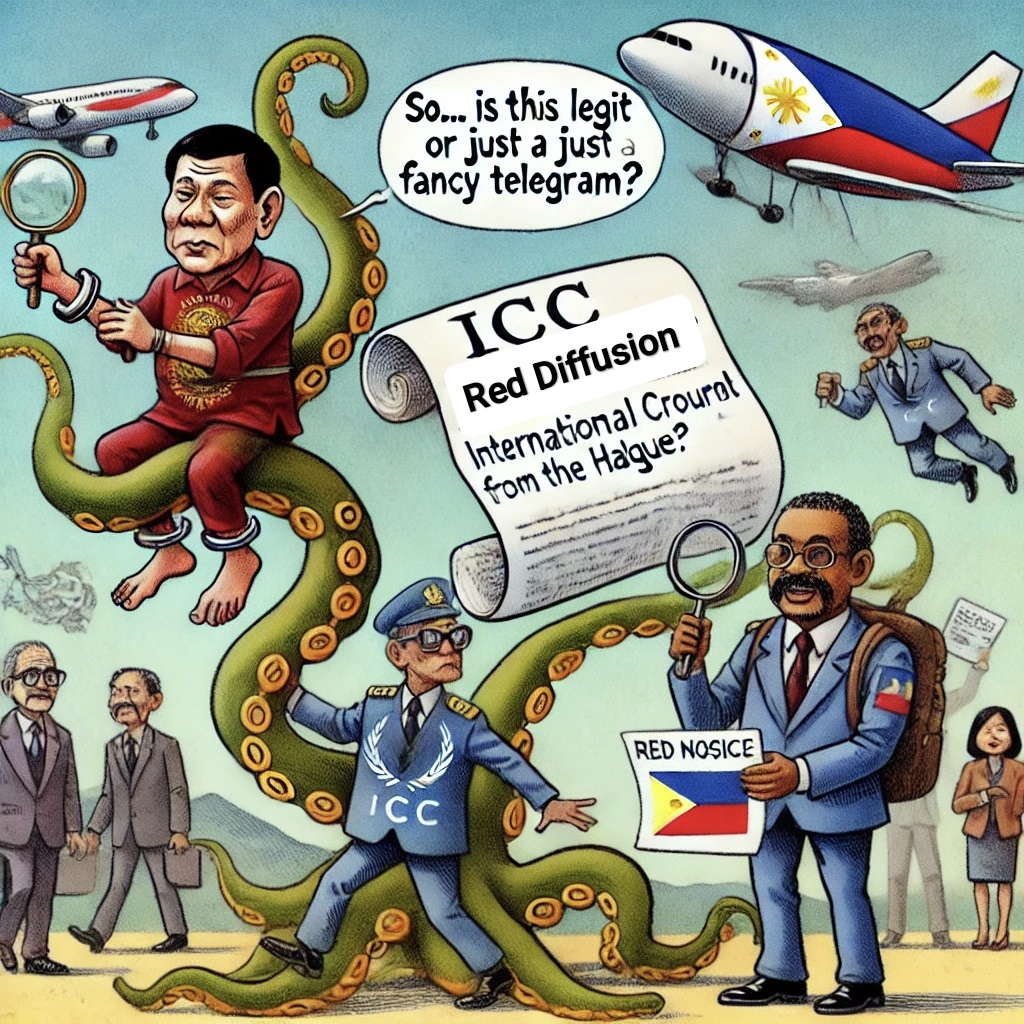
The arrest hinged on an ICC-issued warrant, transmitted via an Interpol “red diffusion,” a term that sparked confusion during a March 20, 2025, Senate hearing chaired by Senator Imee Marcos. Interpol’s framework offers two key tools for international arrest alerts: red notices and diffusions.
A red notice, issued by Interpol’s General Secretariat at the request of a National Central Bureau (NCB) or an international tribunal like the ICC, is a formal, global call to locate and provisionally arrest a suspect pending extradition. In contrast, a red diffusion is a less centralized mechanism, initiated directly by an NCB—here, Interpol’s Manila office—to specific or all member states, seeking similar enforcement actions (e.g., arrest or detention). Both are vetted for compliance with Interpol’s Constitution, notably Article 3’s ban on political interference, but diffusions skip the Secretariat’s formal publication process, as Fair Trials notes, making them “less formal” yet equally potent in effect.
In Duterte’s case, the Philippine Center on Transnational Crime (PCTC) confirmed the use of a red diffusion, not a red notice, to execute the ICC’s March 7, 2025, warrant. Practically, this distinction is a red herring—both tools triggered Duterte’s arrest upon his return from Hong Kong, as Joel Butuyan, a human rights lawyer, emphasized in a March 21 briefing. Interpol’s role, he clarified, is coordination, not enforcement; the warrant’s validity, not its delivery method, is what matters. Yet the choice of a diffusion over a notice—possibly a strategic move by Philippine authorities to retain control—added a layer of opacity, amplifying public and political scrutiny. Compare this to Sudan’s Omar al-Bashir, whose 2009 ICC warrant relied on a red notice broadcast globally, underscoring how delivery mechanisms can shape perceptions of legitimacy.
Legality of the Arrest: A Tale of Two Narratives
Was Duterte’s arrest lawful? The Philippine government says yes; Duterte’s camp cries foul. The ICC’s warrant, a 15-page document served digitally and later physically, aligns with international norms—Butuyan and official statements from Malacañang affirm its validity under the Rome Statute, which governs ICC procedures. The Philippines, a member state until its 2019 withdrawal, remains subject to ICC jurisdiction for crimes committed pre-exit, including the drug war’s alleged extrajudicial killings from 2011 to 2019. Human Rights Watch and the ICC’s own press release corroborate this, noting Duterte’s initial appearance on March 14, 2025, as evidence of due process. Philippine officials, during a five-hour Senate grilling, insisted the arrest was “above-board,” with “courtesies” extended to the former president.
Duterte’s allies, however, paint a different picture, labeling it a “kidnapping” via media blitzes and social media campaigns. They argue the arrest lacked a domestic legal basis, given the Philippines’ ICC exit, and question the diffusion’s authority absent a red notice’s formal imprimatur. This echoes defenses in other cases—like Slobodan Milošević’s 2001 arrest, where Serbian nationalists decried external overreach—but lacks legal heft here. The ICC’s residual jurisdiction is clear under Article 127 of the Rome Statute, and Interpol’s facilitation via diffusion, while unconventional, falls within its mandate. The Duterte camp’s claims, unsubstantiated by official records, seem more a political rallying cry than a viable defense, especially with protests planned for his 80th birthday on March 28, 2025.
Political Context: A Nation Divided, a World Watching
The arrest’s political backdrop is as volatile as its legal underpinnings. The Philippines’ 2019 ICC withdrawal, effective March 17, was Duterte’s own gambit to dodge accountability for the drug war, which left thousands dead. Yet, as with Bosnia’s Ratko Mladić, whose post-Dayton Accord arrest came years later, time doesn’t erase jurisdiction over past atrocities. The current administration’s cooperation—arresting Duterte and flying him to The Hague—marks a stunning reversal, likely driven by domestic pressure from human rights groups and international calls from outlets like Al Jazeera and The Washington Post. Senator Marcos’s skepticism, flashing the diffusion as ‘lesser,’ signals a rift from her brother—President Ferdinand Marcos Jr., who analysts believe tacitly authorized Duterte’s arrest—and echoes a broader nationalist pushback against foreign courts.
Domestically, the arrest has polarized the electorate. Duterte’s base, rallied by cries of sovereignty, plans nationwide protests, per NPR, while critics see it as justice long overdue. Internationally, it’s a litmus test for the ICC’s clout post-withdrawals—Russia and Burundi have pulled out too, yet face ongoing scrutiny. The Duterte case could embolden the ICC to pursue other ex-leaders, like Venezuela’s Nicolás Maduro, under investigation since 2018, or deter states from cooperating if political costs escalate. The Philippines’ Senate debates, mirrored by ABS-CBN News coverage, underscore how legal technicalities become political footballs, complicating global justice efforts.
From Confusion to Clarity: Strengthening Global Legal Frameworks
The Duterte saga exposes a transparency gap in ICC-Interpol operations that fuels mistrust.
- Standardize Public Explanations: Interpol should clarify the differences between red notices and diffusions in plain language—think FAQs or real-time case trackers—to demystify the process for laypeople and lawmakers.
- Clarify Jurisdictional Reach: The ICC must proactively explain its jurisdiction post-withdrawal, perhaps through annual reports or live-streamed briefings, to counter narratives of overreach.
- Adopt Joint Protocols: Both bodies could develop a joint protocol for high-profile cases, detailing warrant-to-arrest timelines (e.g., March 7 to March 11 here), akin to the U.S. DOJ’s press releases on extraditions.
- Engage Local Media: Early engagement with local outlets like Rappler, supported by fact sheets, could preempt misinformation—a lesson from the Milošević case, where Serbian confusion delayed acceptance.
Forward-Looking Perspective
Duterte’s arrest is more than just a legal proceeding—it’s a defining moment for global justice. It proves the ICC’s reach can extend beyond political borders, but at a price: national sovereignty debates, legal ambiguities, and public unrest. Whether this case cements the ICC’s credibility or exposes its fragility will depend on what happens next. One thing is clear—history is watching, and the world’s response to Duterte’s fate will shape the future of international law for years to come.
Sources: Rappler.com article, Human Rights Watch, Al Jazeera, The Washington Post, Interpol, Fair Trials, ICC press releases, GMA News, Tribune.net.ph, CNN, Philippine News Agency, NPR, ABS-CBN News.

- ₱75 Million Heist: Cops Gone Full Bandit

- ₱6.7-Trillion Temptation: The Great Pork Zombie Revival and the “Collegial” Vote-Buying Circus

- ₱1.9 Billion for 382 Units and a Rooftop Pool: Poverty Solved, Next Problem Please

- ₱1.35 Trillion for Education: Bigger Budget, Same Old Thieves’ Banquet

- ₱1 Billion Congressional Seat? Sorry, Sold Out Na Raw — Si Bello Raw Ang Hindi Bumili

- “We Will Take Care of It”: Bersamin’s P52-Billion Love Letter to Corruption

- “Skewed Narrative”? More Like Skewered Taxpayers!

- “Scared to Sign Vouchers” Is Now Official GDP Policy – Welcome to the Philippines’ Permanent Paralysis Economy

- “Robbed by Restitution?” Curlee Discaya’s Tears Over Returning What He Never Earned

- “My Brother the President Is a Junkie”: A Marcos Family Reunion Special

- “Mapipilitan Akong Gawing Zero”: The Day Senator Rodante Marcoleta Confessed to Perjury on National Television and Thought We’d Clap for the Creativity

- “Just Following Orders” Is Dead: How the Hague Just Turned Tokhang’s Finest Into International Fugitives

 KWEBA ni BAROK
Leave a comment