By Louis ‘Barok‘ C. Biraogo — March 24, 2025
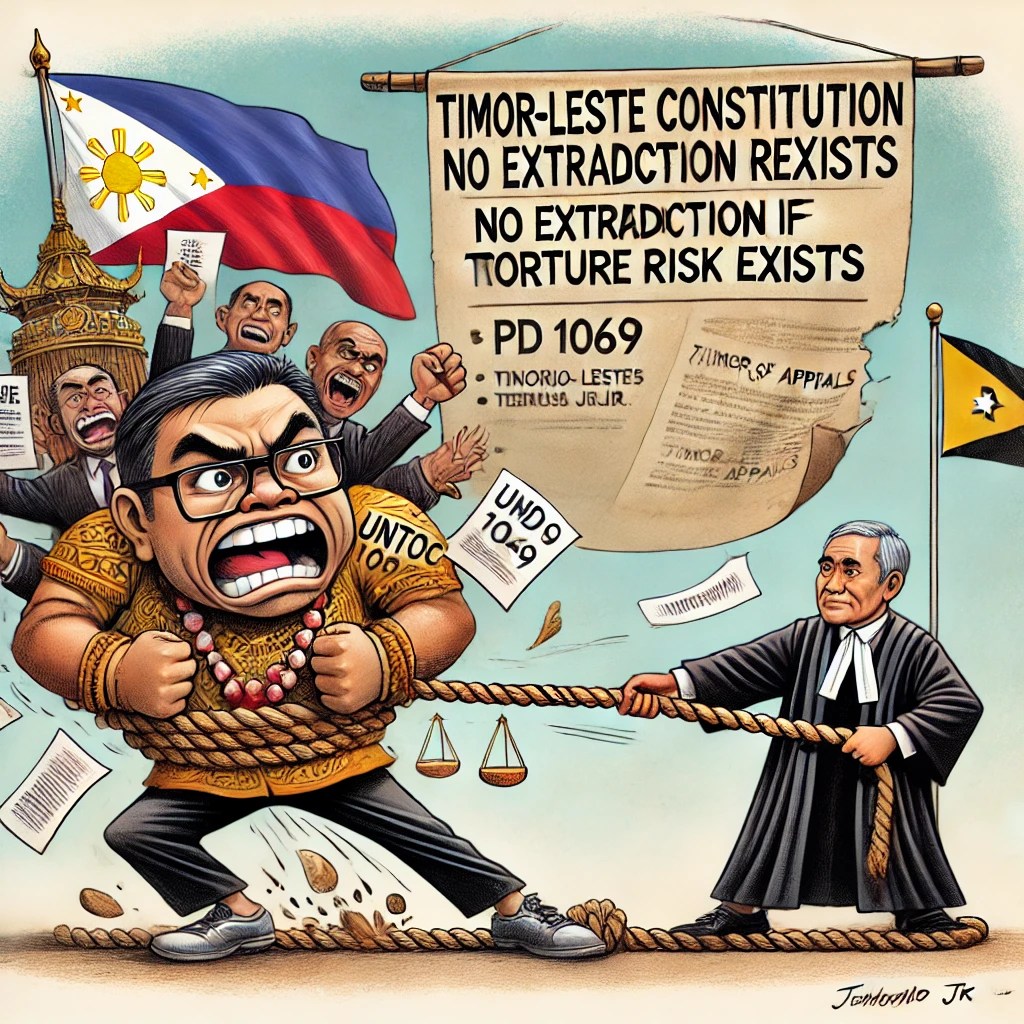
A high-profile murder, an international tug-of-war, and a legal system caught in the crossfire—Arnolfo Teves Jr.’s extradition saga has taken a dramatic turn. Timor-Leste’s Court of Appeals has slammed the brakes on Manila’s efforts to bring the fugitive congressman home, triggering a diplomatic standoff. With Justice Secretary Jesus Crispin Remulla lashing out at Dili’s decision, what comes next? Buckle up as we unravel the legal maze, the political stakes, and the Philippine government’s next move.
Legal Showdown: Two Nations, One Fugitive
Global Rules of the Game
The Philippines and Timor-Leste share no bilateral extradition treaty, so the DOJ leans on the United Nations Convention Against Transnational Organized Crime (UNTOC) (Article 16), a multilateral pact both nations signed to tackle cross-border crime. UNTOC urges cooperation but doesn’t mandate it—Article 16(4) lets states refuse if they see fit, a loophole Timor-Leste exploited. The Vienna Convention on the Law of Treaties (VCLT) (Article 27) bars dodging treaty duties with domestic law excuses, yet Timor-Leste’s sovereign discretion holds firm absent a binding agreement. This isn’t a legal slam dunk for Manila; it’s a handshake deal gone sour.
Timor-Leste’s Constitution (Section 35) throws a wrench: no extradition if torture or inhumane treatment looms. That’s straight out of the International Covenant on Civil and Political Rights (ICCPR) (Article 7) and the UN Convention Against Torture (CAT) (Article 3)—both binding on Dili. The court’s nod to witness recantations and Teves’ secretary’s gun-to-the-face horror story suggests Manila’s case might deliver Teves to a kangaroo court, not justice. International law isn’t bending for the DOJ here.
Timor-Leste’s Line in the Sand
Dili’s judiciary isn’t just flexing for fun. Section 35 reflects a post-independence human rights obsession—think East Timor’s brutal past under Indonesia. The Court of Appeals’ pivot after two pro-extradition calls (June and December 2024) isn’t “peculiar” (DOJ’s word); it’s a recalibration based on fresh evidence or pressure to toe the constitutional line. Without the full ruling text, we’re guessing, but the coercion claims align with CAT’s non-refoulement ethos. Timor-Leste’s system may be green, but it’s not clueless.
Philippine Legal Playbook
Manila’s extradition bid rests on Presidential Decree No. 1069 (1977) (PD 1069), the go-to for treaty-less requests (Section 20). It demands a prima facie case—here, murder, frustrated murder, and attempted murder under Revised Penal Code Articles 248, 6, and 51 for the March 4, 2023, Degamo hit and 2019 killings. The Manila RTC Branch 51 warrants check the box (Section 6), but PD 1069 Section 4 insists evidence meets the requested state’s standards. Recanted affidavits and coercion allegations? That’s a due process dumpster fire under the 1987 Constitution, Article III, Section 1, and Rules of Court, Rule 112 (preliminary investigation). The Philippines brought a knife to a gunfight.
Flashpoints: Where the Sparks Fly
Witness Coercion and Human Rights Speed Bumps
Timor-Leste’s ruling hinges on ugly claims: witnesses forced to sign pre-cooked affidavits by police and military, Teves’ secretary grilled sans warrant with a gun to her head. If true, that’s a blatant violation of 1987 Constitution, Article III, Section 2 (no warrantless arrests) and Section 12(1) (no coercion). The Supreme Court in People v. Dy (G.R. No. 115236, 2002) trashed convictions built on forced statements—credibility matters, and Manila’s evidence looks like it was squeezed out under duress. RA 7438 mandates rights for detainees; ignoring it torpedoes the case’s integrity. Timor-Leste isn’t wrong to smell torture risk—CAT Article 3 backs their skepticism.
Remulla’s Firestorm: Bold or Brash?
Justice Secretary Remulla’s criticism of Timor-Leste’s “immature justice system” and allegations of corruption have ignited controversy. While his remarks may violate Republic Act No. 6713 (Section 4), which emphasizes professionalism, they reflect the intense pressure he faces from the widow of the murdered governor and the public. The DOJ’s statement expressing “surprise and deep disappointment” at the court’s decision underscores the high stakes. While the UN Basic Principles on the Independence of the Judiciary (1985) call for respect, Remulla’s aggressive tone may be a strategic move to rally domestic support or pressure Timor-Leste. However, it risks straining ASEAN relations and undermining Manila’s diplomatic efforts.
Political Powder Keg
Negros Oriental’s a pressure cooker—Teves allegedly masterminded Governor Roel Degamo’s assassination amid a clan feud turned bloodbath. His brother Henry’s gubernatorial run and Janice Degamo’s congressional bid against a Teves aunt scream electoral stakes. The DOJ’s dogged pursuit fits Marcos Jr.’s tough-on-crime flex, but Timor-Leste’s flip smells like sovereign pushback, not a bribe-fest. Pangilinan v. Cayetano (G.R. No. 238875, 2021) gives Manila foreign policy leeway, but overriding Dili’s call risks a diplomatic black eye. Janice Degamo’s “influenced court” gripe—echoing Remulla—hints at a coordinated PR blitz, potentially skirting RA 3019 (Anti-Graft) if it’s more than venting.
Courtroom Playbook: Precedents That Pack a Punch
- Secretary of Justice v. Lantion (G.R. No. 139465, 2000): Extradition isn’t a rubber stamp—due process applies. Teves could contest evidence at evaluation, and coercion claims mirror Lantion’s fairness mandate. Timor-Leste’s on solid ground here.
- Government of Hong Kong v. Olalia (G.R. No. 153675, 2007): Extradition demands a fair-trial guarantee. If Manila’s process reeks of strong-arming, Olalia says it’s a no-go—Timor-Leste’s human rights lens fits this script.
- Pangilinan v. Cayetano (2021): Executive discretion in treaties bows to constitutional limits. The DOJ can push, but Timor-Leste’s sovereignty isn’t Manila’s punching bag.
Battle Plan: Manila’s Path Out of the Mire
Evidence Overhaul: Clean the Slate
Ditch the tainted affidavits. Rebuild the case with clean, voluntary testimony—Rules of Court, Rule 133 demands it, and Timor-Leste won’t bite otherwise. Probe the coercion claims; if cops or soldiers went rogue, heads should roll under RA 7438. A transparent redo beats crying corruption.
Rhetoric Reset: Play It Cool
While Remulla’s passion is understandable, a more measured approach is needed. Focus on legal arguments in the reconsideration process under PD 1069 Section 20. Emphasize cooperation under UNTOC Article 16(3) rather than confrontation. Timor-Leste’s aspirations for ASEAN membership could be leveraged as a diplomatic incentive.
Rights Reboot: Prove the Promise
Prove Manila’s trial won’t be a torture fest. Document compliance with ICCPR Article 7 and CAT Article 3—court oversight, detainee rights, the works. Timor-Leste’s Section 35 obsession isn’t negotiable; meet it head-on.
Politics Purge: Keep It Clean
Keep Janice Degamo’s lobbying at arm’s length—optics matter. The DOJ should firewall this from Negros Oriental’s election circus to dodge RA 3019 whiffs. Focus on justice, not votes.
The Big Picture: A Cautionary Tale
This case is more than just the pursuit of Arnolfo Teves Jr.—it is a test of the Philippine justice system’s integrity and its standing on the global stage. The DOJ’s frustration over the reversal of two earlier favorable rulings is understandable, but Timor-Leste’s decision reflects a principled commitment to human rights that Manila cannot ignore. Shaky evidence and allegations of coercion echo past controversies, such as the Duterte administration’s heavy-handed tactics, while Remulla’s combative rhetoric risks painting the Philippines as a bully rather than a partner.
Teves—a fugitive, alleged assassin, and designated terrorist under RA 11479—is no hero, but Timor-Leste’s decision grants him a temporary reprieve under the banner of the rule of law. The DOJ’s next steps must balance determination with diplomacy, ensuring that justice is served without compromising the principles that underpin it. The world is watching.

- “Forthwith” to Farce: How the Senate is Killing Impeachment—And Why Enrile’s Right (Even If You Can’t Trust Him)

- “HINDI AKO NAG-RESIGN!”

- “I’m calling you from my new Globe SIM. Send load!”

- “Mahiya Naman Kayo!” Marcos’ Anti-Corruption Vow Faces a Flood of Doubt

- “Meow, I’m calling you from my new Globe SIM!”

- “No Special Jail for Crooks!” Boying Remulla Slams VIP Perks for Flood Scammers

- “Philippine-Controlled” or Yankee Gas Station? The Davao Fuel Depot Farce Exposed

- “PLUNDER IS OVERRATED”? TRY AGAIN — IT’S A CALCULATED KILL SHOT

- “Several Lifetimes,” Said Fajardo — Translation: “I’m Not Spending Even One More Day on This Circus”

- “Shimenet”: The Term That Broke the Internet and the Budget

- “We Did Not Yield”: Marcos’s Stand and the Soul of Filipino Sovereignty

- “We Gather Light to Scatter”: A Tribute to Edgardo Bautista Espiritu





 KWEBA ni BAROK
Leave a comment