By Louis ‘Barok‘ C. Biraogo — March 26, 2025
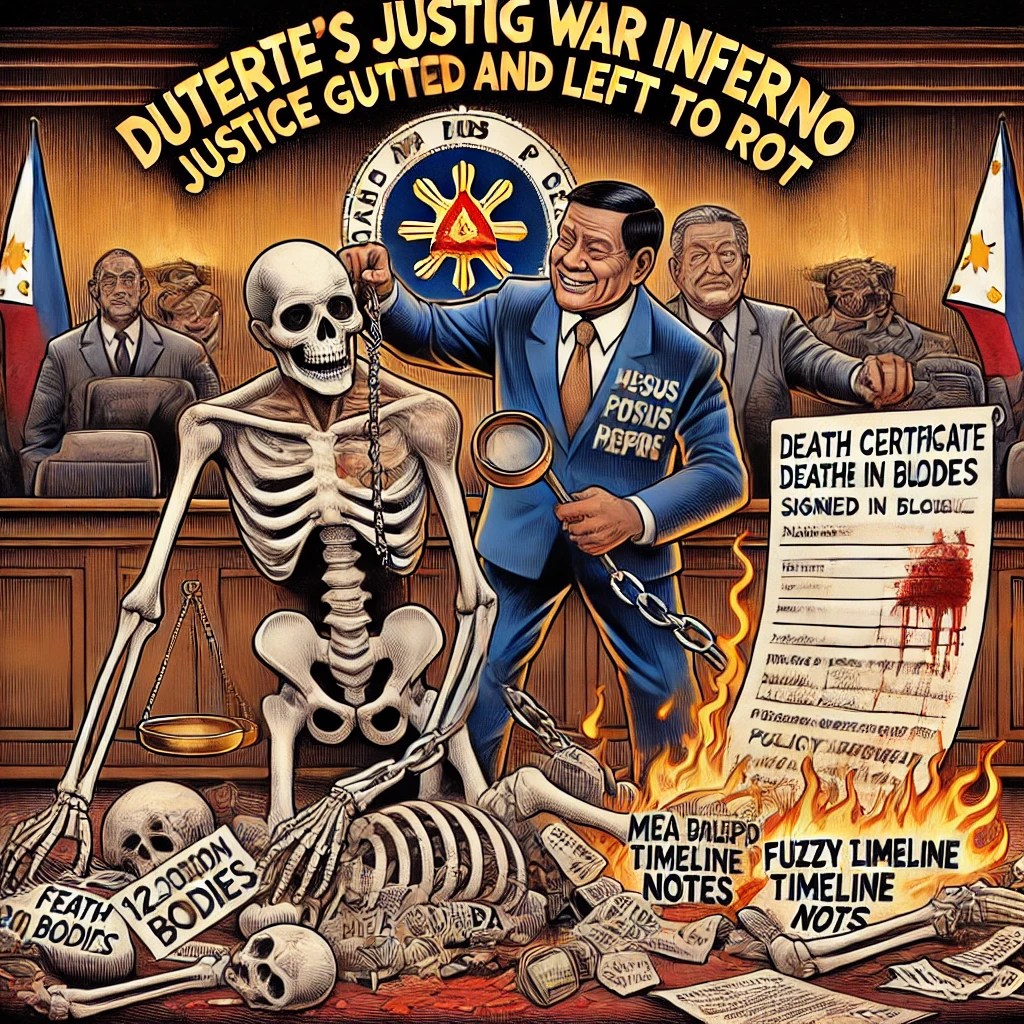
WHEN Justice Secretary Jesus Crispin “Boying” Remulla took the Senate floor on March 20, 2025, and declared the Philippine justice system a corpse during Rodrigo Duterte’s drug war, it wasn’t news—it was a death certificate signed in blood. With Duterte hauled off to The Hague on an ICC warrant two weeks prior, Remulla’s mea culpa, backed by falsified death records and a ghost town of police reports, screams systemic collapse. This isn’t a glitch in the matrix; it’s a blueprint for how strongmen torch accountability and smirk while the ashes settle. Let’s rip this open—Manila’s legal carcass, Marcos Jr.’s tightrope, and the forensic trail of a nation dodging its demons.
Justice DOA: How the System Became a Duterte Casualty
Remulla’s gut punch—“The families of the victims who died had nowhere to go, so they went to the ICC”—lands hard because it’s true. Human Rights Watch and Amnesty International clocked at least 12,000 bodies, maybe 30,000 with vigilante hits, piling up under Duterte’s reign. The ICC’s probe, kicked off in 2021 and revived in 2023, spans 2011 to 2019—drug war carnage plus Duterte’s Davao death squad prequel. Families started banging on the ICC’s door in 2017, led by lawyer Jude Sabio, after local courts turned into a shrug emoji. Remulla’s bit about pre-2016 filings is fuzzy—formal complaints hit later—but Davao’s kill streak hints at a long-brewing rot.
Why bolt to The Hague? Because the Philippine justice system wasn’t asleep—it was an accomplice. Remulla’s claim that “pati ho ang piskal tinatakot po nung pulis” (cops scared off prosecutors) lacks a smoking gun but tracks with the vibe. A 2017 Human Rights Watch exposé caught police planting guns and scripting fairy tales. If prosecutors were gagged by fear, no wonder cases flatlined. Contrast this with Colombia’s post-narco cleanup—domestic courts, juiced by global pressure, nailed paramilitary brass. In the Philippines, that spine never grew, leaving the ICC as the last resort. Per the Rome Statute, it swoops in when states are “unwilling or unable” to prosecute atrocities. Manila checked both boxes with a flourish.
Marcos Jr.’s Masquerade: Reform or Smoke and Mirrors?
Now, the Marcos Jr. era, where Remulla’s singing a new tune: “Mas maayos ngayon… ang piskal at ang pulis ay magkasama na mag-imbestiga.” Prosecutors and cops, besties at last—cute, but prove it. Marcos Jr. touts a “fully functional” justice system, flashing digital courts and AI toys. Yet when Senator Imee Marcos asked why drug war cases aren’t clogging local dockets, Remulla punted: families already ran to the ICC, not our circus. Zero prosecutions of Duterte-era killings under this shiny new regime say it all—reforms might gleam, but they’re dodging the drug war’s radioactive fallout.
Politically, it’s a circus on a razor’s edge. The Philippines flipped the ICC the bird in 2019, a Duterte swagger move. Marcos Jr. keeps the line—“we didn’t help” The Hague snag him—but Interpol’s leash yanked them into compliance anyway. Duterte’s March 11 arrest wasn’t a favor; it was a handcuff they couldn’t dodge. This sovereignty strut trips over itself: a nation too impotent to jail its own ex-boss isn’t exactly flexing. It’s a darkly comic bind—reject the ICC’s meddling, then lean on global muscle to mop up your mess. Remulla’s reform hype feels like a stage prop when the killing fields stay unplowed.
Blood on the Blanks: Forensic Proof of a Cover-Up Conspiracy
Enter Dr. Raquel Fortun, the grim reaper of Duterte’s lies. Remulla dropped her findings like a grenade: “The death certificate indicated cardiac arrest… but in the autopsy, there were bullet holes in the head.” Her 2022 bone-digging, splashed across The New York Times, exposed a sick farce—natural causes scribbled over gunshot wounds. Then the gut shot: “Maybe 95% had no police reports.” That’s not oversight; it’s a state-sanctioned blackout.
This is authoritarian erasure 101. Pinochet’s Chile scrubbed “disappeared” victims from existence; apartheid South Africa’s coroners turned murders into accidents. In the Philippines, fake certificates and vanished reports didn’t just protect triggermen—they mocked the grieving. Fortun’s evidence shows the drug war wasn’t a mess; it was a machine. The Senate’s murmur about probing these discrepancies, nudged by Interior Secretary Jonvic Remulla, looks earnest—until you clock Imee Marcos, Duterte’s cheerleader, running the show. It’s less a reckoning, more a scripted sideshow.
Cracking the Code: Paths Out of the Justice Graveyard
Where’s the exit? The Philippines can keep burying its head or face the music. Here’s the raw deal:
- Back to the ICC? Fat chance. Marcos Jr. won’t eat the optics of undoing Duterte’s exit—it’s red meat for the nationalist mob. Rejoining wouldn’t rewind the clock anyway; the ICC’s already got Duterte in its crosshairs. Still, it’d scream “we’re serious” louder than the current dodgeball game.
- Fix the Damn Thing: First, shield witnesses—families didn’t flee to the ICC for kicks; they were terrified. Second, grow prosecutors some guts—wall them off from political hacks with a standalone tribunal. Third, rip open the past—a real truth commission, not a Senate soap opera, could weaponize Fortun’s data into justice.
- ICC’s Shadow: It’s a clutch move, not a cure. The Hague can lock Duterte up—crimes against humanity mean life—but it won’t rebuild Manila’s courts. The neo-colonial jab stings—Western courts playing judge isn’t a cozy look—but when your justice system’s a skeleton, the ICC’s less imperialist, more undertaker.
The Senate’s death certificate crusade could dig up truth—or just more hot air. Without spine, it’s theater. Marcos Jr.’s Interpol shuffle proves international law’s a boomerang—duck it, and it still smacks you. Sovereignty’s a hollow brag when you’re cuffed by your own cowardice.
Final Gavel: A Nation Still Hemorrhaging
Remulla’s “we failed” isn’t gutsy—it’s a no-shit moment. The Philippine justice system didn’t stumble; it was Duterte’s enforcer, from cowed prosecutors to AWOL reports. Marcos Jr.’s polish might shine, but the drug war’s dead linger unavenged. Fortun’s bullet-pocked corpses are the proof—truth outlasts lies, even if paperwork doesn’t. The ICC yanked Duterte to The Hague, but it’s no magic wand; it’s a spotlight on Manila’s gutted soul.
Marcos Jr. can’t piss off Duterte’s diehards—Imee’s got their back—but stonewalling the slaughter courts global scorn. The Senate’s certificate probe might unearth bones, but don’t bet on it breaking the script. Real fixes—witness armor, fearless courts, a past unburied—aren’t brain surgery, just balls Manila lacks. The ICC’s warrant might be Duterte’s first reckoning, but the Philippine justice system’s epilogue? Still a blank page, soaked in red and gathering dust.

- ₱75 Million Heist: Cops Gone Full Bandit

- ₱6.7-Trillion Temptation: The Great Pork Zombie Revival and the “Collegial” Vote-Buying Circus

- ₱1.9 Billion for 382 Units and a Rooftop Pool: Poverty Solved, Next Problem Please

- ₱1.35 Trillion for Education: Bigger Budget, Same Old Thieves’ Banquet

- ₱1 Billion Congressional Seat? Sorry, Sold Out Na Raw — Si Bello Raw Ang Hindi Bumili

- “We Will Take Care of It”: Bersamin’s P52-Billion Love Letter to Corruption

- “Skewed Narrative”? More Like Skewered Taxpayers!

- “Scared to Sign Vouchers” Is Now Official GDP Policy – Welcome to the Philippines’ Permanent Paralysis Economy
- “Robbed by Restitution?” Curlee Discaya’s Tears Over Returning What He Never Earned

- “My Brother the President Is a Junkie”: A Marcos Family Reunion Special

- “Mapipilitan Akong Gawing Zero”: The Day Senator Rodante Marcoleta Confessed to Perjury on National Television and Thought We’d Clap for the Creativity

- “Just Following Orders” Is Dead: How the Hague Just Turned Tokhang’s Finest Into International Fugitives


 KWEBA ni BAROK
Leave a comment