By Louis ‘Barok‘ C. Biraogo — March 25, 2025
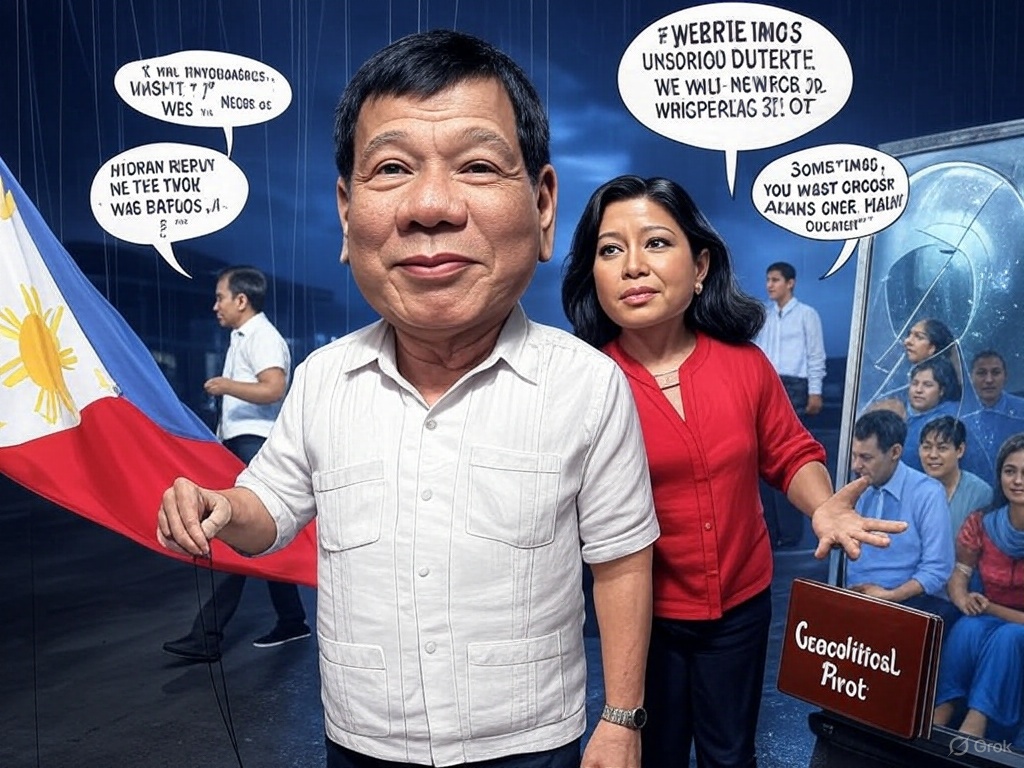
RODRIGO Duterte once held a nation in his grip, ruling with an iron fist. Today, that grip has loosened to cold steel bars in a detention cell at The Hague. Arrested by the International Criminal Court (ICC) for crimes against humanity, Duterte’s downfall has ignited a fierce political battle. His staunch ally, Senator Imee Marcos, calls it treason, accusing her own brother of selling out Philippine sovereignty. Malacañang fires back, deflecting blame with reminders of Duterte’s ties to China. But beneath the outrage and rhetoric lies a deeper reckoning: Can a country confront its own darkness without losing its soul?
Puppets and Pawns: The Political Chessboard
Senator Imee Marcos’ voice trembles with indignation as she defends Duterte, painting him as a “fellow Filipino—a leader, a father, a grandfather”—dragged away by foreign hands. Her words are a masterstroke of political theater, but they’re also a calculated move. As the daughter of Ferdinand Marcos Sr., whose dictatorship left scars still visible today, and the sister of President Ferdinand Marcos Jr., Imee is navigating a tightrope. She’s defending a family ally whose strongman legacy echoes her father’s, while subtly carving out her own space in a political dynasty now split by power. Her appeal to Filipino pride—“We do not give up one of our own”—is a rallying cry for Duterte’s base, a populist gambit ahead of future elections.
Malacañang’s response, delivered by Undersecretary Claire Castro, is equally strategic. “We do not want to become a province of Fujian, China,” she quips, a barbed reminder of Duterte’s flirtation with Beijing, including his 2018 jest about making the Philippines a Chinese province. This is more than a clever retort—it’s a geopolitical pivot. President Marcos Jr. is steering the country toward the West, distancing himself from Duterte’s China-friendly tenure and burnishing his credentials as a defender of Philippine rights in the West Philippine Sea. Citing a poll showing 51 percent of Filipinos favor Duterte’s accountability, the administration cloaks its cooperation with the ICC in democratic legitimacy.
Then there’s the ICC, an institution born of humanity’s resolve after the Holocaust and Rwanda’s genocide, now cast as a colonial villain by Duterte’s defenders. Its pursuit of the former president reflects a broader mission: to hold individuals accountable when national systems fail. Yet in the Philippines, where trust in institutions is thin, its intervention risks being seen as an overreach by a distant elite.
Words as Weapons: The Power of Framing
Language here is a weapon. Imee Marcos’ “province of The Hague” line is a rhetorical flourish, conjuring images of subjugation to stir nationalist fervor. It’s emotional blackmail, sidestepping the ICC’s legal basis to focus on wounded pride. Her brother’s administration counters with its own framing: independence from China, accountability for the drug war’s dead. Both sides wield nationalism, but for different ends—one to shield, the other to justify.
Justice Secretary Jesus Crispin Remulla offers a legalistic defense: the ICC targets “people, not states,” under international humanitarian law, a principle enshrined in the Philippines’ 2009 statute. It’s a dry argument, but it cuts through the noise—until you realize it dodges the political fallout of handing over a former leader. Meanwhile, Rep. Jude Acidre speaks of justice, not statistics, pointing to 43 documented extrajudicial killings as evidence of a “scary pattern of violence.” His words carry moral weight, echoing the cries of widows I’ve met in Manila’s poorest barangays, yet they lean heavily on fear to sway hearts.
Lies We Live By: The Fallacies We Tell Ourselves
The arguments collapse under scrutiny. Imee Marcos’ claim that cooperating with the ICC makes the Philippines a vassal state is a strawman—she exaggerates a limited legal act into a total surrender of sovereignty. Her slippery slope warning—“what stops them from doing it again, to you, to me, to any of us?”—is fearmongering, ignoring the ICC’s narrow focus on crimes like genocide and mass murder. She leans on pathos, not reason, to cloak Duterte in victimhood.
Malacañang’s Fujian jab is an ad hominem attack, skewering Duterte’s past rather than engaging Imee’s core critique. It sets up a false dichotomy: subservience to The Hague or Beijing, as if no middle ground exists. The Remulla brothers’ insistence on ignorance—“no one knew until 3 a.m. on March 11”—strains credulity when a diffusion notice suggests prior consultation. It’s an appeal to ignorance, sidestepping clarity on what the government knew and when.
The Duterte camp’s demand for local court approval rests on a false premise: that withdrawal from the Rome Statute in 2019 erased all obligations. The 2009 law says otherwise, allowing extradition to international courts. On the flip side, Bagong Alyansang Makabayan’s (Bayan) call to rejoin the ICC assumes this would have sidestepped the mess—a post hoc fantasy that ignores the political firestorm any such move would ignite.
Blood on the Streets: Human Rights at the Heart
This isn’t just politics—it’s personal. I’ve spoken to mothers in Quezon City who lost sons to Duterte’s drug war, their bodies dumped in alleys, their grief met with shrugs. The ICC’s warrant cites crimes against humanity, a charge rooted in thousands of deaths—estimates range from 6,000 to 30,000, many extrajudicial. Justice for them isn’t abstract; it’s a reckoning with a policy that turned neighborhoods into war zones.
The Philippines withdrew from the ICC in 2019, but the 2009 Act binds it to international humanitarian law, a legacy of joining over 150 nations in rejecting impunity. Duterte’s arrest doesn’t erase sovereignty—it tests it. Sovereignty isn’t just about borders; it’s about a government’s duty to protect its people, not prey on them. When local courts falter, as they did under Duterte’s sway, the ICC steps in—not as a conqueror, but as a mirror.
Yet the optics sting. A Filipino leader hauled to The Hague recalls colonial wounds, from Spanish friars to American generals. Imee Marcos exploits this, but she glosses over the irony: her father’s regime crushed dissent with impunity, a stain her family still wrestles with. The Marcos administration’s cooperation, however pragmatic, risks alienating a nation wary of foreign judgment.
Breaking the Chains: A Path Forward
This collision of pride and principle demands more than posturing. First, the Philippine government must own the narrative. President Marcos Jr. should address the nation—not through press officers, but directly—explaining why cooperating with the ICC upholds, not undermines, Filipino values. Transparency about the diffusion notice would help, too; denials only fuel distrust.
Second, civil society—church leaders, academics, grassroots groups—must bridge the divide. The Catholic Bishops’ Conference, a moral force in 1986’s People Power, could mediate dialogues between Duterte’s victims and his defenders, fostering truth over tribalism. The 43 cases Acidre cites aren’t numbers—they’re stories. Tell them.
Third, the ICC must tread carefully. It’s not enough to issue warrants; it must engage Filipinos, explaining its mandate in Tagalog, Visayan, and Ilocano, not just legalese. The court’s legitimacy hinges on being seen as a partner, not a puppeteer. Rejoining the ICC, as Bayan urges, isn’t the answer yet—political realities make it a lightning rod. Better to strengthen local courts first, as South Africa did post-apartheid with its Truth and Reconciliation Commission.
Finally, Filipinos deserve a reckoning. Hold Duterte accountable, but don’t stop there. Probe the system—police, judges, politicians—that enabled the drug war’s carnage. Rwanda rebuilt after genocide by facing its past; the Philippines can too.
A Flame in the Dark: A Fragile Hope
Colombia learned that peace requires both justice and sacrifice. The Philippines now faces the same choice. Will it shield the powerful under the guise of nationalism, or demand accountability at last? Duterte’s arrest is not an ending—it is a beginning. For the families who lost loved ones, for a nation seeking redemption, the moment of truth is here. The only question left is: do we have the courage to face it?

- “Forthwith” to Farce: How the Senate is Killing Impeachment—And Why Enrile’s Right (Even If You Can’t Trust Him)
- “HINDI AKO NAG-RESIGN!”

- “I’m calling you from my new Globe SIM. Send load!”

- “Mahiya Naman Kayo!” Marcos’ Anti-Corruption Vow Faces a Flood of Doubt

- “Meow, I’m calling you from my new Globe SIM!”

- “No Special Jail for Crooks!” Boying Remulla Slams VIP Perks for Flood Scammers

- “PLUNDER IS OVERRATED”? TRY AGAIN — IT’S A CALCULATED KILL SHOT

- “Several Lifetimes,” Said Fajardo — Translation: “I’m Not Spending Even One More Day on This Circus”

- “Shimenet”: The Term That Broke the Internet and the Budget

- “We Did Not Yield”: Marcos’s Stand and the Soul of Filipino Sovereignty

- “We Gather Light to Scatter”: A Tribute to Edgardo Bautista Espiritu

- $150M for Kaufman to Spin a Sinking Narrative




 KWEBA ni BAROK
Leave a comment