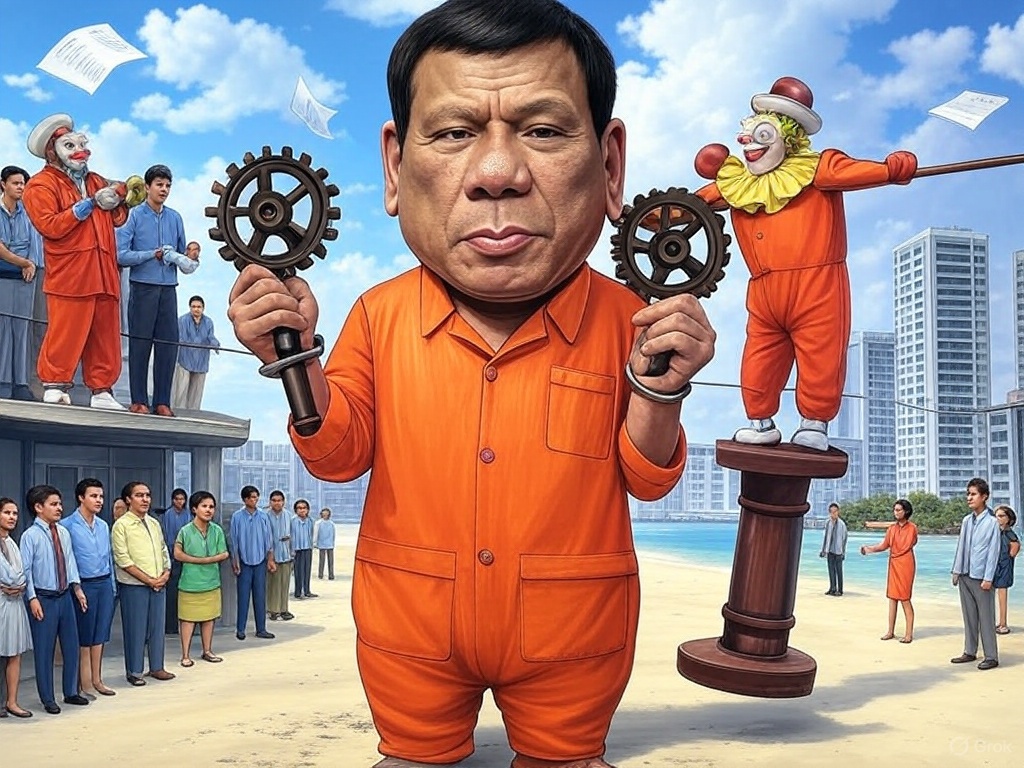
By Louis ‘Barok‘ C. Biraogo — March 30, 2025
RODRIGO Duterte, the man who once taunted the International Criminal Court (ICC) like a schoolyard bully, is now getting a firsthand tour of The Hague—from the inside. His dramatic escape from accountability has come full circle, and irony, as always, has the last laugh. While his family wavers, the Marcos administration dithers, and human rights groups keep score, one thing is certain: his boldest bet has turned into his biggest blunder. Welcome to the political spectacle you didn’t know you needed.
Sovereignty as a Suicide Pact
Here’s the kicker: Duterte’s 2019 ICC withdrawal—his grand “screw you” to international oversight—might just keep him rotting in The Hague. The Philippines bolted from the ICC on March 16, 2019, after Duterte’s drug war landed him in the crosshairs for crimes against humanity. Fast forward to March 2025, and he’s nabbed on an ICC warrant, facing trial for a body count officially pegged at 6,000 but whispered to be as high as 30,000. Now, he’s angling for interim release, but there’s a catch: the ICC needs Philippine cooperation to enforce conditions like monitoring or house arrest. Oops.
Cue Article 127(2) of the Rome Statute:
“A State shall not be discharged, by reason of its withdrawal, from the obligations arising from this Statute while it was a Party.”
Translation? The ICC still has dibs on crimes from 2011 to 2019—Duterte’s bloody heyday—and Manila’s supposed to play ball on ongoing cases. The Philippine Supreme Court doubled down in Pangilinan v. Cayetano (G.R. Nos. 238875, etc., 2021), a unanimous 15-0 slapdown that said, yeah, you’re still on the hook to cooperate, withdrawal or not. But is that ruling binding or just judicial hot air? Legal nerds are split—some call it obiter dictum (fancy Latin for “nice try, but not law”), while heavyweights like ex-Justice Antonio Carpio say it’s gospel. Either way, Duterte’s sovereignty gambit has him staring at a Dutch cell wall, proving that sometimes your own middle finger points right back at you.
Family Values: Hypocrisy Edition
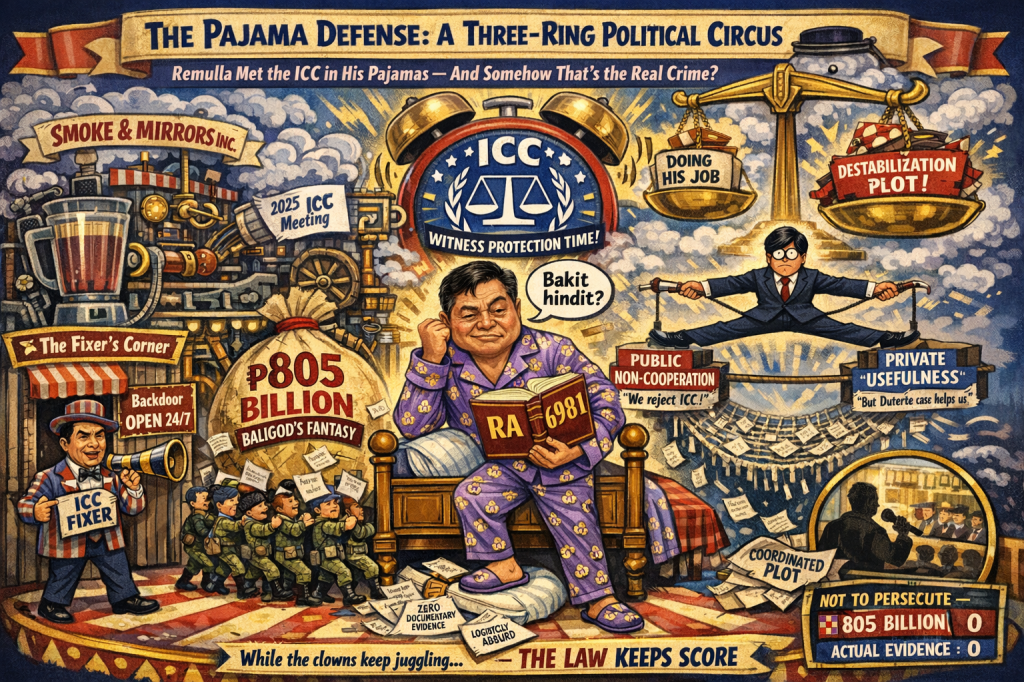
Enter the Duterte clan, stage right, with a legal strategy that’s either genius or a self-inflicted gunshot. They’ve filed habeas corpus petitions to spring their patriarch, implying the government should nudge the ICC for his release. But wait—they’ve also lodged a certiorari and prohibition petition (March 11, 2025, per the Supreme Court) begging the justices to stop Manila from cooperating with The Hague. Pick a lane, folks! This isn’t a legal strategy; it’s a political tantrum dressed up in court filings.
The hypocrisy’s so blatant it’s almost performance art. If the government cooperates, Duterte might walk free—yet the family’s anti-ICC crusade ensures that door stays slammed shut. Palace Press Officer Claire Castro nailed it:
“Does that mean [they’d] withdraw their habeas corpus petitions?”
Good question, Claire. This flip-flop smells less like lawyering and more like posturing for Duterte’s diehard base, who’d rather see him a martyr than a free man under ICC terms. Meanwhile, Malacañang’s “no jurisdiction” mantra—echoed by Marcos Jr. in November 2024: “No cooperation unless PRRD wants it”—is either a sovereignty flex or a quiet nod that they’d rather not poke the drug-war hornet’s nest. Guilt by omission? You decide.
The Hague’s Catch-22
So, how does interim release even work? ICC spokesperson Fadi El Abdallah laid it out: Duterte needs Manila to sign off on “technical measures”—think ankle bracelets or a promise not to flee to Davao. Without that, The Hague’s hands are tied; they can’t just ship him back to a non-compliant state and hope for the best. Article 86 of the Rome Statute demands cooperation, but as a non-member, the Philippines can technically tell the ICC to pound sand—except for that pesky Supreme Court ruling suggesting otherwise.
Claire Castro’s “hypothetical” dodge—“What if the ICC freezes his assets?”—is less a deflection and more a preview of the chaos to come. If The Hague orders arrests or financial lockdowns, and Manila stonewalls, Duterte stays caged, and the ICC’s left flexing a paper tiger. Enforcement’s the rub: without Philippine buy-in, the Court’s stuck relying on moral suasion or third-party pressure—good luck with that in ASEAN’s “don’t meddle” club. The procedural quagmire’s so deep it’s practically quicksand.
Impunity’s Last Laugh
Let’s talk numbers:
- 6,000 dead, says the government.
- 30,000, scream human rights groups.
Either way, the drug war was a bloodbath, and domestic accountability’s a joke—four convictions by 2024, per the Marcos admin’s own admission. That’s not a justice system; it’s a rounding error. The ICC’s case thrives on this gap, with its 2023 investigation greenlight pinning Duterte for systematic killings from 2011 to 2019. The death-toll discrepancy isn’t just stats; it’s the fuel for crimes-against-humanity charges, painting a regime that didn’t just fight drugs but waged war on its own people.
Non-cooperation screams impunity louder than a Duterte rant. By dodging the ICC, Manila’s not just shielding its ex-prez—it’s signaling that extrajudicial killings get a pass if you wave the sovereignty flag hard enough. For a country that’s dodged real reckoning, this is less a legal standoff and more a middle finger to the 30,000 ghosts haunting the stats.
Recommendations: Law, Politics, and the ASEAN Ripple
Legal: Marcos Jr. should bite the bullet and comply with Pangilinan. Defying it risks torching the Supreme Court’s cred and turning the rule of law into a punchline. Cooperation doesn’t mean rejoining the ICC—just honoring a pre-2019 debt. The fallout? A stronger judiciary, but a pissed-off Duterte base. Tough call, BBM.
Political: Duterte’s release could backfire hilariously. If he walks thanks to ICC terms, it’s tacit proof The Hague still calls shots—undercutting his whole “no jurisdiction” schtick. His family might choke on that irony before Marcos does. Better to let him stew and keep the sovereignty myth alive.
International: ASEAN’s watching. If the Philippines pulls this off—exit the ICC, dodge cooperation, and thumb its nose at accountability—expect copycats. Myanmar’s junta and Thailand’s brass are already taking notes. The precedent’s a green light for strongmen: quit the club, kill with impunity, and dare the world to care.
Verdict: Grading the Clowns
- Duterte Family: F
Self-sabotage champs. They’ve turned a winnable release bid into a sovereignty soapbox, leaving Rodrigo in orange jumpsuits. Masterclass in cutting off your nose to spite your face. - Marcos Jr.: C-
Playing both sides—nodding to the Supreme Court while winking at Duterte’s base—isn’t leadership; it’s cowardice. Pick a hill to die on, Bongbong. - ICC: B+
Persistent as hell, but enforcement’s their Achilles’ heel. They’ve got Duterte in custody; now they need teeth to make Manila care. - Philippine Justice System: D
Four convictions in a sea of 6,000–30,000 dead? That’s not justice; it’s a shrug. Step up or shut up.
Final Thought
Duterte’s ICC exit was supposed to be his triumph over meddling foreigners. Instead, it’s a masterstroke of self-ownage, trapping him in a Dutch cell while his family and successors bicker over scraps of pride. The law says cooperate; politics says resist; and the dead just keep piling up in the stats. Welcome to Manila’s mess—where sovereignty’s a suicide pact, and accountability’s a ghost story.
Sources: Rome Statute, Pangilinan v. Cayetano (2021), ICC statements, news reports, and a healthy dose of snark.

- “Forthwith” to Farce: How the Senate is Killing Impeachment—And Why Enrile’s Right (Even If You Can’t Trust Him)
- “HINDI AKO NAG-RESIGN!”

- “I’m calling you from my new Globe SIM. Send load!”

- “Mahiya Naman Kayo!” Marcos’ Anti-Corruption Vow Faces a Flood of Doubt

- “Meow, I’m calling you from my new Globe SIM!”

- “No Special Jail for Crooks!” Boying Remulla Slams VIP Perks for Flood Scammers

- “PLUNDER IS OVERRATED”? TRY AGAIN — IT’S A CALCULATED KILL SHOT

- “Several Lifetimes,” Said Fajardo — Translation: “I’m Not Spending Even One More Day on This Circus”

- “Shimenet”: The Term That Broke the Internet and the Budget

- “We Did Not Yield”: Marcos’s Stand and the Soul of Filipino Sovereignty

- “We Gather Light to Scatter”: A Tribute to Edgardo Bautista Espiritu

- $150M for Kaufman to Spin a Sinking Narrative


 KWEBA ni BAROK
Leave a comment