By Louis ‘Barok‘ C. Biraogo — April 5, 2025
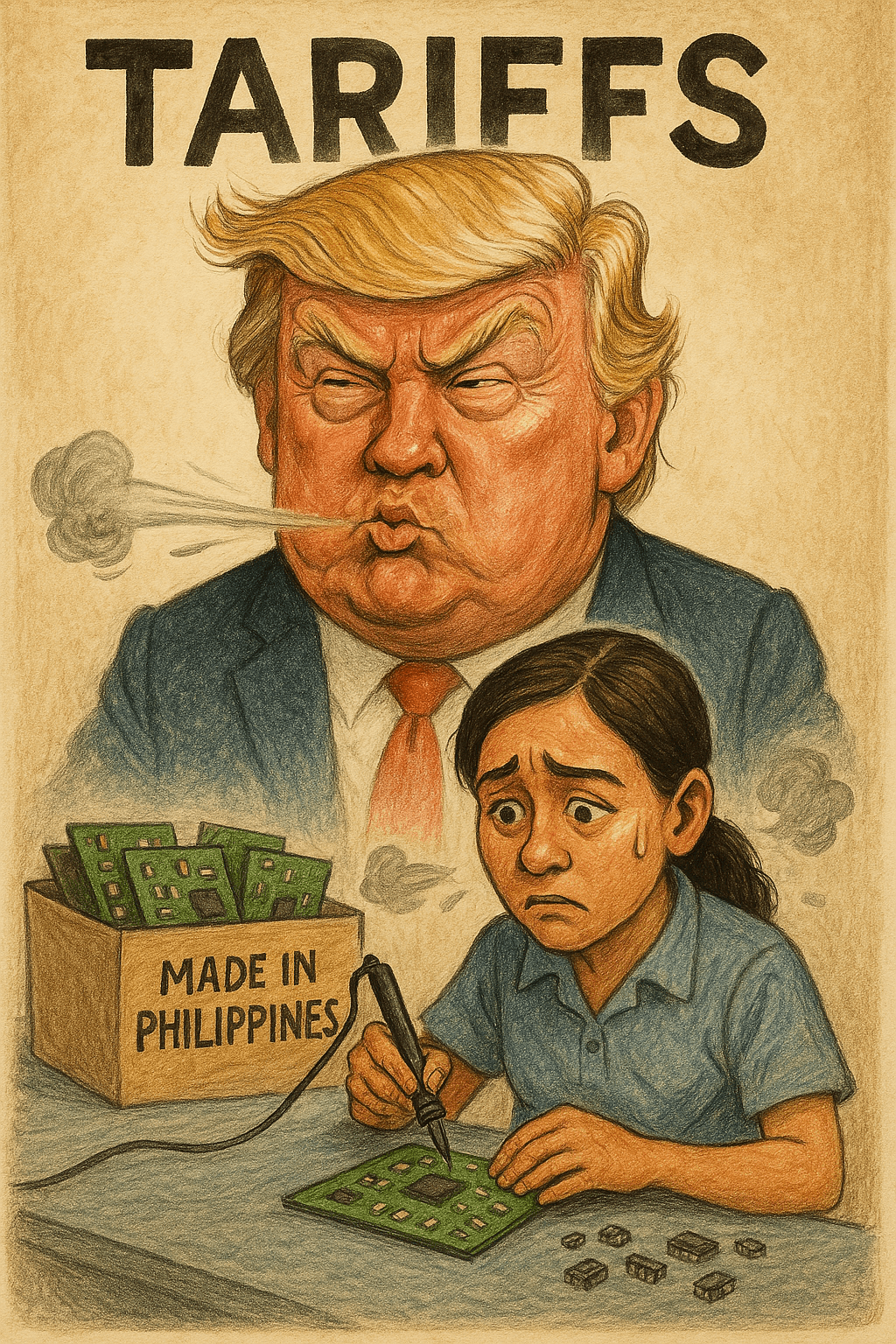
IN A cramped factory in Batangas, a province in the Philippines’ CALABARZON region, Maria Santos, 34, assembles circuit boards for export to the United States. Her P560.00 ($10) daily wage supports her two children, but last week, her supervisor warned of potential layoffs. On April 2, 2025, President Donald Trump announced a 17% tariff on Philippine exports, part of his sweeping “Liberation Day” policy targeting over 180 countries. For Maria and millions like her, this isn’t about trade balances—it’s about survival. As Washington flexes its economic muscle, the Philippines, a steadfast U.S. ally, finds itself caught in the crossfire. What does this mean for a nation of 115 million, and why isn’t Manila shouting louder?
Caught in the Crosshairs: A Tariff’s Devastating Ripple
Trump’s tariff, effective April 9, aims to correct what he calls “large and persistent U.S. goods trade deficits,” leveraging the International Emergency Economic Powers Act of 1977. The Philippines, exporting $12.1 billion to the U.S. in 2024—16.6% of its total exports—now faces a 17% price hike on those goods. Economists at the Bank of the Philippine Islands (BPI) predict a stark reversal: export growth, once projected at 6.1% for 2025, could contract by 4.2%, slashing $1.25 billion in revenue. That’s not just a statistic—it’s a hit to livelihoods in electronics hubs like CALABARZON and coconut farms in Quezon.
Yet Malacañang, the Philippine presidential palace, shrugs. Palace Press Officer Claire Castro calls the impact “very minimal,” arguing exports to the U.S. aren’t substantial enough to wound. The Department of Trade and Industry (DTI) even sees a silver lining: with Vietnam slapped with a 46% tariff and Thailand 36%, the Philippines might lure investors fleeing steeper levies elsewhere. Economists disagree. BPI’s Jun Neri warns of supply chain disruptions, peso volatility, and inflationary pressures that could shrink GDP growth by 0.5%. Who’s right—and who pays if they’re wrong?
Dollars and Desks: The Economic Fallout Unveiled
The immediate sting is clear. Electronics, making up over half of U.S.-bound exports, face a competitive squeeze—think semiconductors and smartphones suddenly costing 17% more in American stores. Agriculture, from coconut oil to seafood, isn’t spared either. BPI estimates industrial production could slow by 1.7%, threatening jobs in regions like CALABARZON, where 2 million workers power export industries. Inequality could widen here; urban factory workers might scrape by, but rural coconut farmers, earning pennies per kilo, have no cushion.
The peso’s wobble adds insult to injury. As investors eye trade uncertainties, a weaker currency could spike import costs—fuel, food, medicine—hitting the poor hardest. The Bangko Sentral ng Pilipinas (BSP) might limit rate cuts to 25 basis points, stifling relief for borrowers, despite inflation risks nearing the 4% ceiling. Yes, domestic consumption, at 75% of GDP, offers some buffer. But does it truly insulate Maria Santos, whose wages barely cover rice and rent, when prices climb?
Long-term, the tariff’s shadow looms larger. A 0.5% GDP drag might sound modest, but in a nation targeting 6-8% growth, it’s a brake on schools, roads, and clinics. Michael Ricafort of Rizal Commercial Banking Corp. notes exports are “three to five times lower” than ASEAN peers, suggesting resilience. Yet slower demand from the U.S., which took $12.1 billion in goods last year, still bites. Could redirected Chinese goods or lower oil prices soften the blow? Perhaps—but that’s cold comfort to workers facing pink slips now.
Allies or Collateral Damage? The Geopolitical Reckoning
Manila’s muted response raises eyebrows. Is it strategic restraint—preserving a 70-year U.S. alliance—or naive optimism? The U.S.-Philippines Mutual Defense Treaty binds them against China’s South China Sea ambitions, yet Trump’s tariff treats Manila more like a rival than a partner. DTI’s Cristina Roque touts potential foreign direct investment (FDI) from firms dodging Vietnam’s 46% hit. But Vietnam’s industrial base dwarfs the Philippines’; will investors really pivot to a nation with higher electricity costs and less infrastructure?
ASEAN’s cohesion hangs in the balance. Singapore’s 10% tariff gives it an edge, while Vietnam’s 46% could push it toward China’s orbit. The Philippines might follow, leaning on the Regional Comprehensive Economic Partnership (RCEP) to offset U.S. losses. Trump’s “Liberation Day” echoes his 2018-2020 trade wars with China, which saw global growth stutter. Back then, the Philippines pivoted to ASEAN and Japan; today, diversification feels more urgent—yet less robust—amid private-sector jitters.
Globally, this is multilateralism’s retreat. Trump’s tariffs—34% on China, 20% on the EU—signal a U.S. turning inward, leaving allies like the Philippines exposed. Is this a blunt weapon that punishes friends more than foes? The $3.9 billion trade surplus Manila enjoys with Washington hardly seems the “hollowing out” Trump decries. So why the hit?
Power Plays and Silent Screams: Unmasking the Controversies
Malacañang’s cheer clashes with private-sector dread. Electronics firms whisper of layoffs; coconut farmers fear unsold harvests. Who benefits from this optimism? Perhaps officials banking on short-term political calm—or exporters with deep pockets to weather the storm. The disconnect reeks of an accountability gap. Why hasn’t Manila released a sector-by-sector impact study? Transparency could rally support; silence breeds mistrust.
The human cost is visceral. Maria Santos works 10-hour shifts, her hands nimble on assembly lines feeding U.S. tech giants. A tariff-driven slowdown could idle her factory, slashing her income. In Mindanao, coconut farmer Juan dela Cruz, 52, tends groves that ship oil to California. A 17% tariff might glut local markets, dropping prices below his break-even. These aren’t abstract figures—they’re the 2 million workers exports sustain, per the Philippine Statistics Authority.
Policy alternatives feel absent. Why not subsidize exporters or fast-track free trade agreements (FTAs) with Europe or Canada? The U.S. alliance—bolstered by shared security stakes—offers leverage for exemptions. Has Manila even tried? In 2018, Trump spared Australia steel tariffs after diplomatic nudges. The Philippines, a frontline ally against China, deserves no less.
Blueprint for Survival: Bold Solutions to Fight Back
Short-Term: Manila must ditch the platitudes and get real. Release detailed impact assessments—how many jobs in Batangas or Quezon are at risk? Emergency credit lines for small and medium enterprises (SMEs), like Maria’s factory, could stave off collapse. The DTI should map supply chain fixes now, not later.
Long-Term: Diversification is the lifeline. Push high-value services—think call centers, IT outsourcing—where tariffs don’t bite. Niche manufacturing, like medical devices, could tap new markets. ASEAN solidarity matters too; a united front against protectionism, via RCEP or joint lobbying, could blunt Trump’s edge.
Diplomatic Leverage: Play the alliance card. The U.S. needs Philippine bases to counter China; Manila should demand trade carve-outs in return. Highlight the absurdity: a 17% tariff on an ally while Beijing gets 34%. Frame it as mutual interest—stable Filipino jobs bolster a reliable partner.
Rise Up or Fall Silent: A Call to Action
This tariff isn’t just economics—it risks destabilizing the lives of 2 million Filipino workers. Trump’s “Liberation Day” may free American industry, but it shackles allies like the Philippines. Manila must act—not with blind optimism, but with fierce clarity. Profile the Marias and Juans, not just the balance sheets. Push Washington for fairness, not silence. And ask: if allies bear the brunt of America’s trade wars, who’s really winning?
Note: This critique draws on data from Keisha Ta-Asan’s “Trump Tariffs to Impact Philippine Exports, Growth,” The Philippine Star, April 5, 2025, Jean Mangaluz’s “Trump Slaps 17% Tariff on Philippine Exports,” Philstar.com, April 3, 2025, and the U.S. Trade Representative’s Philippines profile, grounding global policy in human stakes.

- “Forthwith” to Farce: How the Senate is Killing Impeachment—And Why Enrile’s Right (Even If You Can’t Trust Him)

- “HINDI AKO NAG-RESIGN!”

- “I’m calling you from my new Globe SIM. Send load!”

- “Mahiya Naman Kayo!” Marcos’ Anti-Corruption Vow Faces a Flood of Doubt

- “Meow, I’m calling you from my new Globe SIM!”

- “No Special Jail for Crooks!” Boying Remulla Slams VIP Perks for Flood Scammers

- “PLUNDER IS OVERRATED”? TRY AGAIN — IT’S A CALCULATED KILL SHOT

- “Several Lifetimes,” Said Fajardo — Translation: “I’m Not Spending Even One More Day on This Circus”

- “Shimenet”: The Term That Broke the Internet and the Budget

- “We Did Not Yield”: Marcos’s Stand and the Soul of Filipino Sovereignty

- “We Gather Light to Scatter”: A Tribute to Edgardo Bautista Espiritu

- $150M for Kaufman to Spin a Sinking Narrative

 KWEBA ni BAROK
Leave a comment