By Louis ‘Barok‘ C. Biraogo — April 7, 2025
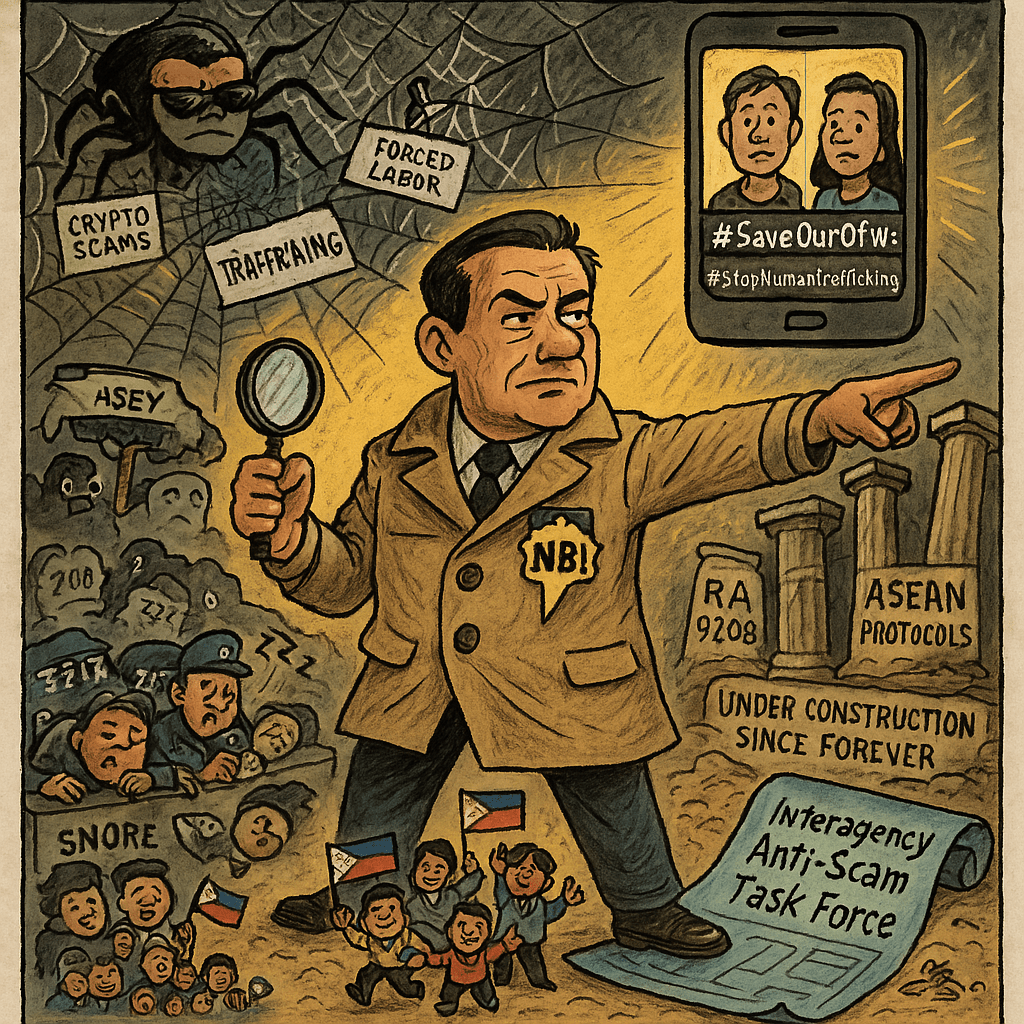
WHEN the National Bureau of Investigation (NBI) dropped its March 11, 2025, press release detailing the rescue of three Filipino nationals from a Cambodian scam operation, it read like the opening chapter of a legal thriller: desperate victims, shadowy recruiters, and a lightning-fast rescue mission spearheaded by NBI Director Jaime Santiago. Five days after receiving a chilling video plea—complete with photos of bruised and battered Filipinos—the NBI had them back on home soil, patched up and counseled. Cue the applause for Santiago’s decisive action. But here’s the twist: this isn’t just a tale of heroism. It’s a neon-lit exposé of systemic failures, murky diplomacy, and unanswered questions that could keep this case simmering for months. Let’s peel back the layers—legal, operational, diplomatic, and controversial—and see what’s really at play.
Legal Firestorm: Trafficking Charges, Jurisdictional Jousting, and Global Treaties
This is a textbook case of trafficking—or a damning indictment of border security? The answer is both. Under Philippine law, Republic Act No. 9208 (Anti-Trafficking in Persons Act of 2003), as beefed up by RA 10364 in 2012, the elements are crystal clear. Section 4 criminalizes the recruitment and transportation of persons for exploitation—think forced labor, servitude, or, in this case, scamming elderly foreigners via cryptocurrency under duress. The victims’ story checks every box: lured by a $1,000/month customer service gig, shipped off to Cambodia, and locked in a compound run by Chinese bosses and a Filipino supervisor. Instead of headsets and cubicles, they got cellphones loaded with Signal, Twitter, and Instagram, tasked with fleecing vulnerable marks. When they balked, they got beaten. That’s exploitation, plain and simple, and RA 9208’s penalties—up to life imprisonment and hefty fines—are itching to be slapped on someone.
But jurisdiction? That’s where it gets spicy. The crime kicked off in the Philippines with an online job ad and a Filipino HR puppet, then sprawled across borders to Cambodia. Section 6 of RA 9208 extends the law’s reach extraterritorially when Filipino citizens are involved, a principle cemented by the Supreme Court in People v. Catantan (G.R. No. L-30577-78, 1973). There, the Court ruled Philippine courts can prosecute crimes against Filipinos abroad, no matter where the gavel falls. Precedents like People v. Casio (2013) and People v. Sanchez (2016) further flex RA 9208’s muscle, nailing traffickers for forced labor and organ harvesting. Here, the NBI’s got a solid shot at pinning charges—human trafficking, illegal recruitment under RA 8042 (as amended), and conspiracy under the Revised Penal Code—on the Filipino recruiters. The Chinese bosses? That’s a diplomatic minefield we’ll detonate later.
Internationally, the United Nations Convention against Transnational Organized Crime (UNTOC) and its Trafficking Protocol are in the driver’s seat. Article 10 demands mutual legal assistance, and the NBI’s coordination with Cambodian authorities fits the script. ASEAN protocols echo this, with the Philippines and Cambodia bound by a 2019 Memorandum of Understanding (MOU) to tackle transnational crime. The legal framework’s there, but execution? That’s where the plot thickens.
Operational Blitz: Santiago’s Speed vs. the Border’s Blind Spot
The NBI moved fast, but the real question is: Why did they have to? Director Santiago deserves a standing ovation for the five-day turnaround—March 11 video to March 16 homecoming is a masterclass in rapid response. Four agents jetted to Cambodia, synced with local counterparts, and extracted the victims from a hellhole compound, all while dodging the geopolitical quicksand of Chinese-run operations. Coordination with the DOJ’s Inter-Agency Council Against Trafficking (IACAT) was seamless, and the victims got medical care and counseling on landing. Santiago’s team didn’t just play the game; they rewrote the playbook.
But let’s rewind. How did three Filipinos hop a plane to Dipolog City, ferry to Basilan, then boat-hop through Tawi-Tawi to Sabah, Malaysia, without a single red flag? This wasn’t a spontaneous jaunt—it was a 10-day odyssey starting January 7, 2025, orchestrated by traffickers who knew the Philippines’ backdoor better than its border guards. The Bureau of Immigration (BI) and Philippine National Police (PNP) were either asleep at the wheel or complicit—and neither option inspires confidence. A 2023 BI report flagged similar routes after repatriating 27 Filipinos from Cambodia, yet here we are, two years later, watching the same movie on repeat. Santiago’s blitz saved the day, but the porous borders that let this happen are a national security embarrassment. Why weren’t these victims intercepted at Ninoy Aquino International Airport or a Mindanao checkpoint? Where’s the proactive sting on those online job ads? The NBI cleaned up the mess, but the mess shouldn’t have been there.
Diplomatic Dance: Allies in Action, Enemies in the Shadows
Santiago’s press release gushes over Cambodia’s “strong and unwavering partnership,” and he’s not wrong. The 2019 MOU greased the wheels, letting NBI agents swoop in and out with the victims in tow. It’s a diplomatic win, a shiny badge for Philippines-Cambodia relations in a region where trust is a rare currency. But behind the diplomatic handshakes, will the Chinese bosses ever see a courtroom? That’s the million-dollar question—and it’s tangled in geopolitics thicker than a Phnom Penh traffic jam.
The Chinese nationals running this scam farm aren’t small fry; they’re part of a web that’s snagged U.S. attention. On September 12, 2024, the U.S. State Department slapped sanctions on Cambodian entities tied to online scam compounds, spotlighting human rights abuses and trafficking. The NBI’s press release fingers “Chinese individuals” for the beatings, but pinning them down means extradition talks, evidence swaps, and navigating Beijing’s long shadow. Cambodia’s cozy with China—think Belt and Road billions—and that could stall any push to haul these bosses before a judge. The Philippines, meanwhile, is juggling its own China tightrope, from West Philippine Sea spats to economic ties. Will Manila risk ruffling feathers for justice, or will geopolitics shield the real puppet masters?
This isn’t just a bilateral tango; it’s a global dance. The UNTOC framework and ASEAN’s anti-trafficking pacts demand cooperation, but when foreign nationals are the muscle, enforcement gets dicey. Santiago’s gratitude to Cambodia is well-placed, but the next act—nailing the Chinese culprits—could test this partnership to its breaking point.
Scandal Unraveled: Filipino Traitors, Systemic Cracks, and Justice on Hold
The NBI’s triumph is real, but the shadows are long. First up: Filipino complicity. Who’s this “Filipino HR” dangling $1,000 carrots online? Who’s the supervisor ordering crypto scams under Chinese oversight? The press release is mum, and as of April 7, 2025, no arrests are on the books. Are they in custody, singing to investigators, or sipping piña coladas in hiding? Their fingerprints are all over this—recruitment, logistics, enforcement—and letting them slip through cracks a case this tight is inexcusable. The NBI’s “thorough investigation” better deliver names, faces, and handcuffs, or this victory’s half-baked.
Then there’s the systemic rot. How many more Filipinos are trapped in Cambodia’s scam mills, or Laos, or Myanmar? A New York Times piece from August 2023 pegged these operations as a regional plague, with Chinese syndicates exploiting lax borders and desperate workers. The three rescued here had the guts to send a video; others might not. The BI’s 2023 repatriation of 27 victims screamed warning signs, yet the Dipolog-to-Tawi-Tawi pipeline still flows. Is this a one-off, or the tip of a trafficking iceberg? The NBI’s reactive heroics won’t cut it if prevention’s stuck in neutral.
And the Chinese bosses? Their beatdowns turned this from fraud to felony, but their fate’s a geopolitical crapshoot. U.S. sanctions signal global heat, but without Cambodia coughing up suspects—or the Philippines pushing hard—they’re ghosts. The Filipino recruiters might face the music, but the masterminds could skate, leaving justice dangling like a loose thread.
Final Gavel: Santiago Shines, System Stumbles—Time to Rewrite the Rules
Director Santiago’s NBI deserves its flowers. Five days from SOS to safe return is a feat of grit and coordination, a beacon in a murky world of transnational crime. The legal scaffolding—RA 9208, UNTOC, ASEAN pacts—holds firm, and Cambodia’s assist proves diplomacy can deliver. But this isn’t a clean win. The border sieve that let three Filipinos vanish into a trafficking abyss is a national disgrace. The Filipino facilitators still at large mock the NBI’s “thorough” probe. And the Chinese bosses? They’re the wildcard that could turn this into a diplomatic dud.
Here’s the call to action: The Philippines needs an interagency task force—NBI, BI, PNP, DFA—with teeth, not just press releases. Monitor online job ads like hawks; shut down these trafficking funnels before they start. Push ASEAN for a region-wide anti-scam crackdown, because Cambodia’s not the only hotspot. And don’t let geopolitics gag justice—lean on that 2019 MOU and demand the Chinese culprits face a docket, not a free pass. Santiago’s team pulled off a rescue for the ages, but the real thriller’s just beginning: Will the system step up, or will this be another chapter in a saga of too-little, too-late? Stay tuned.

- “Forthwith” to Farce: How the Senate is Killing Impeachment—And Why Enrile’s Right (Even If You Can’t Trust Him)

- “HINDI AKO NAG-RESIGN!”

- “I’m calling you from my new Globe SIM. Send load!”

- “Mahiya Naman Kayo!” Marcos’ Anti-Corruption Vow Faces a Flood of Doubt

- “Meow, I’m calling you from my new Globe SIM!”

- “No Special Jail for Crooks!” Boying Remulla Slams VIP Perks for Flood Scammers

- “PLUNDER IS OVERRATED”? TRY AGAIN — IT’S A CALCULATED KILL SHOT

- “Several Lifetimes,” Said Fajardo — Translation: “I’m Not Spending Even One More Day on This Circus”

- “Shimenet”: The Term That Broke the Internet and the Budget

- “We Did Not Yield”: Marcos’s Stand and the Soul of Filipino Sovereignty

- “We Gather Light to Scatter”: A Tribute to Edgardo Bautista Espiritu

- $150M for Kaufman to Spin a Sinking Narrative








 KWEBA ni BAROK
Leave a comment