By Louis ‘Barok‘ C. Biraogo — April 7, 2025
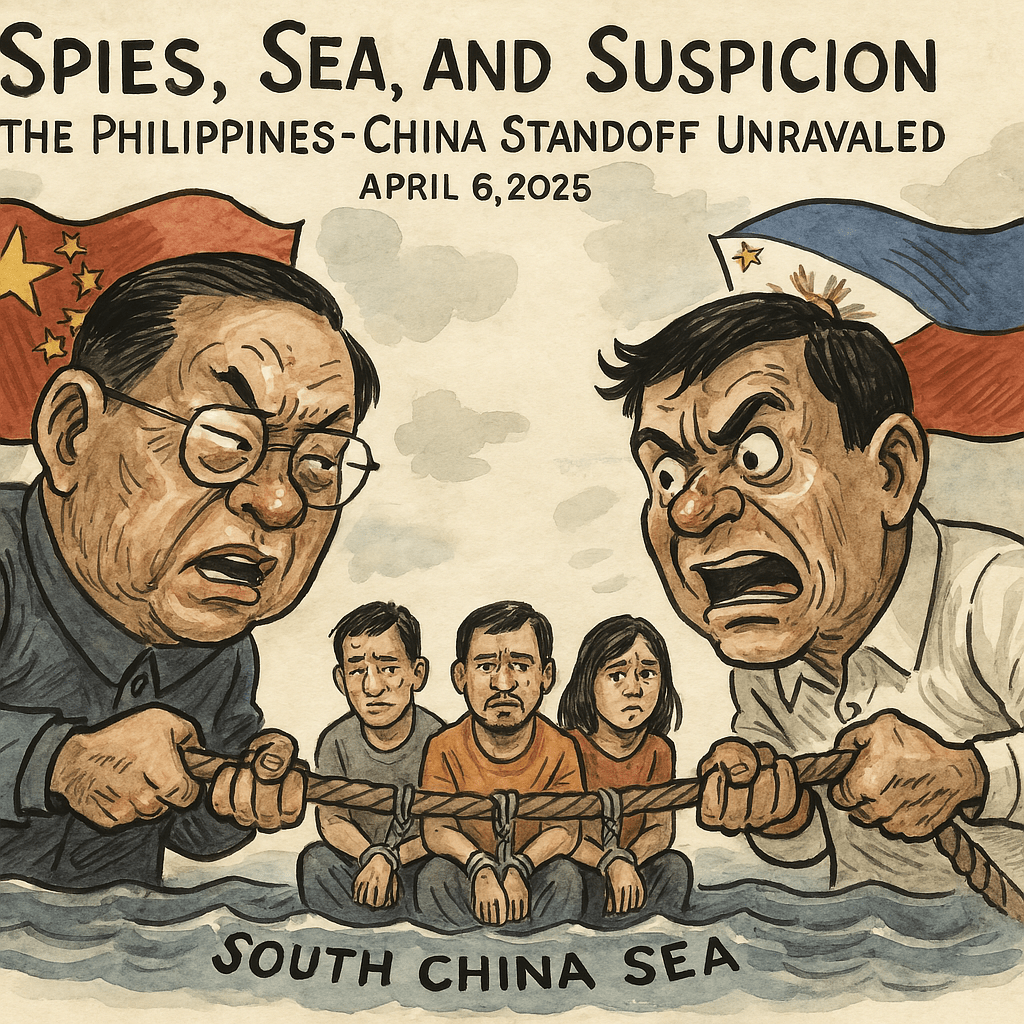
ESPIONAGE. Detention. International intrigue. These aren’t plot points from a political thriller—they’re the real-life nightmare unfolding for three Filipinos held in China. On April 4, 2025, the Philippine government confirmed that David Servañez, Albert Endencia, and Nathalie Plizardo were arrested under suspicion of spying, triggering diplomatic tremors in Manila and beyond.
Across the South China Sea, in the Philippines, Chinese nationals languish in custody, accused of wielding high-tech gadgets to spy on military bases and U.S. installations. The air is thick with mutual accusations, each side claiming the other has crossed a dangerous line. What is unfolding here is not just a legal spat—it’s a suspenseful unraveling of trust, power, and survival in one of the world’s most volatile regions.
I’ve not trekked the jagged frontiers of global strife, from Darfur to Ukraine, yet this tale resonates with the same chilling refrain: everyday souls ensnared by nations flexing their might. Still, beneath the clamor of headlines lurks a pressing riddle: Is this a true security flashpoint, a cunning stage play, or a reckless escalation poised to upend Southeast Asia? To unravel it, we must dig through the strata of history, power plays, and the human price at stake.
Flashpoint Waters: The South China Sea’s Boiling Point
The South China Sea is no stranger to tension—it’s a cauldron of clashing ambitions. For over a decade, China and the Philippines have danced a precarious waltz over its waters—waters that carry $3 trillion in annual trade and harbor untold reserves of oil and gas. China’s sweeping claims, fortified by artificial islands bristling with military hardware, crash against the Philippines’ rights under a 2016 arbitral ruling it won but Beijing scorns. The Scarborough Shoal standoff in 2012 was the match that lit the fuse, souring relations and seeding today’s mistrust.
Enter the United States, Manila’s steadfast ally, whose Enhanced Defense Cooperation Agreement (EDCA) plants American boots on Philippine soil—a red flag to China’s regional dominance. Just this year, Chinese nationals were nabbed in Palawan and Subic Bay, allegedly mapping U.S.-accessible sites with drones and IMSI catchers, snaring cellphone signals from the air. Now, China strikes back, claiming these three Filipinos were prowling near military bases, possibly since 2021. The symmetry is chilling: each side accuses the other of espionage, each clutching the moral high ground in a game where evidence is scarce and motives are shadowed.
This isn’t just about territorial swagger. It’s a high-stakes chess match. China, wielding its economic clout—$9.1 billion in loans to the Philippines since 2000—aims to blunt Manila’s U.S. tilt. The Philippines, buoyed by American muscle, pushes to safeguard its sovereignty without igniting war. Espionage here is both weapon and wound in a rivalry teetering on the brink.
Diplomatic Duel: Words as Weapons
The diplomatic stage is a high-wire act of poise and provocation. The Philippines, via its DFA, strikes a restrained chord, demanding due process and consular access under the Philippines-China Consular Agreement and the Vienna Convention. “Protecting the rights and interests of the said Filipinos remains the prime priority,” the DFA insists, a plea laced with urgency as its Guangzhou consulate scrambles to assist. Yet, frustration simmers—China’s silence on details stokes unease.
Beijing, by contrast, swings a heavier fist. Foreign Ministry spokesperson Guo Jiakun blasts Manila for “fabricating spy cases” against Chinese citizens, branding it “stigmatization and politicization based on presumption of guilt.” State media like Xinhua and Global Times spin a tale of confessed Filipino spies, recruited by a mysterious “Herrera” to plunder military secrets. The story is polished, but the absence of public proof raises red flags. Is this justice or a masterclass in messaging?
The tit-for-tat arrests scream retaliation. Philippine officials, like the National Security Council, see China’s move as a riposte to the February detention of two Chinese nationals near the U.S. embassy. Experts like Kuo Yu-jen from Taiwan’s National Sun Yat-sen University dub it “hostage retaliation,” a page from China’s playbook—recall the Canadians nabbed after Huawei’s Meng Wanzhou was detained in 2018. The timing, amid coastguard skirmishes and Marcos Jr.’s pro-U.S. lean, only thickens the plot.
Caught in the Crossfire: The Human Toll
Behind the grand strategies lie lives entangled in the storm. Servañez, Endencia, and Plizardo aren’t just pawns—they’re living, breathing souls, tethered to families, dreams, and unspoken fears. Two once studied in Hainan, linked to a Palawan sisterhood program, now branded as turncoats who warped education into espionage. Did they knowingly step into treachery, or were they unwitting lures in a grander snare? China boasts of confessions, yet the specter of coerced admissions looms large over authoritarian regimes—think of the Uighurs, dissidents, tales I’ve read of. Without transparent trials, suspicion gnaws and festers.
In the Philippines, the detained Chinese—like Deng Yuanqing, linked to the People’s Liberation Army University—face their own purgatory. Families cry innocence, citing road-survey gigs, not spying. Yet the haul—GNSS systems, drones—whispers darker intent. These souls, too, are ensnared by forces beyond their grasp.
International law screams for due process, fair hearings, consular rights—bedrocks both sides tout but risk trampling. The 1963 Vienna Convention is unequivocal: detainees deserve protection. Yet, in the crucible of superpower rivalry, those rights often melt away. I’ve watched justice morph into a bargaining chip too many times—here, it teeters again.
Spy vs. Spy: Security, Stagecraft, or Showdown?
What’s the real game?
Option one: A bona fide security breach. Espionage is statecraft’s oldest trick—both nations have the motive and means to pry. China’s military sprawl and the Philippines’ U.S. alliance make secrets a glittering prize. The details—loitering near bases, charting infrastructure—fit the espionage mold.
Option two: A grand performance. Blasting these cases across headlines rallies the home crowd—China fires up its nationalists, the Philippines polishes its defiance. The thin public evidence feeds cynicism. Are these arrests more about optics than threats?
Option three: A fuse to chaos. This is the gut punch. A spiral of detentions could explode—more arrests, fiercer sea clashes, even economic blows. The South China Sea is a tinderbox; one spark could blaze, pulling in the U.S., Japan, or ASEAN. Relations are already at a “crossroads,” China warned last year. This could be the flare.
I’d wager it’s a cocktail of all three. Real spying’s afoot—nations don’t fake it entirely—but the loud staging reeks of theater, and the escalation peril looms large. The truth? It’s cloaked in secrecy and swagger.
Breaking the Deadlock: A Call to Action
This isn’t a lost cause, but it demands grit and vision.
For the Philippines: Double down on due process—dispatch lawyers, demand proof, rally allies like the U.S. and ASEAN to echo your voice. Transparency is your armor; don’t let China script the tale solo.
For China: If your case holds water, show it—open the trials, unveil the evidence. Shadowy justice breeds scorn. And halt the tit-for-tat—hostage ploys boomerang, as Canada learned. You’re a titan; act with stature, not spite.
Both must dust off the 2023 hotline between their foreign ministries—talk, don’t taunt. A joint task force on espionage claims, with neutral eyes (Singapore, the UN?), could cool tempers and sift facts. Economic bonds—China’s loans, Philippine trade—are levers for peace, not rupture.
The U.S. should back Manila without baiting Beijing—quiet strength, not saber-rattling. ASEAN must step up, not sit back; the region’s fate hangs here. The world? Stay vigilant. This isn’t a petty squabble—it’s a litmus test for rivalry sans ruin.
The Soul of the Storm: A Moral Cry
I can’t unsee those three Filipinos, their futures dangling on threads they may not comprehend. Nor the Chinese detainees, pawns in a mirrored trap. This is statecraft’s grim underbelly—where humans are chips on a vast board. I’ve chronicled it before: innocents ground down by superpower games in Vietnam, Afghanistan, Syria. Will we let it replay?
From Manila to Beijing, the path forward is clear—talk, or tumble into history’s graveyard of wars born from pride. The South China Sea may shimmer under the sun, but its depths grow darker by the day. The world watches not just for action, but for wisdom. And in the end, power without purpose is merely noise—forgotten, except for its wreckage.

- “Forthwith” to Farce: How the Senate is Killing Impeachment—And Why Enrile’s Right (Even If You Can’t Trust Him)

- “HINDI AKO NAG-RESIGN!”

- “I’m calling you from my new Globe SIM. Send load!”

- “Mahiya Naman Kayo!” Marcos’ Anti-Corruption Vow Faces a Flood of Doubt

- “Meow, I’m calling you from my new Globe SIM!”

- “No Special Jail for Crooks!” Boying Remulla Slams VIP Perks for Flood Scammers

- “PLUNDER IS OVERRATED”? TRY AGAIN — IT’S A CALCULATED KILL SHOT

- “Several Lifetimes,” Said Fajardo — Translation: “I’m Not Spending Even One More Day on This Circus”

- “Shimenet”: The Term That Broke the Internet and the Budget

- “We Did Not Yield”: Marcos’s Stand and the Soul of Filipino Sovereignty

- “We Gather Light to Scatter”: A Tribute to Edgardo Bautista Espiritu

- $150M for Kaufman to Spin a Sinking Narrative







 KWEBA ni BAROK
Leave a comment