By Louis ‘Barok‘ C. Biraogo — April 14, 2025
Introduction: The Senate Showdown That Shook Manila
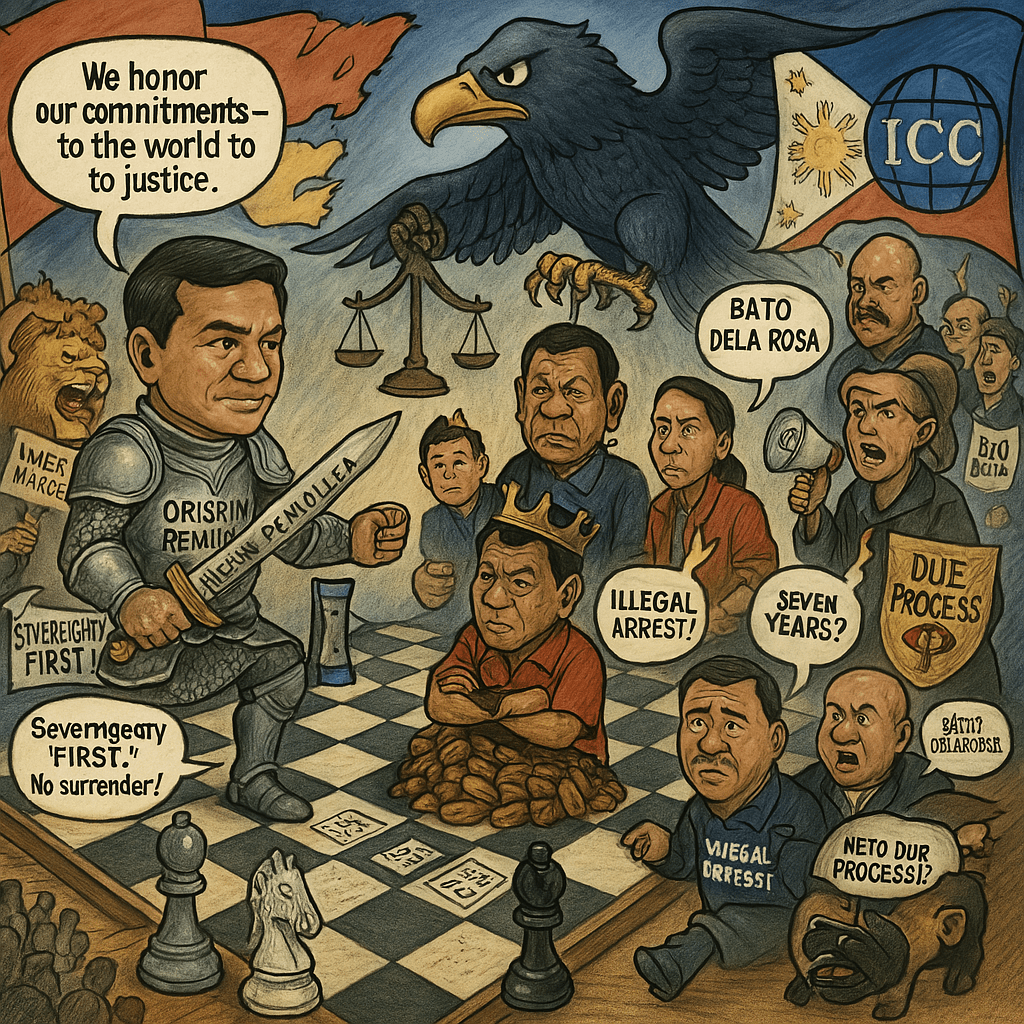
When Justice Secretary Crispin Remulla stepped into the Senate’s lion den on April 10, 2025, he wasn’t just defending the surrender of former President Rodrigo Duterte to the International Criminal Court (ICC)—he was rewriting the rules of Philippine justice. Wielding Republic Act 9851 like a sword, Remulla slashed through claims that Duterte’s handover needed a local court’s blessing. But as Senators Imee Marcos and Ronald “Bato” Dela Rosa roared back with sovereignty war cries, the hearing became a gladiatorial clash: global accountability versus national pride. Here, we carve up Remulla’s legal gambit, parry the counterattacks, and map a way out of this constitutional quagmire—all with the razor-sharp edge Kweba ng Katarungan demands.
Thunder in the Senate: What Went Down
The Senate hearing, a fiery chapter in the Committee on Foreign Affairs’ probe, zeroed in on the March 12, 2025, surrender of Duterte to the ICC, where he faces charges of murder as a crime against humanity tied to his drug war’s estimated 6,000–30,000 body count. Sen. Imee Marcos grilled Remulla on dodging a local court order, waving the Constitution like a battle flag, while Sen. Ronald “Bato” Dela Rosa jabbed at the ICC’s due process, hinting at his own dance with its investigators. Remulla didn’t flinch: surrender wasn’t extradition, and the ICC’s seven-year saga was fairness incarnate. This wasn’t just a legal duel—it was a mirror to a nation torn between global duty and homegrown honor.
Legal Dissection: Remulla’s Playbook Under the Microscope
A. Surrender vs. Extradition: Slamming the Sovereignty Trap Shut
Remulla’s ace—that no local court order was needed—leans hard on Republic Act 9851 (RA 9851), and it’s a legal slam dunk. Section 17 reads like a green light for ICC handovers:
“In the interest of justice, relevant Philippine authorities may… surrender or extradite suspected or accused persons to the appropriate international court… pursuant to applicable extradition laws and treaties” (RA 9851).
This clause torches the need for the judicial rigmarole baked into Presidential Decree No. 1069 (PD 1069), the Extradition Law, which governs state-to-state swaps with treaties and court nods. Duterte, already in Philippine hands, didn’t fit that mold—the ICC isn’t a country. Remulla’s mantra—“We have no other option”—cuts like a knife through the haze.
The Rome Statute tightens the screws. Article 89(1) demands cooperation on arrests, a chain the Philippines wore until its 2019 exit. Even then, Article 127(2) keeps the ICC’s claws in for pre-2019 crimes, like Duterte’s drug war (Situation in the Philippines). Marcos’ sovereignty howls hit a wall—RA 9851 shows Congress already opened the gate.
| Aspect | Surrender (RA 9851) | Extradition (PD 1069) |
|---|---|---|
| Recipient | Global courts (e.g., ICC) | Foreign nations |
| Legal Trigger | RA 9851, Section 17; Rome Statute, Article 89 | PD 1069; treaty obligations |
| Court Order? | Nope—executive’s call | Mandatory judicial stamp |
| Duterte’s Fate | Nailed it: ICC handover, March 12, 2025 | Wrong tool: ICC’s no state |
B. Due Process or ICC Witch Hunt? Seven Years of Paper Trails
Marcos and Dela Rosa swung hard at due process, painting Duterte as a victim of ICC overreach. Remulla fired back: the ICC’s seven-year probe was a masterclass in fairness. He’s not wrong. The Rome Statute lays down the law:
- Article 58: Warrants need “reasonable grounds” and charge notices.
- Article 67(1): Accused get prompt, clear charge details in their language, plus prep time.
The ICC’s rap sheet is ironclad: a 2018 investigation kicked off, culminating in a March 7, 2025, warrant. Duterte was handed over on March 12 and faced Pre-Trial Chamber I on March 14, where charges and rights were spelled out in Filipino (Rodrigo Roa Duterte makes first appearance). Remulla’s claim of notices over seven years holds—Dela Rosa even admitted dodging one, undercutting his own gripe.
ICC’s Fairness Playbook:
- 2018: Drug war probe launches.
- Ongoing: Duterte and crew get pinged with notices, invited to respond.
- March 7, 2025: Warrant drops.
- March 14, 2025: Duterte’s briefed on charges, rights locked in.
Marcos’ clutch at Article III, Section 2 of the 1987 Constitution—barring warrantless grabs—has teeth but crumbles against Bayan Muna v. Romulo (G.R. No. 159618, 2011). It weaves international law into the Philippines’ legal fabric via Article II, Section 2, and RA 9851’s surrender clause screams global justice trumps local qualms.
C. Sovereignty Smackdown: The ICC’s Ghost That Won’t Quit
Marcos’ sovereignty crusade, echoed by Dela Rosa’s “why talk to a court we don’t recognize?” jab, hinges on the 2019 Rome Statute exit. Remulla’s counter—the ICC’s “residual powers”—lands like a legal haymaker. Article 127(2) is crystal:
“A State shall not be discharged… from obligations… particularly respecting… crimes… committed prior to [withdrawal].”
This traps Duterte’s 2016–2019 drug war in the ICC’s net. Pangilinan v. Cayetano (G.R. No. 238875, 2021) doubles down, nodding to the ICC’s grip on pre-exit sins. Sovereignty purists cry foul, but RA 9851 and the Constitution’s global-law embrace hand Remulla the win. He’s not selling out—he’s honoring a deal the Philippines signed.
D. Senate’s Inquisition: Lawmaking or Political Bloodsport?
The Senate’s probe, waving Article VI, Section 21’s “in aid of legislation” banner, smells like more than policy homework. Marcos’ grilling and Dela Rosa’s defensiveness scream loyalty to Duterte, not law-drafting zeal. Standard Chartered Bank v. Senate Committee (G.R. No. 167173, 2007) draws a line: inquiries can’t morph into witch hunts. With Marcos steering and midterms lurking in May 2025, this feels less like legislating and more like a stage for Duterte’s allies to rally the base.
Political Firestorm: A Nation Divided
Flipping the Script: Remulla’s ICC pivot buries Duterte’s 2018 withdrawal, betting on global applause. It’s a savvy play for international cred but a Molotov cocktail at home, where Duterte’s faithful see it as betrayal (Al Jazeera).
Battle Lines Drawn:
- VP Sara Duterte: Brands the arrest “illegal,” swinging for political martyrdom (The Guardian).
- Public’s Pulse: Split down the middle—justice for victims vs. sovereignty’s honor (Reuters).
- Senate’s Game: Marcos’ probe flirts with bias, risking the “legislative” label for Duterte’s defense.
- Election Fever: With May 2025 midterms heating up, Remulla’s DOJ sells surrender as moral high ground, while critics cry foul over timing. It’s a chessboard where every move screams votes (Rappler).
Battle Plan: Fixing the Fault Lines
- Legislative Locksmithing: Forge an RA 9851 amendment mandating a Supreme Court debrief post-surrender—30 days to weigh constitutional fit. It’s a pressure valve for sovereignty hawks.
- Diplomatic Blueprint: Task the DFA with a public playbook on ICC ties post-exit, spelling out when Manila must play ball. Transparency kills conspiracies.
- Judicial Lifeline: Nudge the Supreme Court for a ruling on RA 9851 vs. Article III, drawing a clear line before the next ICC drama hits.
Final Verdict: Remulla’s Triumph, With Asterisks
Remulla’s legal arsenal—RA 9851, Rome Statute, and a seven-year ICC paper trail—crushes doubts about Duterte’s surrender. Due process? Check. Jurisdiction? Locked in by Article 127(2). Sovereignty? A tougher sell, but Pangilinan and the Constitution’s global nod tip the scales. Marcos and Dela Rosa’s pushback stokes valid fears—skipping local courts burns—but the law’s on Remulla’s side. Politically, it’s a tightrope: global high-fives clash with domestic fury, and midterms loom like storm clouds. To dodge future chaos, Congress and the courts need to armor up—because the ICC’s shadow isn’t fading anytime soon.
Key Citations
- RA 9851
- ICC: Situation in the Philippines
- Rome Statute, Articles 58, 67(1), 89, 127(2)
- Bayan Muna v. Romulo, G.R. No. 159618 (2011)
- Pangilinan v. Cayetano, G.R. No. 238875 (2021)
- Standard Chartered Bank v. Senate Committee, G.R. No. 167173 (2007)
- Al Jazeera: Philippines Senate Investigation
- Reuters: Philippines Defends Duterte’s Transfer
- Rappler: Senate Hearing Livestream
- The Guardian: Duterte’s ICC Hearing
Disclaimer: This is legal jazz, not gospel. It’s all about interpretation, not absolutes. So, listen closely, but don’t take it as the final word.

- ₱75 Million Heist: Cops Gone Full Bandit

- ₱6.7-Trillion Temptation: The Great Pork Zombie Revival and the “Collegial” Vote-Buying Circus

- ₱1.9 Billion for 382 Units and a Rooftop Pool: Poverty Solved, Next Problem Please

- ₱1.35 Trillion for Education: Bigger Budget, Same Old Thieves’ Banquet

- ₱1 Billion Congressional Seat? Sorry, Sold Out Na Raw — Si Bello Raw Ang Hindi Bumili

- “We Will Take Care of It”: Bersamin’s P52-Billion Love Letter to Corruption

- “Skewed Narrative”? More Like Skewered Taxpayers!

- “Scared to Sign Vouchers” Is Now Official GDP Policy – Welcome to the Philippines’ Permanent Paralysis Economy

- “Robbed by Restitution?” Curlee Discaya’s Tears Over Returning What He Never Earned

- “My Brother the President Is a Junkie”: A Marcos Family Reunion Special

- “Mapipilitan Akong Gawing Zero”: The Day Senator Rodante Marcoleta Confessed to Perjury on National Television and Thought We’d Clap for the Creativity

- “Just Following Orders” Is Dead: How the Hague Just Turned Tokhang’s Finest Into International Fugitives




 KWEBA ni BAROK
Leave a comment