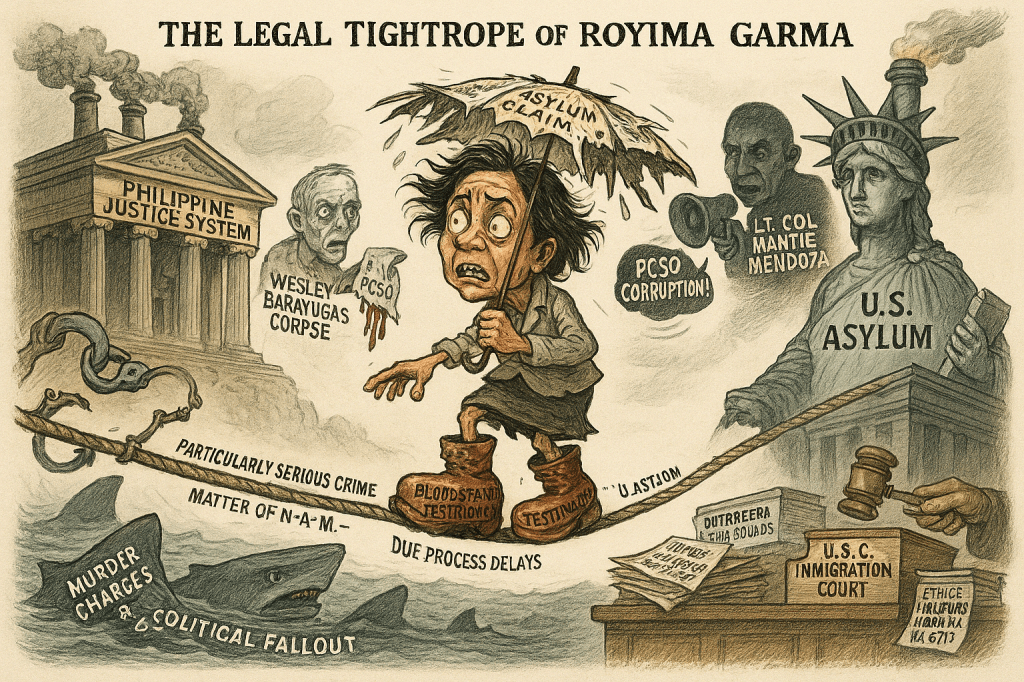
A canceled visa, a corpse in Mandaluyong, and a disgraced ex-cop’s desperate asylum gamble—meet Royima Garma’s legal quagmire.
By Louis ‘Barok‘ C. Biraogo — April 16, 2025
“This isn’t persecution—it’s accountability.”
—Former U.S. ICE Attorney, on Garma’s asylum claim
I. The Legal Stakes: Asylum or the Long Flight Home
A. Asylum Law vs. the Specter of Barayuga’s Corpse
Royima Garma’s claim under 8 U.S.C. § 1158 isn’t just an uphill climb—it’s a legal cliff. To qualify for asylum, she must demonstrate a well-founded fear of persecution based on race, religion, nationality, political opinion, or membership in a particular social group. Her alleged persecution stems from her testimony against Duterte-era “death squads” and her fallout with political patrons. But the law draws a hard line.
That line? 8 U.S.C. § 1158(b)(2)(A)(ii): any alien convicted of a “particularly serious crime” is statutorily barred from asylum. That includes murder—even alleged murder. In Matter of N-A-M-, 24 I&N Dec. 336 (BIA 2007), the BIA emphasized that the seriousness of the crime, not conviction alone, determines eligibility.
In Garma’s case, the NBI’s referral, the PNP’s charges, and witness testimony from Lt. Col. Santie Mendoza all allege she masterminded the 2020 assassination of PCSO board secretary Wesley Barayuga. That’s not just “serious”—it’s cinematic.
No asylum officer wants to greenlight someone accused of orchestrating a political hit job.
B. Extradition: Treaty Terms Meet SC Rulings
If asylum is denied, the U.S. Department of State has one card left to play: extradition under the 1994 U.S.-Philippines Extradition Treaty. The treaty, ratified in 1996, is crystal clear: murder is extraditable—provided the crime is punishable by at least one year of incarceration in both jurisdictions.
And under Article 248 of the Revised Penal Code, murder in the Philippines is punishable by reclusion perpetua to death. Barayuga’s assassination—with evidence of premeditation and treachery—squarely meets this standard.
But don’t expect a midnight deportation.
Enter Secretary of Justice v. Lantion (G.R. No. 139465, 2000), where the Philippine Supreme Court ruled that the respondent must be given due process before an extradition request can proceed. Expect Garma’s U.S. defense team to weaponize Lantion-style arguments to stall and prolong proceedings. Due process delays are practically tradition in high-profile extradition cases.
C. Criminal Exposure: Article 248 and Mendoza’s Bombshell
Back in Manila, the legal noose is tightening. Garma faces charges of murder and frustrated murder under Article 248 of the Revised Penal Code. Murder requires a showing of qualifying circumstances—treachery, abuse of superior strength, etc.—and according to the NBI’s referral, these are present.
The crux of the state’s case? Lt. Col. Santie Mendoza’s testimony before Congress. He claims Garma and fellow ex-cop Edilberto Leonardo orchestrated the hit, possibly to silence Barayuga’s whistleblowing on PCSO corruption.
Prosecutors also point to survivor testimony—likely from Barayuga’s driver, who reportedly survived the ambush—as supporting evidence for frustrated murder, a lesser but still grave offense. These aren’t anonymous affidavits. They’re from people with institutional knowledge and potential insider motive.
If true, the crime wasn’t just premeditated—it was methodical.
II. Exposing the Subtext: Is This Persecution, or a Legal Hail Mary?
A. Political Theater: From Congress to the Courtroom
Garma’s 2024 testimony against Duterte-era extrajudicial killings was explosive—painting a bloody picture of institutional rot. That testimony is now the centerpiece of her U.S. asylum narrative: that her whistleblowing endangered her life.
But the timeline matters. Her asylum application came only after her visa was canceled and after murder charges were filed. The optics? A fugitive seeking sanctuary.
U.S. courts have long warned against cloaking criminal evasion in political garb. In Matter of Acosta, 19 I&N Dec. 211 (BIA 1985), the BIA held that mere political turmoil is not enough; persecution must be personal and credible. Given Garma’s timing and the gravity of charges, the narrative may ring hollow.
B. The Ethics Erosion: A Fall from Grace Under R.A. No. 6713
Even before the body hit the pavement in Mandaluyong, Garma’s ethical compass was wobbling. Under R.A. No. 6713, the Code of Conduct and Ethical Standards for Public Officials, she was bound to uphold transparency, integrity, and public trust.
Yet the very institution she led—the PCSO—is now the scene of alleged political murder. If Mendoza’s testimony holds water, Garma didn’t just violate the law—she turned the PCSO into a crime syndicate in uniform.
That’s not just an ethical breach. It’s institutional betrayal.
III. Predicting the Verdict—and What Her Defense Team Should Do Now
A. Will She Get Asylum? Not Likely.
Legally speaking, asylum is almost certainly off the table. The charges against her rise to the level of a “particularly serious crime”, and courts have routinely denied relief on lesser facts.
Unless Garma can discredit Mendoza and Mariano’s testimonies—or prove they’re retaliatory fabrications—her claim is doomed.
And if she thought the U.S. government wouldn’t extradite a former Duterte ally-turned-witness, she may have underestimated the diplomatic value of compliance.
B. The Extradition Playbook: A Slow March, Not a Sprint
Expect Garma’s U.S. attorneys to:
- Challenge the “dual criminality” clause—arguing the acts don’t constitute murder in both jurisdictions.
- Demand procedural due process under Lantion-like protections.
- Present her testimony before Congress as proof of political motivation behind the charges.
But none of these are sure bets.
C. Worst-Case Scenario: The Legal Doom Spiral
WORST-CASE SCENARIO: GARMA’S LEGAL DOOM SPIRAL
- Asylum Denied: Barred by 8 U.S.C. § 1158(b)(2)(A)(ii)
- Extradition Granted: Fast-tracked under the 1994 U.S.-Philippines Extradition Treaty
- Trial in Manila: Conviction under Article 248 RPC
- Sentence: Reclusion perpetua (30–40 years, no parole)
- Public Fallout: PCSO image collapse, Duterte-era probes reignited
D. What Should the U.S. Do? What Should Garma Do?
For U.S. Authorities:
Uphold the treaty. Extraditing Garma would send a clear message: that human rights abuses and politically charged murders don’t get a pass because of political affiliations.
For Garma’s Defense Team:
Argue procedural irregularities in the NBI’s case. Dig into Mendoza’s credibility. If possible, negotiate her return under controlled conditions to face trial while preserving asylum options in case of retaliation.
Final Verdict:
Garma’s case isn’t persecution. It’s prosecution.
And in the theater of international law, asylum isn’t a stage for fugitives with blood on their boots.
“She’s not seeking protection—she’s seeking escape,” said one former DOJ official off-record.
Unless her legal team performs miracles, she’s headed for a courtroom—not a green card.

- ₱75 Million Heist: Cops Gone Full Bandit

- ₱6.7-Trillion Temptation: The Great Pork Zombie Revival and the “Collegial” Vote-Buying Circus

- ₱1.9 Billion for 382 Units and a Rooftop Pool: Poverty Solved, Next Problem Please

- ₱1.35 Trillion for Education: Bigger Budget, Same Old Thieves’ Banquet

- ₱1 Billion Congressional Seat? Sorry, Sold Out Na Raw — Si Bello Raw Ang Hindi Bumili

- “We Will Take Care of It”: Bersamin’s P52-Billion Love Letter to Corruption

- “Skewed Narrative”? More Like Skewered Taxpayers!

- “Scared to Sign Vouchers” Is Now Official GDP Policy – Welcome to the Philippines’ Permanent Paralysis Economy
- “Robbed by Restitution?” Curlee Discaya’s Tears Over Returning What He Never Earned

- “No Pressure” Luistro? The House Pork Bazaar Exposed
- “My Brother the President Is a Junkie”: A Marcos Family Reunion Special

- “Mapipilitan Akong Gawing Zero”: The Day Senator Rodante Marcoleta Confessed to Perjury on National Television and Thought We’d Clap for the Creativity





 KWEBA ni BAROK
Leave a comment