By Louis ‘Barok‘ C. Biraogo — April 17, 2025
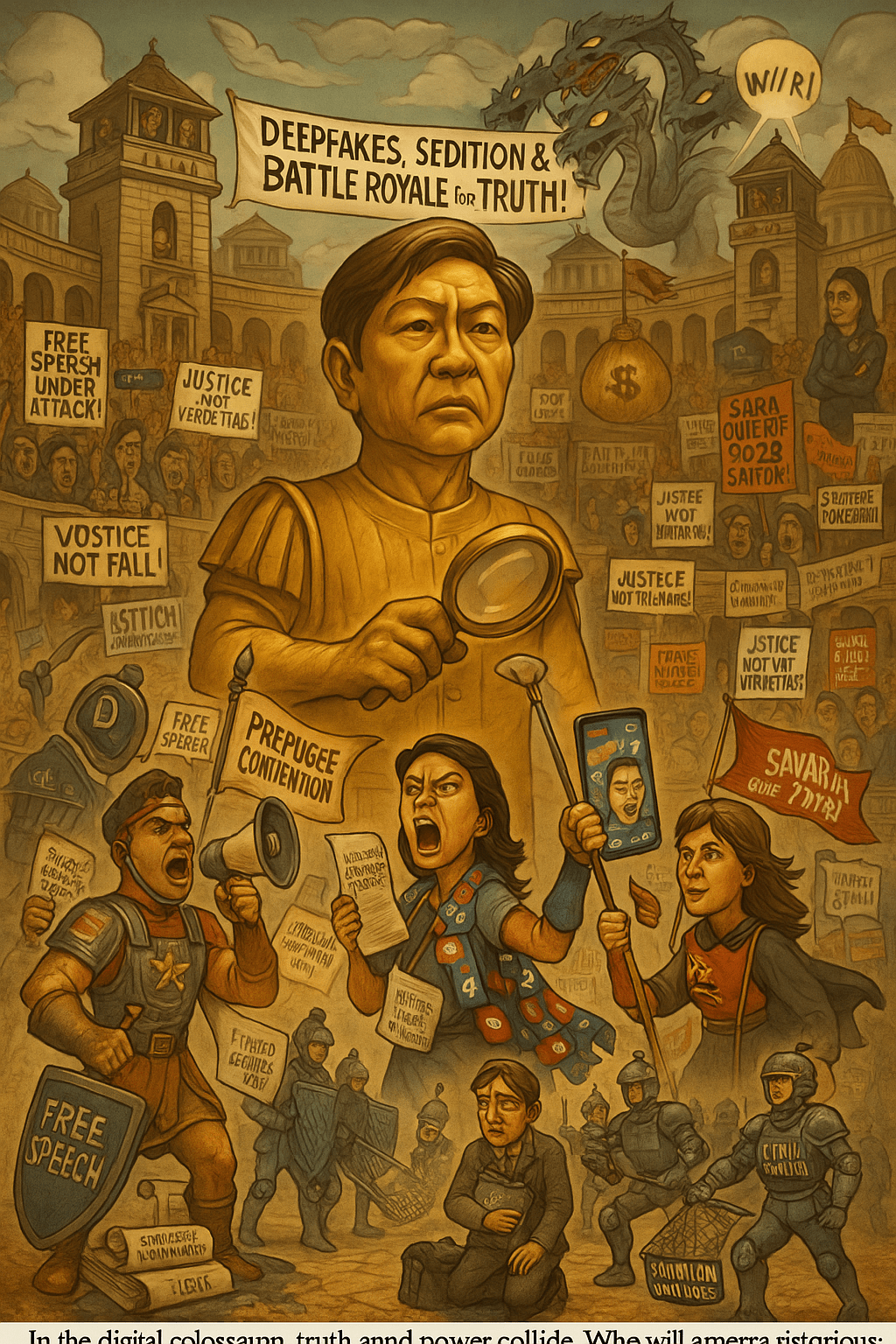
A doctored video alleging President Ferdinand “Bongbong” Marcos Jr. is snorting drugs didn’t just go viral—it ignited a political firestorm. The National Bureau of Investigation (NBI) has unleashed a legal barrage against former Duterte mouthpiece Harry Roque, vlogger Claire “Maharlika” Contreras, and TikTok firebrand Mary Joy dela Cerna Lacierda, charging them with everything from inciting sedition to cyber libel. This isn’t a courtroom drama; it’s a gladiatorial clash between Marcos’s camp and Duterte’s loyalists, with free speech, digital warfare, and the soul of Philippine politics on the line. Welcome to the chaos.
I. The Legal Arsenal: Sedition, Cybercrime, and a Deepfake Dragnet
The NBI’s playbook pulls from the Revised Penal Code (RPC) and the Cybercrime Prevention Act of 2012 (RA 10175), wielding a legal sledgehammer to crush the “polvoron” video and a rogue TikTok clip. Here’s the breakdown of the charges tearing through this case.
A. Inciting Sedition: Stirring the Pot with Article 142
Article 142 of the RPC is the NBI’s big gun, targeting those who “incite others” to sedition via “speeches, writings, or other representations” that “disturb” lawful authorities or “incite people” against the government. Penalties hit prisión correccional maximum (up to 6 years), but RA 10175’s Section 6 jacks it up to prisión mayor (6 years and 1 day to 12 years) for online antics. The NBI claims Roque and Contreras’s “polvoron” video—faking Marcos’s drug use—fomented unrest, while Lacierda’s TikTok, twisting NBI Director Jaime Santiago’s words to spook OFWs, pushed economic sabotage.
B. Cyber Libel: Defamation in the Digital Colosseum
Contreras is in the crosshairs for cyber libel, with the “polvoron” video’s drug allegations branded as a “malicious imputation” under Article 355 of the RPC. Penalties range from prisión correccional (6 months to 6 years), but RA 10175’s Section 4(c)(4) escalates to prisión mayor minimum (4 years and 2 months to 8 years). Forensic proof of the video’s falsity fuels the NBI’s malice argument.
C. Computer-Related Forgery: Deepfakes as Digital Felonies
Also targeting Contreras, Section 4(a)(1) of RA 10175 punishes creating “inauthentic data” to deceive, with the “polvoron” video’s manipulation fitting the crime. Penalties reach prisión mayor (6 years and 1 day to 12 years), marking a bold leap into prosecuting deepfakes.
D. Unlawful Publication: Weaponizing Platforms for Chaos
Contreras and Lacierda face Article 142 charges for using online platforms to spread seditious content. This provision doubles down on the medium, amplifying the NBI’s crusade to criminalize the videos’ ripple effects.
II. Prosecution’s Gambit: A House of Cards or a Slam Dunk?
The NBI’s case looks like a legal juggernaut—fake videos, forensic firepower, and a president’s reputation at stake. But peel back the curtain, and it’s a high-wire act with plenty of weak spots.
A. The Prosecution’s Power Moves
- Forensic Slam: The NBI’s July 2024 takedown of the “polvoron” video as a deepfake hands prosecutors a golden ticket to prove falsity and malice, anchoring cyber libel and forgery charges.
- Economic Jolt: Lacierda’s TikTok, urging OFWs to ditch remittances until Sara Duterte takes the helm, hits a nerve. With $37.2 billion in 2024 remittances, the NBI’s economic disruption angle is a cunning play.
- Precedent Punch: Espuelas v. People (1951) greenlights sedition charges for content with a “dangerous tendency” to spark unrest, even sans actual chaos. The video’s attack on Marcos fits the mold.
B. The Shaky Underbelly
- Danger Deficit: Chavez v. Gonzales (2008) demands a “clear and present danger” for sedition, but the NBI’s talk of public unrest is thin—retweets aren’t riots.
- Evidence Wobble: The NBI leans on vlogger Pebbles Cunanan’s testimony, which Roque trashes as “falsehoods and hearsay.” Without concrete proof tying defendants to the video’s creation, the case could crumble.
- Legal Stretch: Lacierda’s sedition charge for a TikTok rant pushes Article 142 into uncharted waters. Courts may scoff at equating viral clips with economic sabotage.
III. Defense’s Counterattack: Free Speech, Politics, and Legal Jiu-Jitsu
Roque, Contreras, and Lacierda aren’t going down without a fight, armed with constitutional shields, procedural traps, and political haymakers.
A. Free Speech Firewalls
- Constitutional Cover: Article III, Section 4 of the 1987 Constitution guards free speech, with Chavez v. Gonzales and Disini v. Secretary of Justice (2014) demanding a high bar for criminalizing political jabs. Roque’s spin—that the video challenges Marcos to clear his name—could paint it as protected discourse.
- U.S. Shield (Contreras): If Contreras is stateside, Brandenburg v. Ohio (1969) protects speech short of inciting imminent lawlessness. The “polvoron” video’s vague harm could nix extradition.
B. Procedural Pitfalls
- DOJ Showdown: Rule 112’s preliminary investigation lets defendants demand evidence. Roque’s ready to pounce, calling Cunanan’s claims bunk. Contreras and Lacierda could force the NBI to show its forensic cards.
- Asylum Ace (Roque): Roque’s Netherlands asylum bid, citing political persecution under the 1951 Refugee Convention, could stall extradition if the Philippines-Netherlands Extradition Treaty (1989) deems charges politically tainted.
C. Substantive Smackdowns
- Intent Dodge: Roque denies seditious intent, framing the video as public interest. Contreras could argue she just shared, not made, the video, sidestepping forgery. Lacierda might call her TikTok satire, not sedition.
- Public Figure Hurdle: Cyber libel requires actual malice for Marcos, per Tulfo v. People (2008). Contreras’s reliance on third-party sources could blur her intent.
IV. Global Legal Quagmire: Asylum, Extradition, and World Stage Drama
This case isn’t confined to Manila—it’s a geopolitical chess match.
- Roque’s Dutch Gambit: His asylum bid, tied to ICC work and POGO probes, claims Marcos’s vendetta. If the Netherlands buys the political persecution angle, extradition under the 1989 treaty is toast.
- Contreras’s U.S. Fortress: If Contreras is in the U.S., the Philippines-U.S. Extradition Treaty (1994) faces New York Times v. Sullivan (1964)’s high bar for public figure defamation. First Amendment protections could block her return.
- Global Norms Clash: The ICCPR (Article 19) backs free speech but allows public order limits. Overzealous sedition charges could draw flak from human rights watchdogs, as seen in Duterte’s 2020 tweet crackdowns.
V. Political Cage Match: Marcos vs. Duterte, No Holds Barred
Forget legal niceties—this is Marcos-Duterte warfare. Roque, a Duterte stalwart, and Contreras’s Sara Duterte shoutouts mark them as Team Duterte, while Lacierda’s TikTok crowns Sara as 2028 savior. The NBI’s charges, backed by Marcos’s allies, are a power play to crush Duterte’s lingering clout.
- Targeted Takedowns: Hitting Duterte allies while sparing Marcos backers reeks of selective justice, echoing global strongman tactics like Thailand’s royal insult laws.
- POGO Powder Keg: Roque’s POGO probe arrest warrant ties this to a broader anti-Duterte blitz, given POGOs’ Duterte-era boom.
- OFW Flashpoint: Lacierda’s OFW bait risks alienating a $37.2 billion economic bloc. Marcos’s sedition response could misfire if workers feel muzzled.
X posts show a polarized public: some back the NBI’s fake news purge, others smell a Marcos hit job. Opaque forensics only deepen the distrust.
VI. Battle Plan: Who Needs to Do What to Win
This case is a crucible for Philippine democracy, testing disinformation, speech, and power. Here’s the playbook:
- Courts: Lean on Chavez and Disini to demand ironclad proof of imminent danger for sedition. Forensic transparency is a must to keep things legit.
- Congress: Rework RA 10175 to tighten sedition and libel rules, dodging ICCPR violations. A deepfake-specific law could tackle forgery without gagging speech.
- Prosecutors: Bet on cyber libel and forgery, where evidence shines, and ditch sedition unless unrest is crystal-clear. Show the forensic receipts.
- Defendants: Roque should milk asylum and ICC clout to cry persecution. Contreras and Lacierda must grill NBI evidence early, waving the free speech flag.
- Marcos Camp: Fight fake news with open dialogue, not legal cudgels, to avoid radicalizing OFWs or boosting Duterte’s martyr cred.
VII. Crystal Ball and Fallout: What’s Next and Why It Matters
Predictions: The DOJ will likely greenlight cyber libel and forgery against Contreras, thanks to forensic muscle, but sedition may flop without hard proof of harm. Roque’s fate rides on Dutch asylum—if granted, he’s untouchable for now. Lacierda’s TikTok charge is a reach; courts may laugh it off as overblown.
Why It Matters:
- Speech Under Siege: Heavy-handed sedition charges could freeze online dissent, echoing Duterte’s crackdowns. A Supreme Court ruling might redraw digital speech lines.
- 2028 Brawl: This case fuels Marcos-Duterte bad blood, setting the stage for a vicious 2028 election. Sara Duterte’s camp will weaponize persecution claims.
- Justice on Trial: Selective prosecution erodes court legitimacy, cementing law as a political club. Fairness and transparency are the only antidotes.
This isn’t about a fake video or a TikTok tantrum—it’s a fight for who controls truth, silence, and power in a Philippines where democracy hangs by a thread. The world’s watching, and the stakes couldn’t be higher.
Citations
- Revised Penal Code (Act No. 3815, as amended) – https://www.officialgazette.gov.ph/1930/12/08/act-no-3815-s-1930/
- Cybercrime Prevention Act (RA 10175, 2012) – https://www.officialgazette.gov.ph/2012/09/12/republic-act-no-10175/
- Espuelas v. People, G.R. No. L-2990 (1951) – https://lawyerly.ph/juris/view/c3c2b
- Chavez v. Gonzales, G.R. No. 168338 (2008) – https://www.officialgazette.gov.ph/2008/02/15/chavez-v-gonzales-g-r-no-168338-february-15-2008/
- Disini v. Secretary of Justice, G.R. No. 203335 (2014) – https://elibrary.judiciary.gov.ph/thebookshelf/showdocs/1/57347
- Tulfo v. People, G.R. No. 161032 (2008) – https://elibrary.judiciary.gov.ph/thebookshelf/showdocs/1/48505
- Brandenburg v. Ohio, 395 U.S. 444 (1969) – https://supreme.justia.com/cases/federal/us/395/444/
- New York Times v. Sullivan, 376 U.S. 254 (1964) – https://supreme.justia.com/cases/federal/us/376/254/
- Philippines-Netherlands Extradition Treaty (1989) – https://www.officialgazette.gov.ph/downloads/1989/03/03/RP-Netherlands-Extradition-Treaty.pdf
- Philippines-U.S. Extradition Treaty (1994) – https://www.state.gov/wp-content/uploads/2019/02/129-1129.2-Treaty.pdf
- International Covenant on Civil and Political Rights (1966) – https://www.ohchr.org/en/instruments-mechanisms/instruments/international-covenant-civil-and-political-rights
- 1951 Refugee Convention – https://www.unhcr.org/about-unhcr/who-we-are/1951-refugee-convention

 KWEBA ni BAROK
Leave a comment