By Louis ‘Barok‘ C. Biraogo — April 21, 2025
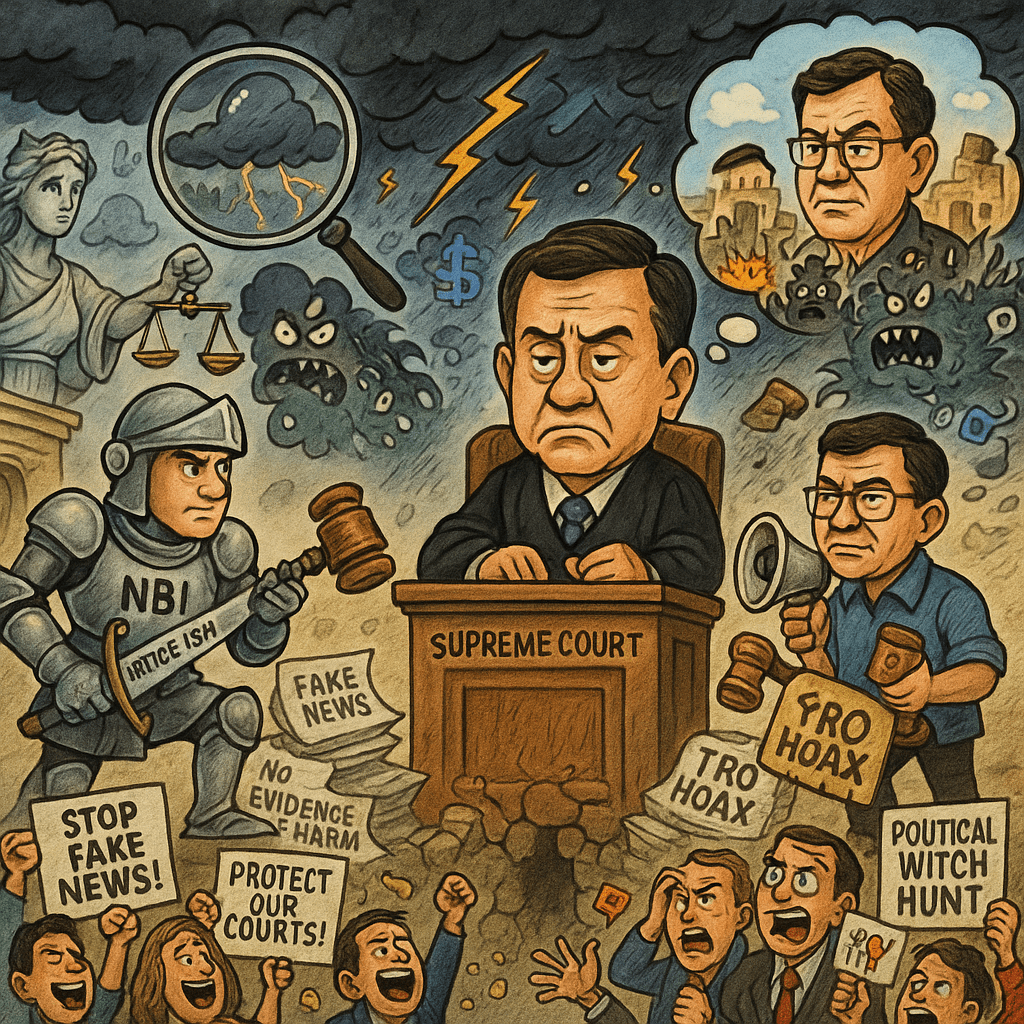
FAKE news is now a crime—and these politicians are the first test case. In a historic crackdown, the National Bureau of Investigation (NBI) has charged senatorial hopeful Raul Lambino and ex-Duterte Youth leader Ronald Cardema for peddling a fabricated Supreme Court Temporary Restraining Order (TRO) allegedly shielding Rodrigo Duterte from arrest by the International Criminal Court (ICC). This isn’t just another disinformation scandal: it’s the Philippines’ first major legal strike against political fake news under Article 154 of the Revised Penal Code. The fallout? A seismic clash over power, free speech, and who controls the truth. Will this landmark case silence trolls—or dissent? Here’s what’s really at stake.
Unmasking the Firestorm: The Controversy Exposed
The NBI claims Lambino, via a Facebook livestream, and Cardema, through social media, falsely trumpeted a Supreme Court TRO to halt Duterte’s March 11, 2025, arrest linked to ICC probes into his drug war. The Court never issued such an order, prompting the NBI to wield Article 154, RPC, which punishes those who “maliciously publish as news any false news which may endanger the public order, or cause damage to the interest or credit of the State.” Violators face arresto mayor (1-6 months in jail) and fines from ₱40,000 to ₱200,000 under Republic Act No. 10951.
The stakes are sky-high. Duterte’s arrest is a geopolitical powder keg, with the Philippines’ ICC cooperation under a microscope since its 2019 exit from the Rome Statute. The fake TRO claim threatens to torch public trust in the judiciary, already battered by political divides, and could escalate tensions with the ICC. For Lambino, a lawyer, the Supreme Court’s demand for answers under Rule 138, Section 27 of the Rules of Court adds a professional guillotine, risking disbarment for misconduct.
Legal Minefield: Can the NBI’s Case Survive Scrutiny?
Cracking the Code: Article 154 Under the Microscope
Conviction under Article 154 demands proof of four elements:
- Publication,
- Falsity,
- Malice, and
- Potential to ignite public disorder or harm state interests.
Publication and falsity are slam-dunks—Lambino and Cardema’s social media posts were public, and the TRO claim was pure fiction. Malice is the wildcard. Did they knowingly lie or recklessly ignore the truth? They might dodge this by claiming good-faith reliance on bad intel, a defense bolstered by Borjal v. Court of Appeals (1999), where the Supreme Court demanded actual malice for public figure defamation. Likewise, Labargan v. Macabangon (2023) raised the bar, requiring malice for statements targeting public officials.
The real battleground is harm. The NBI must prove the fake news posed a “clear and present danger” to public order, per Primicias v. Fugoso (1948), a towering precedent setting a steep threshold for speech restrictions. Without riots, protests, or diplomatic fallout, the DOJ’s case feels like a house of cards. NBI Agent Allan Delfin’s assertion that the posts “tend to endanger the public” rings hollow without hard evidence, risking a constitutional knockout.
Prosecutorial Perils: A Case on Thin Ice
The DOJ must clear the clear and present danger hurdle, a standard cemented in Chavez v. Gonzales (2008), which axed government censorship for lacking imminent harm. No documented unrest undercuts the NBI’s narrative, as Article 154’s focus on “endangering public order” demands more than theoretical risks. Prosecutors could pivot to expert testimony on disinformation’s societal toll, but without tangible chaos, their case is skating on thin ice.
Lambino’s Ethical Quagmire: A Lawyer’s Reckoning
As a lawyer, Lambino faces a double-barreled threat under the Code of Professional Responsibility (CPR), Rule 1.01, which bans “unlawful, dishonest, immoral, or deceitful conduct.” Spreading fake legal claims about the Supreme Court screams dishonesty, triggering the Court’s probe under Rule 138, Section 27. This professional noose tightens Lambino’s predicament, as the Court has a hair-trigger for punishing lawyers who sully its name.
Free Speech Under Siege: The Political Powder Keg
Disinformation vs. Dissent: A Constitutional Showdown
This case is a high-stakes cage match between curbing social media lies and protecting free speech. Like shouting “bomb” on a packed plane, false judicial claims can erode trust, yet Chavez v. Gonzales warns against state overreach. The Supreme Court has long guarded public discourse, as in Borjal v. CA, shielding fair comment on public issues. Lambino and Cardema, as political players, may argue their posts fueled democratic debate, especially given Duterte’s divisive shadow. But Borjal also demands accountability from public figures, who can’t hide behind free speech to spread reckless falsehoods.
Judicial Fortress Under Attack: The Court’s Fight for Credibility
The fake TRO claim is a direct assault on the Supreme Court’s authority, casting it as a political puppet. With ICC pressures mounting, such disinformation risks branding the judiciary as Duterte’s shield, gutting its legitimacy. The Court’s swift call for Lambino’s explanation is a battle cry to defend its independence, but a barrage of similar lies could shatter public faith in the rule of law.
ICC Inferno: Global Fallout Looms
The false narrative fans flames in the Philippines-ICC saga. Duterte’s arrest, tied to the ICC’s drug war probe, is a diplomatic tightrope. The Philippines’ 2019 ICC exit makes cooperation contentious, and fake judicial claims could signal obstruction to the world, as ICC documents demand state compliance. This scandal threatens to stain the Philippines’ global image, cementing Duterte’s legacy as a lightning rod.
Defenses Unleashed: Lambino & Cardema’s Counterattack
Lambino and Cardema are armed with potent defenses:
- Free Speech Fortress: They’ll brandish Article III, Section 4 of the Constitution, claiming their posts were protected debate on a public crisis. Chavez v. Gonzales backs this, prioritizing speech absent imminent danger.
- No Malice, No Crime: Asserting good-faith belief in the TRO could neuter the malice requirement, leaning on Borjal and Labargan’s stringent malice standards.
- Vague Law, Void Law: Article 154, a 1930 relic, may be attacked as too vague for the social media age, echoing People v. de la Piedra (1977), which trashed ambiguous statutes for violating due process.
These defenses exploit the prosecution’s Achilles’ heel: no proven harm. If no riots or global crises erupted, the DOJ’s case could implode under constitutional fire.
Battle Plan: Recommendations for Victory
Prosecutors: Fortify the Arsenal
To prevail, the DOJ must:
- Amass evidence of real harm, tapping experts to quantify disinformation’s damage to trust or ICC ties.
- Dig into Lambino and Cardema’s sources to expose malice, dismantling their good-faith shield.
- Rally behind the judiciary’s honor, tying the case to the Supreme Court’s own probe into Lambino.
Lawmakers: Rewrite the Rules of War
Congress must overhaul Article 154 to tackle digital disinformation without trampling free speech. Gonzales v. COMELEC’s “balancing test” lights the way: craft laws pinpointing verifiable harm, with clear intent and impact standards for social media.
Judiciary: Seize the Throne
The Supreme Court should transform this case into a landmark ruling, defining Article 154’s digital boundaries. By championing free speech while slamming reckless lies, the Court can fortify its authority and set a beacon for future battles.
Verdict Awaits: A Nation on Edge
The NBI’s war on Lambino and Cardema is a legal and political crucible, pitting free speech against the scourge of disinformation. Article 154 offers a weapon, but the prosecution’s quest to prove malice and harm faces a constitutional gauntlet. Politically, the case lays bare the judiciary’s fragility and the Philippines’ ICC tightrope. Without evidence of chaos, the DOJ’s crusade risks being branded a political hit job, yet inaction could unleash a flood of falsehoods. The Supreme Court’s next move will not only decide this clash but chart the nation’s course in the disinformation age.
Key Citations:
- Article 154, Revised Penal Code
- Chavez v. Gonzales, G.R. No. 168338, 2008
- Borjal v. Court of Appeals, G.R. No. 126466, 1999
- Labargan v. Macabangon, G.R. No. 246824, 2023
- Primicias v. Fugoso, G.R. No. L-1800, 1948
- People v. de la Piedra, G.R. No. L-29460, 1977
- ICC Rome Statute

- “Forthwith” to Farce: How the Senate is Killing Impeachment—And Why Enrile’s Right (Even If You Can’t Trust Him)
- “HINDI AKO NAG-RESIGN!”

- “I’m calling you from my new Globe SIM. Send load!”

- “Mahiya Naman Kayo!” Marcos’ Anti-Corruption Vow Faces a Flood of Doubt

- “Meow, I’m calling you from my new Globe SIM!”

- “No Special Jail for Crooks!” Boying Remulla Slams VIP Perks for Flood Scammers

- “PLUNDER IS OVERRATED”? TRY AGAIN — IT’S A CALCULATED KILL SHOT

- “Several Lifetimes,” Said Fajardo — Translation: “I’m Not Spending Even One More Day on This Circus”

- “Shimenet”: The Term That Broke the Internet and the Budget
- “We Did Not Yield”: Marcos’s Stand and the Soul of Filipino Sovereignty

- “We Gather Light to Scatter”: A Tribute to Edgardo Bautista Espiritu

- $150M for Kaufman to Spin a Sinking Narrative



 KWEBA ni BAROK
Leave a comment